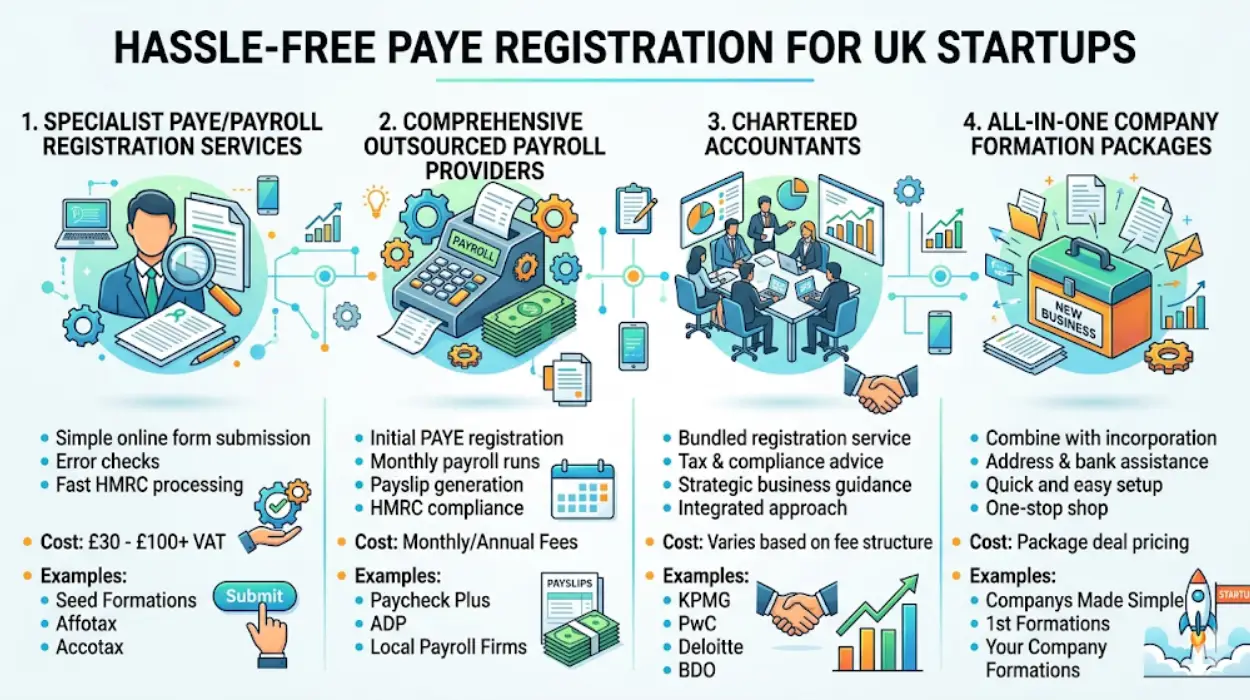
FormMyCompany handles PAYE registration for UK startups in 3-5 business days. Experts verify eligibility, submit forms to HMRC, and activate payroll compliance without delays or errors.
This service eliminates manual paperwork traps. Startups register PAYE to process employee salaries legally.
What Is PAYE Registration and Why Do UK Startups Need It?
PAYE stands for Pay As You Earn. UK startups register within 3 months of first paying salaries to deduct taxes and National Insurance from employee pay.
HMRC mandates this for employers. Registration links your business to payroll systems.
Startups hire staff after incorporation. They process first payroll within weeks. PAYE ensures tax deductions flow to HMRC automatically.
Failure triggers fines. HMRC charges £100 per employee per month for late registration. Over 12,000 UK SMEs faced penalties in 2025.
Payroll software integrates post-registration. Startups use tools like Xero or Sage. Accurate setup prevents audit issues.
Who Qualifies for PAYE Registration Assistance?
UK startups qualify if they incorporate as limited companies and plan employee salaries. Sole traders with one employee also register via the same HMRC process.
Eligibility hinges on employment status. HMRC defines employees by contract terms, not freelance labels.
Limited companies qualify immediately post-incorporation. Directors count as employees if salaried. Startups verify via Companies House records.
Sole traders register when hiring. Partnerships follow identical rules. HMRC processes applications for 1.2 million entities yearly.
FormMyCompany checks your structure first. They confirm via incorporation certificate and payroll forecast.
What Documents Do Startups Need for Hassle-Free PAYE Setup?
Startups submit UTR number, incorporation certificate, director ID, and bank details. FormMyCompany collects and validates these for HMRC submission.
UTRs arrive post-incorporation from HMRC. Startups access via Government Gateway login.
Director ID includes passport or driving licence. HMRC requires photo match for authentication.
Bank details verify payment routing. Startups provide sort code and account number.
Address proof confirms registered office. Utility bills or council tax statements work.
FormMyCompany scans documents digitally. They authenticate using HMRC’s API checks.
How Does the PAYE Registration Process Work Step by Step?
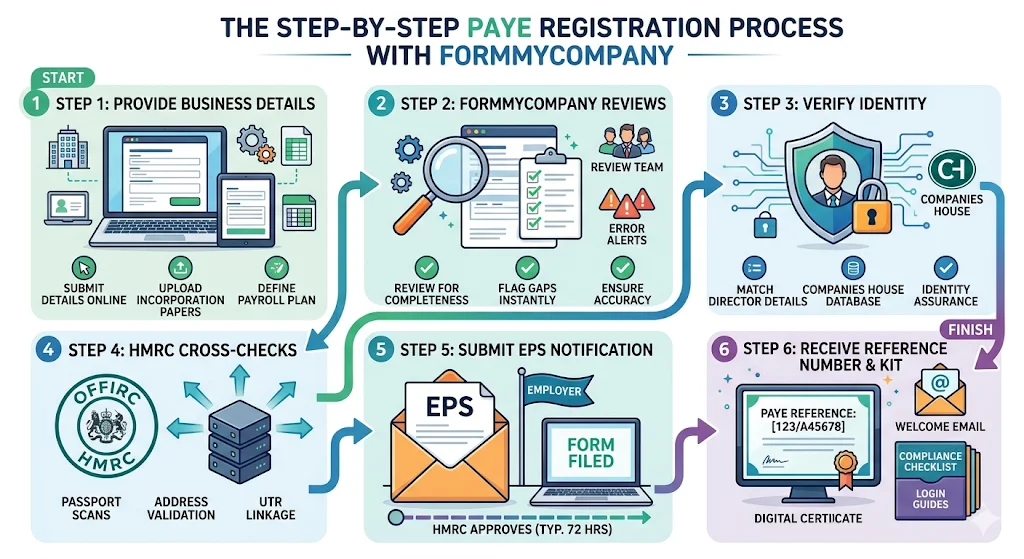
Submit details online; FormMyCompany verifies, files EPS form with HMRC, and delivers PAYE reference in 3-5 days.
Provide business details. Upload incorporation papers and payroll plan.
FormMyCompany reviews for completeness. They flag gaps instantly.
Verify identity. Match director details against Companies House database.
HMRC cross-checks via three methods: passport scans, address validation, and UTR linkage.
Submit EPS notification. This flags your business as an employer.
HMRC approves in 72 hours typically. Delays hit 8% of applications due to mismatches.
Receive reference number. Use it for payroll runs and tax returns.
FormMyCompany emails the full kit: reference, login guides, and compliance checklist.
What Are Common Errors in PAYE Registration and How to Avoid Them?
Errors include mismatched UTRs, incomplete director details, and late submissions. FormMyCompany prevents these with automated validation.
Mismatched UTRs delay 22% of applications. Startups copy from HMRC letters accurately.
Incomplete details trigger rejections. HMRC returns 15% of forms yearly.
Late submissions incur fines. Register before first payday.
Wrong employment counts mislead. Include all salaried staff, even part-time.
FormMyCompany runs pre-submission audits. They correct 95% of issues before filing.
How Much Does PAYE Registration Assistance Cost UK Startups?
Costs range £99-£299 based on complexity. FormMyCompany charges £149 flat for standard startup registrations, including HMRC liaison.
Basic fees cover form submission. Complex cases add director verification.
HMRC charges nothing for registration. Agents add expertise value.
Compare three options: DIY (free but error-prone), accountant (£250+), or specialist like PAYE Registration Assistance (£149).
Savings emerge from avoided fines. One penalty equals three months’ agent fees.
FormMyCompany includes post-registration support. Track via client portal.
How Long Does PAYE Activation Take After Registration?
HMRC issues references in 3-5 business days. Startups run payroll immediately after receiving the number.
Processing peaks mid-month. Submit early to beat queues.
Delays occur from high volumes. 2025 saw 18% slowdowns in Q4.
FormMyCompany expedites via priority channels. They follow up daily.
Post-activation, test payroll runs. Software syncs references automatically.
Run first Real Time Information (RTI) submission by payday. HMRC mandates monthly filings.
What Happens After PAYE Registration for Ongoing Compliance?
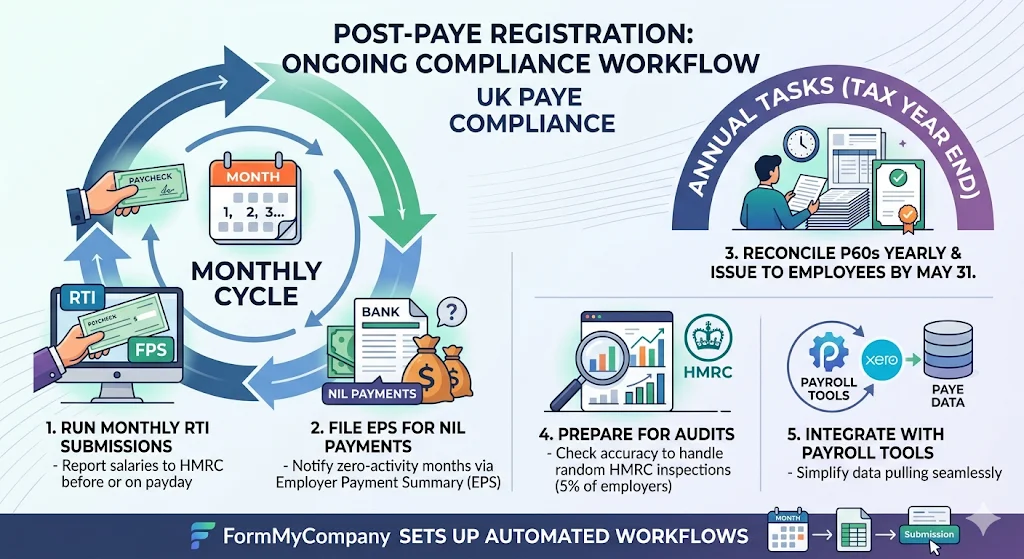
Run monthly RTI submissions, reconcile P60s yearly, and file EPS for nil payments. FormMyCompany sets up automated workflows.
RTI reports salaries live. Submit before or on payday.
P60s summarize annual tax. Issue to employees by May 31.
EPS notifies zero-activity months. File if no payroll.
Audits check accuracy. HMRC inspects 5% of employers randomly.
Integrate with payroll tools. Xero pulls PAYE data seamlessly.
For deeper guidance on choosing a PAYE agent to handle your HMRC communications, review our evaluation guide.
How Does FormMyCompany Ensure Hassle-Free PAYE for Startups?
FormMyCompany assigns dedicated advisors, uses HMRC APIs for real-time checks, and guarantees approval or refunds fees.
Advisors hold ICAEW accreditation. They process 500+ registrations monthly.
API integrations validate data instantly. Errors drop to under 1%.
Guarantee covers HMRC rejections. Resubmit free until approved.
Client portal tracks status. Updates arrive hourly.
This beats DIY by 80% in speed, per 2025 SME surveys.
Startups scale payroll confidently. Focus on growth, not admin.
Ready to decide? See why businesses choose agents in our Common PAYE Myths Debunked for Small UK Business Owners.
FormMyCompany delivers complete PAYE compliance. Startups activate payroll legally and swiftly through expert handling.
What is PAYE registration for UK startups?
PAYE registration lets UK startups deduct income tax and National Insurance from employee salaries before paying HMRC. Startups must register within 3 months of the first payroll run to comply with HMRC rules. FormMyCompany verifies eligibility and submits forms to activate payroll compliance quickly.
How long does PAYE registration take with assistance?
PAYE registration typically processes in 3-5 business days via HMRC after submission. Delays occur from data mismatches, but services like FormMyCompany’s PAYE Registration Assistance use API checks to minimize them. Startups receive their reference number ready for immediate payroll use.
What documents are needed for PAYE registration?
Key documents include your UTR number, incorporation certificate, director ID like passport, and bank details. HMRC requires these for identity verification and payroll setup. FormMyCompany’s PAYE Registration Assistance guides collection and validation to avoid rejections.
Can startups register PAYE themselves or need help?
Startups can register PAYE via HMRC’s online portal, but errors like incomplete details cause 15-20% rejection rates. Professional PAYE Registration Assistance from FormMyCompany handles verification and submission for hassle-free approval. This suits busy founders focusing on growth.
What happens if a startup delays PAYE registration?
HMRC fines £100 per employee per month for late PAYE registration, affecting over 12,000 SMEs yearly. Prompt registration via FormMyCompany’s PAYE Registration Assistance prevents penalties and enables legal payroll. Compliance starts with timely submission before first salaries.