

Professional registered offices provide mandatory Companies House compliance, protect director privacy, enable reliable statutory mail receipt, support HMRC interactions for VAT and PAYE, and shield against legal notices or creditor claims. These services ensure limited companies meet UK statutory requirements under the Companies Act 2006 from incorporation onwards, avoiding fines up to £5,000 for non-compliance. For directors and shareholders establishing business structures, they offer a credible address without personal exposure or physical office costs.
When entrepreneurs incorporate limited companies through Companies House, selecting a registered office address becomes a legal imperative that extends far beyond mere formality, directly impacting compliance, privacy, and operational legitimacy. Home addresses expose directors to public scrutiny via the Companies House register, while PO Boxes fail statutory tests, risking dissolution. Professional registered office services, typically costing £20-50 monthly, provide vetted business addresses in prestigious locations, complete with mail handling and forwarding, essential for receiving critical documents like annual confirmation statements or HMRC assessments.
This choice proves vital during formation and scaling phases when juggling VAT registration, PAYE setup, and shareholder communications. Government data reveals over 10,000 companies struck off annually for registered office failures, underscoring the stakes. For sole directors transitioning to multi-shareholder entities, these services maintain seamless compliance, projecting stability to banks, suppliers, and clients without the liabilities of physical premises. By fulfilling section 87 of the Companies Act 2006 requiring an address for official communications they safeguard business continuity from day one.
Understanding Registered Office Requirements: Step-by-Step Legal Breakdown
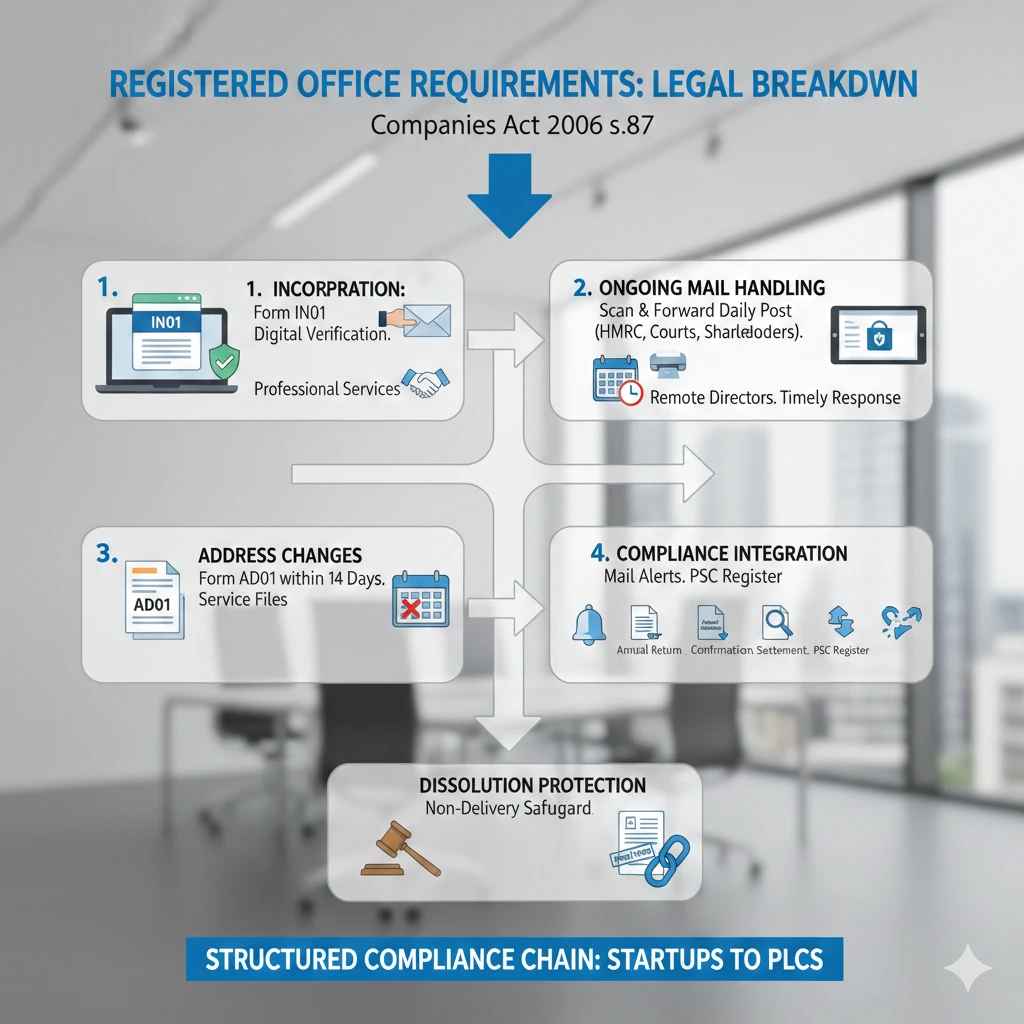
The obligation stems from Companies Act 2006 section 87, mandating every UK limited company maintain a registered office capable of receiving statutory mail during business hours. Step one during incorporation involves listing the address on form IN01, where professional services confirm acceptance instantly via digital verification, unlike personal setups requiring proof of control.
Step two ensures ongoing functionality: providers collect daily post from HMRC, courts, or shareholders, scanning contents to secure portals within hours, enabling remote directors to respond to VAT assessments or PAYE disputes without delays. Third, address changes notify Companies House via form AD01 within 14 days, with services handling filings to prevent lapses.
Fourth, integration supports compliance ecosystem mail alerts flag annual returns or confirmation statements, tying into broader obligations like PSC registers. Fifth, dissolution protection activates when companies face strikes for non-delivery, as providers furnish proof of service. This structured compliance chain, often bundled with director services, underpins legal operations across business structures from startups to PLCs.
The 10 Legal Reasons Explained in Depth
Reason one: mandatory Companies House acceptance section 1137 allows strikes for invalid addresses, with professionals guaranteeing compliance. Reason two: privacy protection under data laws, keeping director homes off public records viewed millions annually.
Reason three: secure HMRC correspondence handling for VAT registrations and PAYE notices, preventing missed deadlines triggering penalties up to £3,000. Reason four: creditor notice receipt under Insolvency Act 1986, enabling timely defences against winding-up petitions.
Reason five: court document service compliance per Civil Procedure Rules, ensuring defended claims. Reason six: shareholder and PSC register mail management, maintaining accurate filings. Reason seven: annual return delivery under section 428, avoiding late fees.
Reason eight: director disqualification avoidance per Company Directors Disqualification Act 1986. Reason nine: GDPR-aligned data handling for scanned mail. Reason ten: business rescue facilitation during administrations. These collectively mitigate dissolution risks exceeding 400,000 cases yearly.
Benefits and Potential Risks of Professional Services
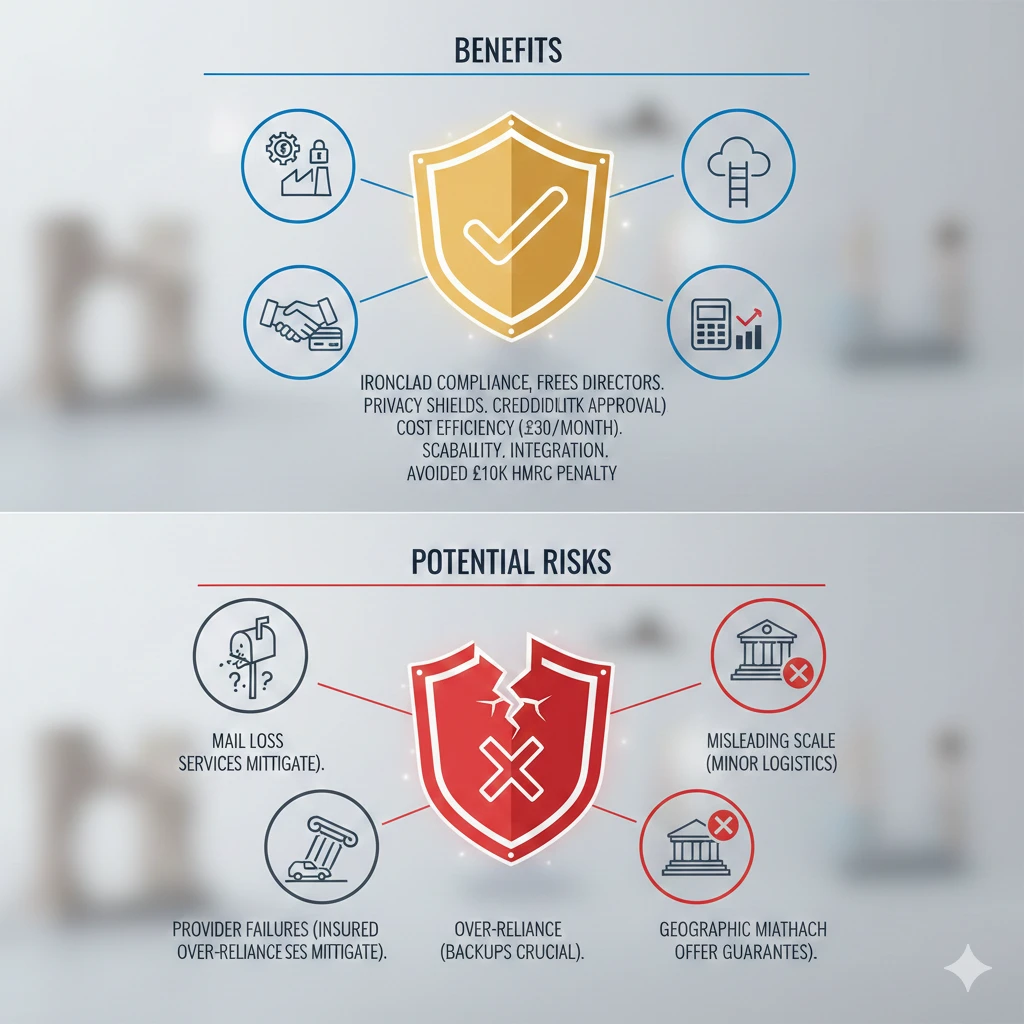
Benefits encompass ironclad compliance, freeing directors for revenue activities while providers assume mail liabilities. Privacy shields families from spam or visits, crucial for remote shareholders. Credibility unlocks banking, 85% approval rates versus 40% for home addresses per FSB data. Cost efficiency at £30/month dwarfs fines or legal fees.
Scalability supports growth from sole trader conversions to complex structures. Integration with virtual offices enhances VAT/PAYE workflows. A fintech startup avoided £10,000 penalties through timely HMRC responses via scans.
Risks include provider failures causing mail loss, though insured services mitigate via SLAs. Over-reliance without backups risks disruptions. Premium addresses might mislead on scale. Geographic mismatches for local courts pose minor logistics. Reputable operators minimise these through guarantees.
Legal and Compliance Considerations for UK Businesses
Services must strictly adhere to Companies Act section 87, with addresses physically manned 9am-5pm weekdays, evidenced by business occupancy. HMRC’s VAT Notice 700/129 accepts virtual handling if timely digital access proven. PAYE correspondence under RTI requires prompt employer action, facilitated by alerts.
GDPR Article 28 demands data processing agreements for scans, with encryption and deletion protocols. Insolvency rules per 1986 Act necessitate immediate notice forwarding to avoid preference claims. Shareholder resolutions under section 288 need reliable delivery.
Director duties section 170 emphasise compliance diligence, where services indemnify against mail mishandling. Annual confirmation statements section 853 mandate current addresses. Overseas directors qualify fully. Sector regulations like FCA add recording needs. Robust contracts ensure alignment across structures.
Common Mistakes to Avoid When Selecting Providers
Using PO Boxes violates section 87, triggering immediate rejections during incorporation. Overlooking mail volume limits causes overflows during tax seasons, delaying VAT refunds. Ignoring scanning resolution leads to unreadable HMRC penalties.
Selecting non-business addresses risks occupancy challenges from inspectors. Failing SLAs omits compensation for losses, unlike insured alternatives. Budget traps pick £10 deals lacking portals, forcing manual collections. Neglecting GDPR clauses exposes data fines up to 4% turnover.
Auto-renewal without reviews locks suboptimal services. Geographic bias ignores court proximity for local directors. Due diligence checklists prevent these compliance traps.
Practical Tips and Best Practices for Implementation
Verify eligibility via Companies House address search pre-signup. Test mail cycles with dummies, confirming 24-hour scans. Integrate portals with email auto-forwards for directors/shareholders. Set tiered alerts for statutory postcodes like HMRC’s.
Bundle with compliance packages covering AD01 filings. Promote addresses on websites for SEO gains in “UK registered office services.” Quarterly audits review volumes against growth forecasts. Transition plans to serviced offices maintain continuity.
Document provider indemnity for audits. These practices embed reliability into operations.
These ten legal reasons underscore professional registered offices as non-negotiable for UK company compliance, privacy, and resilience.
If you’re ready to register your company with confidence, Form My Company provides fast, fully online company formation with expert compliance support, virtual offices, VAT & PAYE handling. Get started today and let our specialists manage the essentials while you focus on growing your business.
Frequently Asked Questions
Is a professional address mandatory for Companies House?
No, but legally required under section 87; professionals ensure compliant receipt, avoiding strikes affecting 10% of firms yearly.
Can I use my home address initially then switch?
Yes, via AD01 within 14 days, but professionals recommend immediate setup to protect privacy from public registration.
Do they handle VAT and PAYE mail effectively?
Yes, digital scans enable same-day responses, preventing £3,000+ penalties for missed deadlines.
What if mail goes missing?
Insured providers compensate and furnish affidavits for Companies House/HMRC disputes.
Are they suitable for overseas directors?
Fully, handles all UK statutory mail, supporting remote business structures seamlessly.