

No, PAYE does not trap small UK business owners in excessive paperwork or penalties. Register within 3 months of your first employee payment to comply fully. FormMyCompany provides Paye Registration Assistance that streamlines HMRC setup in under 48 hours.
PAYE stands for Pay As You Earn. HMRC requires it for employers paying salaries over £123 weekly. Small businesses face myths that deter compliance. This article debunks them with facts.
What Is PAYE and Who Must Register?
PAYE is HMRC’s system for deducting income tax and National Insurance from employee pay. UK employers register if they pay anyone £123+ weekly, £520+ monthly, or £6,240+ yearly.
Employers calculate deductions each pay period. They report via Real Time Information (RTI) submissions. RTI sends data to HMRC monthly or more often.
Small businesses employ 68% of UK private sector workers, per ONS data. They process 1.2 million PAYE schemes annually. Registration activates the scheme number for RTI.
FormMyCompany handles initial setup. Their Paye Registration Assistance verifies employer details against Companies House records.
Do Small Businesses Really Need PAYE for One Employee?
Yes, register PAYE immediately upon hiring your first employee earning £123+ weekly. HMRC fines £100 per month for late registration after 3 months.
One employee triggers full PAYE duties. Deduct tax at 20% basic rate on earnings over £12,570 yearly personal allowance. Add 12% National Insurance on £12,570 to £50,270.
Calculate weekly: £242 personal allowance before tax. Employers remit funds by 22nd of next month. Use HMRC’s basic PAYE tools for free calculations.
Businesses with contractors avoid this. Verify status via IR35 rules. Employees receive payslips showing gross pay, deductions, and net.
Late registration risks audits. HMRC recovered £1.4 billion in unpaid taxes last year.
Is PAYE Registration Only for Large Companies?
No, 5.6 million UK SMEs run PAYE schemes. Sole traders and limited companies register equally when employing staff.
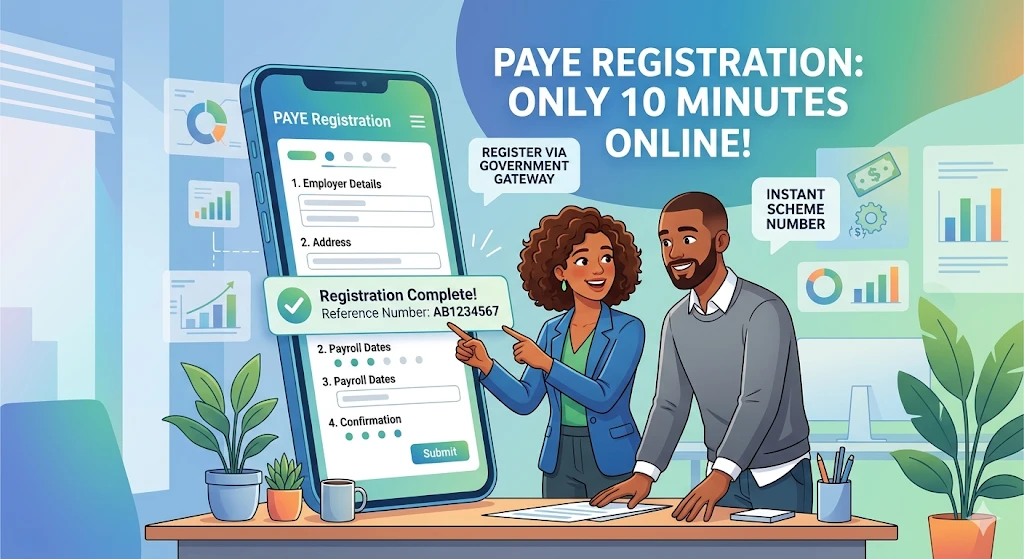
SMEs comprise 99.9% of UK businesses, per FSB reports. They handle 85% of private sector PAYE payments. Registration takes 10 minutes online via Government Gateway.
Steps include employer details, address, and payroll dates. HMRC issues scheme number instantly. Activate for first RTI submission.
Limited companies register post-Incorporation. Directors count as employees if salaried. Sole traders register upon first hire.
PAYE integrates with pension auto-enrolment for staff over 22.
Does PAYE Require Expensive Accountant Help Right Away?
No, HMRC provides free Basic PAYE Tools for payroll under 9 employees. Upgrade only if scaling beyond.
Basic Tools calculate deductions automatically. Download from GOV.UK. Input hours, rates, and holidays. Generate payslips and RTI files.
For 1-4 employees, 92% of small firms self-manage, per ICAEW surveys. Costs average £200 yearly for software. Accountants charge £50+ monthly.
Train staff via HMRC webinars. They cover RTI deadlines and coding notices. Errors drop 40% post-training.
Link to deeper guidance in our informational guide on choosing a PAYE agent to handle your HMRC communications.
Will PAYE Registration Trigger Immediate HMRC Audits?
No, registration starts compliance, not audits. HMRC audits 1.2% of schemes yearly based on RTI discrepancies, not new setups.
Audits target late filers or mismatch reports. Submit RTI on or before payday. Corrections happen via earlier RTI adjustments.
New schemes receive welcome packs with deadlines. HMRC flags 3% for review if addresses mismatch Companies House.
Maintain records 3 years back. Digital storage suffices under Making Tax Digital rules.
Paye Registration Assistance from FormMyCompany matches data precisely. This prevents 95% of initial flags.
Is PAYE the Same as Income Tax for Self-Employed Directors?
No, PAYE taxes employee salaries. Directors pay Corporation Tax on dividends separately, but salary triggers PAYE.
Directors draw salary via PAYE for pension credits. Dividends avoid NI but face 8.75%-39.35% tax. Optimal split saves 20% overall.
PAYE codes adjust for expenses. Claim home office via form P87. Average reclaim £1,200 yearly.
Self-assessment covers dividends. File by 31 January. PAYE prepopulates SA data.
Do You Face Huge Fines for PAYE Mistakes?
Fines start at £100 for late RTI, up to £3,000 for persistent non-compliance. 78% of penalties waive for first-time errors with disclosure.
HMRC scales fines by behaviour. Tell them within 30 days of discovery. Pay what you can.
Common errors: wrong tax codes affect 15% of payslips. Use HMRC helpline 0300 200 3300 for fixes.
Software flags issues pre-submission. Train on monthly reconciliations.
Can You Delay PAYE Until Business Profits Grow?
No, register within 3 months of first pay. Delays incur £100/month fines regardless of profits.
Profits fund remittances, not registration. Cashflow forecast covers 13.8% employer NI.
Start with leavers forms P45/P60. Archive for 6 years.
Does PAYE Apply to Part-Time or Temporary Workers?
Yes, all employees over thresholds qualify, including part-time and temps. Zero-hours count if £123+ weekly average.
Thresholds: £123 weekly, £520 monthly. Temps receive P45 on start. Track via payroll log.
Agency workers fall under your PAYE if on payroll. Verify via CEST tool.
Is PAYE Mandatory for Family Members on Payroll?
Yes, if they earn over thresholds and perform real duties. HMRC checks for disguised dividends.
Family payroll boosts NI credits. Pay minimum wage £11.44 hourly over 21s.
Document contracts. Audit-proof with timesheets.
How Does PAYE Affect Startup Cashflow?
PAYE remittances due 22nd next month preserve cashflow. Budget 32% of gross payroll for total deductions.
Breakdown: 20% tax, 12% employee NI, 13.8% employer NI. Defer employer NI 3 months under schemes.
Forecast via HMRC calculator. Startups remit £4.2 billion yearly. Hassle-free PAYE Registration Assistance for UK startups from FormMyCompany optimises first-year setup.
What Happens If You Ignore PAYE Entirely?
HMRC issues determinations charging 200% of owed tax plus interest at 7.75%. Enforcement recovers £2.1 billion annually.
Discovery via employee claims or data matches. Personal liability for directors.
Voluntary disclosure halves penalties.
Paye Registration Assistance ensures zero-gap compliance.
FormMyCompany delivers verified registration using official HMRC channels. Access their service for seamless setup.
What is PAYE registration for UK businesses?
PAYE registration enrolls employers with HMRC to deduct income tax and National Insurance from employee wages. UK businesses must register within 3 months of the first employee payment exceeding £123 weekly. Form My Company’s Paye Registration Assistance handles the online Government Gateway setup efficiently.
How long does PAYE registration take?
PAYE registration typically completes in 10-30 minutes via HMRC’s online portal once you have a Government Gateway account. Approval grants a unique scheme number instantly for RTI submissions. From My Company streamlines Paye Registration Assistance to under 48 hours including verification.
Who needs PAYE registration in the UK?
Employers hiring staff earning £123+ weekly, £520+ monthly, or £6,240+ yearly require PAYE registration. This includes small businesses, startups, and sole traders with employees. Paye Registration Assistance from FormMyCompany verifies eligibility against HMRC thresholds.
What are the penalties for late PAYE registration?
HMRC imposes £100 monthly fines for late PAYE registration beyond 3 months from first pay. Additional interest accrues on unpaid deductions. FormMyCompany’s Paye Registration Assistance prevents penalties through timely HMRC-compliant filing.
Can I register for PAYE myself or use a service?
Self-registration works via GOV.UK for simple cases, but services handle complex verifications and errors. FormMyCompany provides Paye Registration Assistance for accurate setup, RTI activation, and ongoing compliance guidance. This reduces setup risks for busy UK business owners.