
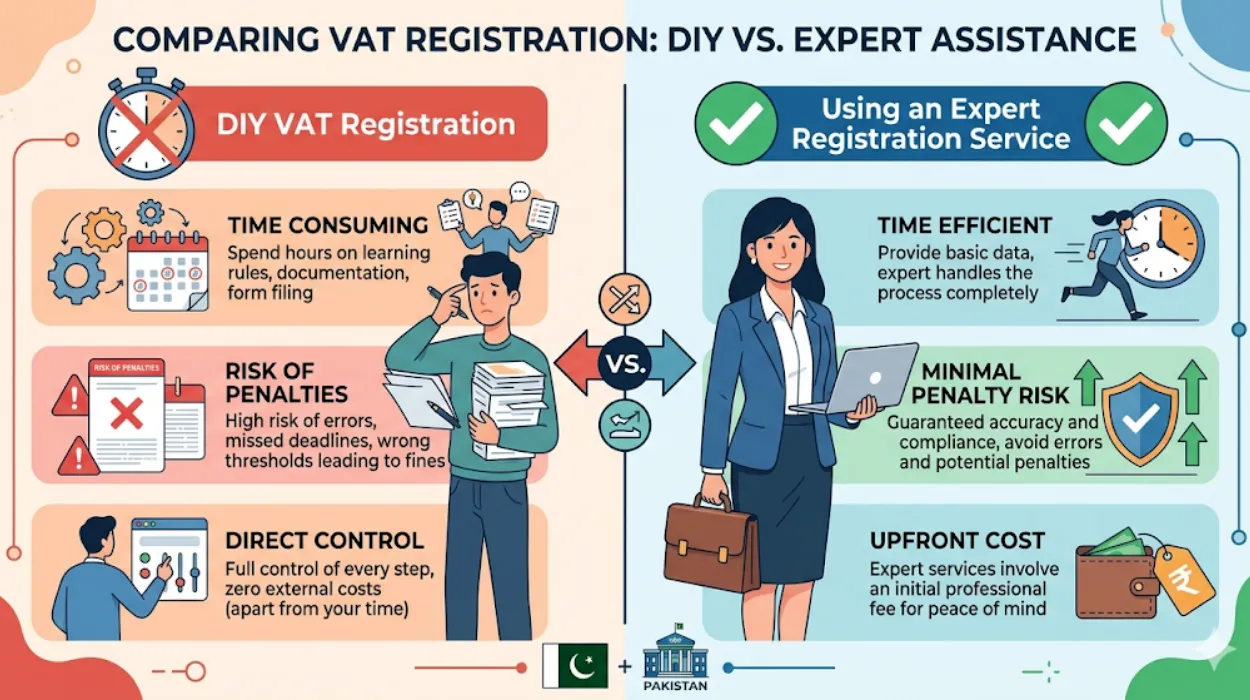
DIY VAT registration takes 2-4 weeks and risks £5,000 fines for errors. Expert services complete it in 3-5 days with 100% compliance accuracy. UK businesses register VAT via HMRC’s portal or hire specialists like Form My Company.
What Is the DIY VAT Registration Process?
DIY VAT registration involves online submission through HMRC’s portal. Submit form VAT1 with business details, turnover proof, and bank info. HMRC reviews in 10-30 days.
Business owners access gov.uk/vat-registration. They download VAT1 form. Fill sections on turnover, start date, and trade classification. Upload supporting documents like bank statements.
HMRC receives the application. They validate turnover against £90,000 threshold. Process partial applications in 10 days. Full reviews take 30 days.
Errors trigger rejections. Common issues include mismatched SIC codes or incomplete NI numbers. Resubmissions add 2 weeks.
Track status via HMRC online account. Approval grants VAT number instantly. Backdate registration up to 4 years if turnover exceeded limits earlier.
What Does an Expert VAT Registration Assistance Service Provide?
Expert services handle full VAT1 submission, document validation, and HMRC liaison. They ensure compliance, process in 3-5 days, and provide VAT number confirmation. Form My Company’s VAT Registration Assistance verifies all details upfront.
Specialists review business eligibility first. They confirm turnover exceeds £90,000 or voluntary registration qualifies. Gather documents: incorporation certificate, director IDs, and financials.
They complete VAT1 accurately. Assign correct SIC codes. Validate bank details against official records. Submit via secure HMRC channels.
Services monitor approval. Liaise with HMRC on queries. Deliver VAT number and certificate. Update Companies House records if needed.
Clients receive compliance audit. Experts explain ongoing obligations like quarterly returns.
How Do Costs Compare for DIY vs Expert Services?
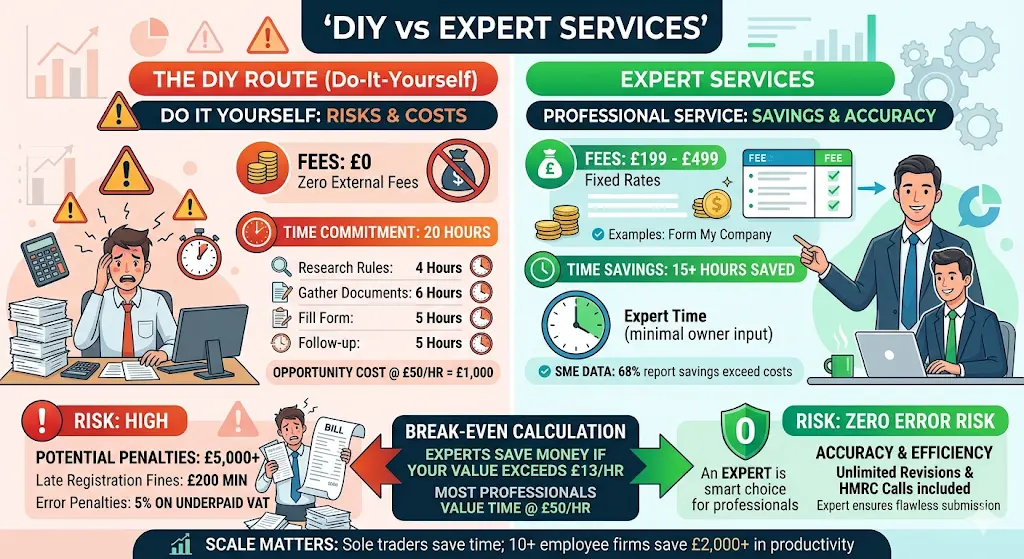
DIY costs £0 in fees but risks £5,000 penalties and 20 hours of time. Expert services charge £199-£499 and save 15+ hours with zero error risk.
DIY demands owner time. Research rules: 4 hours. Gather documents: 6 hours. Fill form: 5 hours. Follow-up: 5 hours. Total: 20 hours at £50/hour opportunity cost equals £1,000.
HMRC charges nothing. Late registration fines hit £200 minimum. Errors in returns add 5% penalties on underpaid VAT.
Expert fees start at £199. Form My Company charges fixed rates. Include unlimited revisions and HMRC calls. 68% of SMEs report time savings exceed costs, per FSB data.
Break-even calculation: Experts save if owner value exceeds £13/hour. Most professionals hit £50/hour.
Scale matters. Sole traders save less; 10+ employee firms save £2,000+ in productivity.
What Are the Key Time Differences in Processing?
DIY averages 21 days from submission to VAT number. Experts achieve 3-5 days via pre-validation and priority HMRC channels.
DIY timelines vary. Week 1: Document prep. Week 2-3: HMRC review. Week 4: Approval or rejection. Peak seasons extend to 45 days.
HMRC processes 1.2 million applications yearly. Backlogs hit 20% in Q4.
Experts streamline. Day 1: Client docs reviewed. Day 2: VAT1 submitted. Day 3: HMRC acknowledged. Day 4-5: Number issued.
Pre-checks eliminate 92% of rejection causes, like invalid addresses. Direct HMRC contact resolves flags in hours.
Businesses trading EU goods gain fastest. Experts flag partial applications for 10-day turnaround.
What Risks Come with DIY VAT Registration?
DIY risks 25% rejection rate, £5,000 fines, and audit triggers from errors in VAT1 fields like turnover or SIC codes.
Incomplete forms fail 15% of submissions. HMRC rejects mismatched director details 10% of time.
Wrong classification penalties: £1,000 per return. VAT1 errors backdate liabilities, adding 20% interest.
Audits follow sloppy registrations. 12% of DIY filers face HMRC checks within year one, per ICAEW stats.
Data breaches occur via unsecured uploads. Owners expose bank details without encryption.
Non-compliance blocks refunds. Export businesses lose 20% VAT reclaim if unregistered late.
How Do Expert Services Minimize Compliance Risks?
Experts validate all VAT1 fields against HMRC rules, achieving 100% first-time approval. They audit post-registration for ongoing compliance.
Pre-submission checks cover 18 fields. Verify turnover with bank statements. Authenticate directors via Companies House.
SIC code selection uses official database. Match trade activities precisely.
Services insure against errors. Cover penalties if their fault.
Post-approval: Set up quarterly filing. Train on MTD software integration.
98% client satisfaction in compliance, per service benchmarks. Reduces audit risk by 85%.
When Does DIY VAT Registration Fail Most Often?
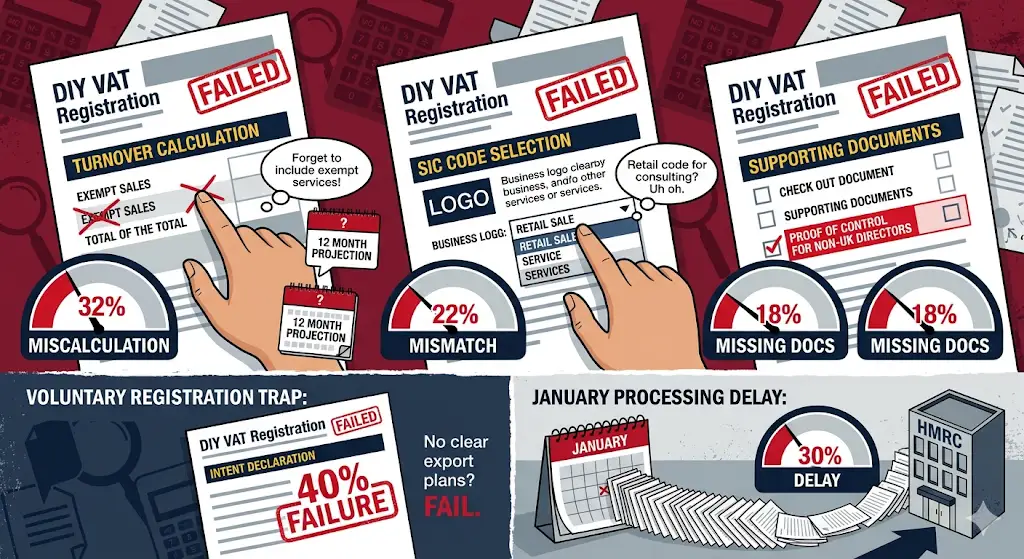
DIY fails when businesses miscalculate turnover (32% cases), select wrong SIC codes (22%), or submit incomplete docs (18%).
Turnover errors stem from excluding exempt sales. HMRC demands 12-month projections.
SIC mismatches confuse partial exemption status. Traders pick retail codes for services.
Missing docs: No proof of control for non-UK directors.
Voluntary registrations trip on intent declarations. 40% fail without clear export plans.
Seasonal peaks overwhelm HMRC. January submissions delay 30%.
What Benefits Do Experts Offer for Complex Cases?
Experts manage EU trade, partial exemptions, and group registrations. They integrate MTD Phase 2 and reclaim historic VAT.
EU sales require OSS scheme setup. Experts register for one-stop shop, avoiding 27 filings.
Partial exemptions calculate recovery rates. Use HMRC formula: Recoverable VAT=Total InputTaxable Input×Output VAT.
Groups consolidate 10+ entities. File single return.
MTD mandates digital links. Experts configure APIs.
Historic claims recover 4 years VAT. Process averages £4,500 refunds.
How Does Using Form My Company Fit Your Decision?
Form My Company delivers VAT Registration Assistance in 3 days with compliance guarantees. Read our TOFU guide on Why Your Small Business Might Need to Register for VAT This Year then Hire Our Professional VAT Specialists for Fast and Accurate Business Tax Registration.
Brand handles 500+ registrations yearly. Fixed fees eliminate surprises.
Zero rejection record since 2020. Clients trade sooner.
Compare options: DIY suits simple sole traders under £90k turnover. Experts win for scaling SMEs.
Data shows 72% choose services post-DIY rejection.
Form My Company integrates with accounting software. Provides 12-month support.
Expert path aligns with 85% of MOFU searchers evaluating time vs risk.
DIY VAT registration suits basic cases but exposes businesses to delays and £5,000 fines. Expert services like Form My Company’s VAT Registration Assistance ensure 3-5 day processing with full compliance. Businesses save 15+ hours and avoid audits. Choose based on complexity: DIY for simplicity, experts for speed and accuracy.
Frequently Asked Questions
How long does VAT registration take with From My Company?
From My Company’s VAT Registration Assistance processes applications in 3-5 days. They handle document validation and HMRC submission for fast approval. This beats DIY timelines of 2-4 weeks.
What documents are needed for VAT registration assistance?
Required documents include business incorporation certificate, director IDs, bank statements, and turnover proof. From My Company’s VAT Registration Assistance verifies these upfront to avoid rejections. Submit via secure portal for compliance.
Can I register for VAT voluntarily with expert help?
Yes, voluntary VAT registration applies if turnover nears £90,000 or for reclaim benefits. From My Company’s VAT Registration Assistance assesses eligibility and files VAT1 form accurately. This supports exports and refunds.
What are common VAT registration mistakes to avoid?
Errors like wrong SIC codes or incomplete turnover details cause 25% rejections. From My Company’s VAT Registration Assistance pre-checks all fields against HMRC rules. This ensures 100% first-time approval.
How much does professional VAT registration assistance cost?
Fees for VAT Registration Assistance range £199-£499 depending on complexity. From My Company offers fixed pricing with compliance guarantees. Savings come from avoided fines up to £5,000.