
Yes, expert document verification and apostille services ensure your UK documents meet international legal standards, preventing costly rejections abroad. The process involves validating document authenticity before attaching an official Apostille certificate that confirms recognition under the Hague Convention.
When it comes to international business, education, or residency applications, correctly legalising your UK documents is essential. Errors in verification or incomplete apostille procedures can result in rejections from foreign authorities, delaying your plans and increasing expenses. This article explains why using a recognised provider like Form My Company for Apostilled Documents can help you avoid such issues and why expert oversight matters more than ever.
Understanding Apostille Legalisation and Document Verification
Apostille legalisation is the process of certifying a UK-issued document so that it is accepted as valid in other countries that are part of the Hague Apostille Convention. It proves the signature, seal, or stamp on your document has been issued by a legitimate UK authority, such as a registrar, court, or public official.
Document verification comes before this step. It confirms that the documents you intend to legalise are complete, authentic, and meet the acceptance criteria of the target country. Without verification, even small discrepancies like a missing signature or outdated notarial wording can cause foreign authorities to reject your submission outright.
For instance, a birth certificate, university diploma, or corporate formation certificate all require different verification steps. A professional service coordinates this process to ensure each document passes through proper channels efficiently.
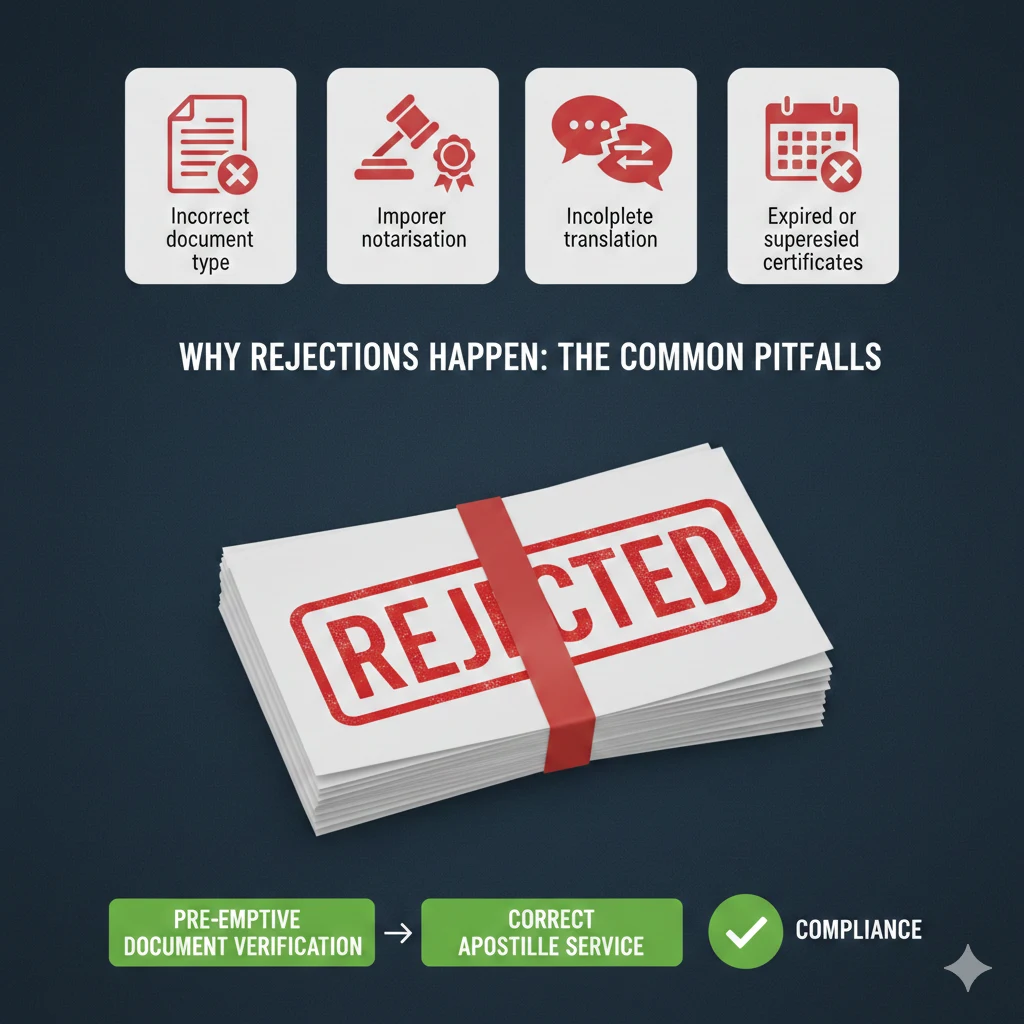
Why Rejections Happen: The Common Pitfalls
Many individuals attempt to legalise and apostille documents independently. While the process may seem straightforward, rejections frequently occur due to subtle but critical oversights.
- Incorrect document type: Certain copies or scans are not acceptable for apostille certification, even if they appear identical to originals.
- Improper notarisation: Not every notary public uses wording compliant with international legalisation requirements.
- Incomplete translation: If a document is to be used in a non-English-speaking country, certified translation may be required before the apostille stage.
- Expired or superseded certificates: Documents such as criminal record checks or incorporation records can expire in under six months.
A detailed breakdown of these issues is explored further in 5 Common Reasons Foreign Authorities Reject UK Documents, a guide explaining why procedural errors are so often the cause of delays or rejections. Linking pre-emptive document verification with correct apostille service ensures compliance from the start.
How Expert Apostille Services Prevent Rejection
As a BOFU-stage offering, Form My Company’s Apostilled Documents service focuses on the final, legally binding phase of document preparation. The process integrates three major safeguards: document authentication, legalisation, and certification tracking.
- Authentication and consistency check: Verification specialists review each document for proper seals, signatures, and formats. This step confirms that every document originates from a valid UK source before submission to the Foreign, Commonwealth & Development Office (FCDO).
- Official apostille issue: Once verified, the FCDO attaches the Apostille certificate. This certificate validates the authority of the UK signature or seal for use internationally.
- Country-specific validation: Some nations still require additional embassy or consular legalisation even after an apostille. Expert services identify these cases preemptively to avoid rejection.
This structured process helps clients whether private individuals, universities, or multinational businesses secure compliant documentation efficiently.
The Role of Verification Before Apostille
The verification stage may seem administrative, but it plays a decisive legal role. Every apostille certificate depends on accurate verification of the underlying document.
For example, a university transcript might first need to be certified by the university registrar before it can be notarised and apostilled. A marriage certificate, on the other hand, may be sent directly to the FCDO in its original form. A corporate document like a Certificate of Incorporation often requires legal representative authorisation.
Form My Company ensures that these layered steps are completed properly in the correct order saving clients from the back-and-forth that typically occurs when documents are returned for correction.
Apostille vs. Notarisation: Understanding the Difference
Confusion between notarisation and apostille legalisation is another reason documents fail to meet destination country standards. Notarisation verifies the signature or identity of the signatory but does not itself make a document internationally valid. Apostille legalisation, however, certifies that a UK notary or other official has legitimate authority to issue that notarisation.
A deeper comparison of the two is discussed in The Difference Between Notarisation and Apostille Legalisation,
explaining which process applies depending on your purpose, such as company formation abroad or study visa applications.
Business Use Cases: Getting Corporate Documents Apostilled
In corporate and commercial contexts, apostilled documents often include:
- Certificates of Incorporation and Good Standing for overseas branch registration.
- Board Resolutions and Power of Attorney authorisations for international business transactions.
- Shareholder Agreements or Contractual Authorisations where cross-border enforcement is required.
Using a professional provider like Form My Company ensures that these documents undergo the proper chain of verification and legalisation. Errors in company documentation can cause contract rescissions or regulatory delays in foreign jurisdictions problems much harder to fix once detected abroad.
Moreover, clients can track document progress securely through the firm’s online portal, reducing uncertainty during the process.

Benefits of Using a Professional Document Apostille Service
Beyond accuracy, expert-managed apostille services deliver measurable practical advantages:
- Speed and reliability: Reputable services work directly with the FCDO, avoiding lengthy postal queues and unclear status updates.
- Compliance assurance: Specialists understand country-specific acceptance rules (for example, UAE embassy requirements differ greatly from Spain’s).
- End-to-end support: Clients receive assistance from initial verification through to delivery of the final apostilled documents.
- Reduced risk: Using professionals minimizes the chance of rejection that can lead to added costs, resubmissions, or missed deadlines.
These advantages make expert apostille support a cost-effective choice for applicants seeking predictable results and legal transparency.
Accuracy and Efficiency in International Legalisation
Global administrative requirements continue to evolve. Many countries now integrate digital verification systems and electronic apostilles, meaning technical errors or outdated submission formats can trigger rejection. Document verification experts remain current with these regulatory updates, ensuring compliance with both digital and paper-based standards.
For business users, this means avoiding the disruption of reapplying for apostille certification under tighter scrutiny. For individuals, such as those submitting birth or education certificates, this ensures peace of mind that documents will be accepted on the first attempt.
Why Form My Company Delivers Trusted Apostille Services
Form My Company provides integrated, high-compliance Apostilled Documents services built around accuracy, audit traceability, and convenience. The company’s expertise spans corporate documentation, academic record verification, and personal certificate legalisation.
By combining verification, notarisation coordination, FCDO submission, and delivery tracking under one process, clients benefit from completeness and accountability at every stage. Clear communication and regulatory precision allow Form My Company to consistently achieve successful acceptance rates for apostilled UK documents worldwide.
When the margin for error is zero, expert document verification and apostille handling become essential, not optional. Working with a specialist such as Form My Company ensures your UK documents are certified to international standards, recognised abroad without delay, and free from procedural error. Whether you’re registering a business overseas, proving educational qualifications, or transferring official records, accurate apostille certification is your proof of authenticity on a global scale.
What does the apostille process for UK documents involve?
The apostille process verifies the authenticity of a UK document so it can be legally recognised abroad. It involves checking the document’s origin, confirming official signatures or seals, and issuing an Apostille certificate through the UK Foreign, Commonwealth & Development Office (FCDO). From My Company handles this process to ensure accuracy and compliance.
How long does it take to get Apostilled Documents through From My Company?
Processing times for Apostilled Documents depend on document type and FCDO workload, but standard service typically takes 2–5 working days. From My Company monitors each stage to ensure your legalised documents are completed and returned promptly.
Which documents can be apostilled in the UK?
Common documents include birth certificates, academic transcripts, marriage certificates, company incorporation papers, and powers of attorney. From My Company verifies that each document meets FCDO standards before applying for the Apostille certificate.
What is the difference between notarisation and apostille legalisation?
Notarisation confirms the authenticity of a signature or signer’s identity, while an apostille certifies that the notary or issuing official is authorised under UK law. From My Company ensures that notarised documents are properly legalised with an Apostille certificate for international use.
Why might foreign authorities reject UK documents without an apostille?
Many foreign jurisdictions require apostille certification as proof that a UK-issued document is genuine and legally valid. Without an apostille, legal, academic, or business documents may be rejected during visa applications, company formation, or official registrations abroad. From My Company prevents such rejections through proper verification and legalisation.