

Setting up PAYE correctly ensures your business meets all HMRC obligations and pays employees accurately. Engaging an expert PAYE registration service saves time, prevents costly mistakes, and ensures your payroll runs in full compliance from day one.
Understanding PAYE and Its Essential Role
For any UK employer, Pay As You Earn (PAYE) is the system HM Revenue and Customs (HMRC) uses to collect income tax and National Insurance contributions from employees’ wages. When a company hires its first employee whether full‑time, part‑time, or even a director drawing salary it must register for PAYE before paying them.
The PAYE system links your business directly to HMRC’s real‑time reporting framework. Every payroll submission communicates taxable income, deductions, and contributions. Without proper registration, the business risks penalties, delays, or even investigations that can stall operations during the crucial early growth stage.
When and Why Your Company Must Register for PAYE
A limited company must register for PAYE as soon as it starts paying employees or directors above the Lower Earnings Limit (LEL). This threshold changes each tax year, but as a rule of thumb, if anyone earns above £123 per week (as of the 2025/26 tax year), PAYE registration becomes mandatory.
Even if directors take minimal pay or dividends, registering early ensures readiness for payroll changes and avoids compliance breaches. You can read more about early timing and HMRC thresholds in our informational guide on when a UK limited company should register for PAYE tax.
Key Steps in Setting Up PAYE Correctly
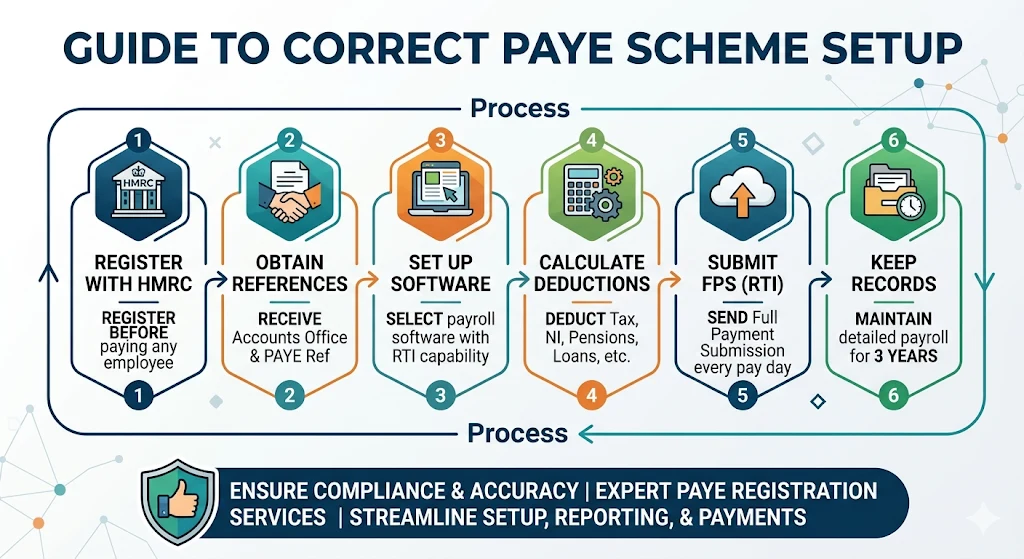
While registering a PAYE scheme might seem simple, it involves a sequence of strictly timed steps that affect tax reporting accuracy and employee payments.
- Register with HMRC for PAYE before paying anyone.
- Receive your Accounts Office Reference and PAYE Reference, which uniquely identify your business.
- Set up compatible payroll software capable of submitting Real Time Information (RTI) to HMRC.
- Calculate tax and NI deductions, including any student loan repayments, pensions, or benefits.
- Send an FPS (Full Payment Submission) to HMRC every time wages are paid.
- Keep detailed payroll records for at least three years, as required by law.
Skipping or delaying any of these steps can trigger compliance issues. An expert PAYE registration service streamlines this process so that setup, reporting, and wage payments align seamlessly.
Common PAYE Setup Mistakes New Companies Make
Many new limited companies misjudge when and how to register for PAYE. Some assume it’s needed only after hiring external staff, ignoring that directors on payroll also count as employees. Others use incompatible software, causing Real-Time Information (RTI) submission errors.
Typical missteps include:
- Registering with incorrect business details or missing HMRC emails.
- Failing to activate the Government Gateway account linked to PAYE.
- Missing the first FPS submission, which flags the account as inactive.
- Paying staff before PAYE registration is processed a reportable compliance breach.
Each of these errors leads to administrative backlog, HMRC fines, or the need to backdate payroll data manually.
Why Expert PAYE Registration Services Are Worth It
Using a professional service such as Form My Company’s PAYE Registration Assistance eliminates these complexities. Beyond completing HMRC registration accurately, an expert handles payroll configuration, confirmatory communication with HMRC, and system validation before processing wages.
For small businesses or sole-director companies, this support ensures no technical or legal step is overlooked. It also means PAYE scheme references, RTI submissions, and payroll software integrations are handled together a crucial combination for reliable financial records.
Professional registration services also provide continued oversight. Once PAYE is active, they can maintain compliance by:
- Reconciling tax and NI deductions each month.
- Monitoring deadline adherence for submissions.
- Providing advice on employee classification, benefits, and deductions.
This end-to-end management removes uncertainty and allows a company to focus on operations rather than paperwork.
Comparing DIY PAYE Registration vs. Professional Setup
Some company owners attempt to register for PAYE directly via GOV.UK. While the process is designed for public use, it assumes ongoing familiarity with HMRC software, deadlines, and terminology factors that can trip up a first‑time employer.
A commercial overview comparing DIY registration versus professional setup shows that outsourcing usually saves both time and cost in the long term. DIY registration may appear free, but errors often lead to fines or hours spent on corrections with HMRC support time that quickly outweighs initial savings.
Experts ensure compliance from the outset, helping employers stay focused on sustainable business growth rather than administrative troubleshooting. As discussed in our decision-focused comparison of DIY PAYE registration versus professional setup, the professional route consistently offers predictable setup times and verified accuracy.
PAYE Registration in the Context of Modern UK Employment
As of 2026, HMRC continues expanding its digital integration systems for payroll monitoring. Real‑Time Information submissions are mandatory; late or missing reports trigger automatic alerts. That means businesses can no longer “fix” payrolls retroactively without financial penalty.
In this regulatory environment, expert guidance offers value far beyond registration alone. Correct setup influences everything from corporation tax reporting to pension enrolment alignment. It defines how employee data flows between software, government gateways, and banking systems the framework underpinning every legitimate wage cycle.
Integration with Other Compliance Services
In practice, PAYE setup functions closely with other compliance steps managed during company formation. Firms such as Form My Company often assist clients with company incorporation, VAT registration, and business bank account setup alongside PAYE registration. This holistic approach ensures all systems link under the correct company registration number and Government Gateway ID.
This is particularly valuable for new directors unfamiliar with HMRC’s digital processes. By aligning all setup steps under a single service, delays and data mismatch between VAT and payroll systems can be eliminated.
How Expert Support Accelerates Payroll Readiness
Working with professionals simplifies payroll readiness from issuing the first payslip to filing the first HMRC submission. Qualified registration specialists:
- Confirm accurate company and director data before registration.
- Manage timely communication with HMRC to confirm PAYE references.
- Configure payroll software for automatic RTI updates.
- Verify compliance with employment law thresholds.
In practical terms, this support allows companies to start paying staff confidently within days instead of weeks. It also minimizes rework later, when incorrect early data often needs correction during tax returns.
Choosing the Right PAYE Registration Partner
When evaluating professional PAYE registration services, business owners should focus on accuracy, transparency, and responsiveness. The provider should:
- Offer clear timelines for registration completion.
- Demonstrate understanding of HMRC protocols.
- Provide documentation confirming scheme activation.
- Integrate payroll setup and training support.
Providers like Form My Company combine PAYE registration with continued payroll management, creating a reliable relationship covering compliance, updates, and employer education. This balance between accessibility and accuracy defines effective professional service.
How Proper PAYE Setup Supports Long-Term Tax Compliance
Beyond immediate payroll needs, correct PAYE registration establishes a company’s foundation for corporate governance. It supports future processes like pension enrolment, benefits management, and end‑of‑year tax reporting.
When managed by professionals, the PAYE account synchronizes seamlessly with HMRC’s online business tax accounts, ensuring that every return from P60s to P11Ds derives from consistently accurate data. This uniformity represents not only compliance but also operational efficiency that benefits directors, employees, and accountants alike.

Why Now Is the Time to Register Professionally
For any new or growing business, a functioning payroll is core infrastructure. Delaying proper registration exposes companies to unnecessary risk. With HMRC expecting fully digital, real‑time updates, professional guidance prevents technical missteps that could otherwise escalate into penalties or cash flow disruptions.
By engaging a PAYE specialist now, directors guarantee accuracy from their first wage payment onward. This reduces administrative workload and ensures that employees receive correct, timely pay fostering trust and professionalism across the business.
Final Thoughts: Set Up PAYE the Right Way
Establishing PAYE is one of the first administrative steps that distinguish an operating UK limited company from a dormant one. Done right, it secures compliance and operational efficiency. Done incorrectly, it can result in extensive rework and potential HMRC scrutiny.
That’s why expert support matters. Through its PAYE Registration Assistance service, Form My Company helps directors set up, verify, and operate payroll systems in full accordance with HMRC rules. With accurate registration and integrated payroll setup, businesses can employ staff confidently and professionally from day one.
Frequently Asked Questions
When should a new UK company register for PAYE?
A new UK company should register for PAYE as soon as it starts paying employees or directors above the Lower Earnings Limit set by HMRC. Early registration ensures all tax and National Insurance deductions are processed correctly from the first payroll.
What information is needed to register for PAYE with HMRC?
To register for PAYE, businesses must provide their company registration number, business address, contact details, and director information. Using a professional service like Form My Company’s PAYE Registration Assistance ensures these details are submitted accurately to HMRC.
How long does PAYE registration take in the UK?
PAYE registration typically takes between 5 and 10 working days once HMRC receives all correct details. With Form My Company’s PAYE Registration Assistance, the process is managed efficiently to minimize delays and ensure payroll setup is ready on time.
Can a company director be paid through PAYE?
Yes, company directors can and often should be paid through PAYE if they receive a salary. Registering directors under PAYE ensures income tax and National Insurance contributions are reported correctly to HMRC.
What happens if a business pays staff before registering for PAYE?
Paying employees before PAYE registration can lead to late reporting penalties from HMRC. Proper registration through Form My Company’s PAYE Registration Assistance ensures payroll reporting begins correctly, avoiding compliance issues and backdated submissions.