

You can register a UK limited company from the UAE entirely online without travelling to Britain, as long as you meet basic requirements for directors, shareholders, and a UK registered office address. The process usually takes 24–72 hours and can be handled end‑to‑end through digital filing and a professional formation service.
For entrepreneurs in Dubai, Abu Dhabi, Sharjah and across the UAE, registering a UK company has become a popular way to access European and global markets, bill international clients in GBP, and benefit from the strength of the UK legal system. Unlike many jurisdictions, the UK does not require directors or shareholders to be UK residents, which makes it particularly attractive for non‑resident founders. A UAE‑based owner can incorporate a private limited company (Ltd) remotely, appoint themselves as director and shareholder, and operate the business while remaining physically in the Gulf. This flexibility enables e‑commerce brands, consultancies, trading companies and tech startups in the UAE to build a recognised UK presence without relocating.
In practice, a UK company formed from the UAE is governed by the Companies Act 2006 and registered with Companies House, the UK’s central corporate registry. You will need a compliant company name, at least one director, at least one shareholder, a UK registered office address, and a clear description of your business activities (via SIC codes). Once incorporated, you must then register for Corporation Tax, consider VAT registration depending on turnover, and ensure any employees are paid via PAYE. For owners accustomed to free‑zone structures and mainland LLCs, the UK regime feels familiar yet distinct, with more emphasis on public filing and transparency. This guide walks through each step, highlighting where a specialist formation partner such as Form My Company can save time, reduce errors and strengthen your compliance footprint from day one.
Step-by-Step: How to Register a UK Company from the UAE
The process to register a UK company from the UAE is structured and highly digital, but it still demands careful preparation. The most common route for UAE residents is to form a private company limited by shares (Ltd), which offers limited liability, flexible share structures and straightforward governance. Before you touch any official form, clarify your business model: are you selling digital services into Europe, acting as an international trading intermediary, or setting up a holding company for intellectual property? This will influence your Standard Industrial Classification (SIC) code and how banks view your risk profile. Once your strategy is clear, choose a unique company name that ends with “Limited” or “Ltd”, avoid restricted words (such as “Bank”, “Authority”, “Royal”) and ensure there is no conflict with existing trademarks. A quick search of the public register and a trademark database is a sensible first step.
Next, decide who will act as directors and shareholders. The UK requires at least one human director who is 16 or over and not disqualified; they can be a UAE resident and can also be the sole shareholder. You will need basic details for each person: full name, date of birth, nationality, occupation, residential address and a service address for the public register. At the same time, arrange a UK registered office address – this must be a real UK postal address where official mail from Companies House and HMRC can be sent. As a UAE resident, you will almost always use a professional registered office and optional virtual office service rather than a physical office lease. With these elements in place, you can prepare your incorporation documents: the memorandum of association (confirming the founding shareholders’ agreement to form the company) and the articles of association (the rules for running the company). Most non‑resident founders use standard “model articles”, unless you need complex investor rights.
You then submit the application to Companies House, usually through a professional agent like Form My Company. You’ll provide company name, registered office, director and shareholder details, share capital structure (for example, 100 ordinary shares at £1 each), SIC code(s), and a statement of People with Significant Control (PSC). The government filing fee for online incorporation is modest, and approval typically comes within 24–72 hours, after which you receive a digital Certificate of Incorporation and official company number. The final stage is post‑incorporation setup: registering for Corporation Tax within three months of starting to trade, opening a UK business bank account or multi‑currency account, deciding whether to register for VAT, and, if you will employ staff in the UK, registering as an employer and setting up PAYE. When handled properly, the entire journey from UAE decision to UK company formation can be completed within a few working days, with most administration done by your chosen formation service.

Benefits and Potential Risks for UAE-Based Founders
Forming a UK company while living in the UAE offers several strategic benefits that go beyond simple incorporation. First, there is the credibility factor: a UK limited company is widely recognised by investors, marketplaces and corporate clients, which can make winning contracts or entering new markets easier than trading under a purely offshore or free‑zone structure. Invoices issued by a UK company, especially when backed by a well‑known jurisdiction and English law, can help reduce friction with European partners. Second, there are tax advantages in specific scenarios. Although the UK has moved to a tiered corporation tax system, many small and medium businesses remain in competitive bands, and there is no requirement to distribute profits as dividends immediately. Combined with double‑tax treaties, this can create efficient structures when managed correctly with professional advice.
The UK framework is also relatively simple compared to some other jurisdictions. There is no minimum share capital requirement, no need for a UK‑resident director, and most filings can be done online. The concept of limited liability means your personal assets in the UAE are generally protected if the company faces financial difficulty, provided you have not given personal guarantees. From an operational perspective, a UK entity can plug directly into global payment gateways, payment processors and marketplaces such as Stripe, PayPal and Amazon, often with greater ease than a purely UAE‑based business. The UK time zone, sitting between Asia and North America, is also convenient for international trading and remote teams.
However, these advantages come with risks that UAE founders must manage. The UK is a high‑compliance jurisdiction: annual accounts, confirmation statements, corporation tax returns, and, where relevant, VAT returns and PAYE filings all have strict deadlines. Late filings quickly attract penalties and can harm your company’s credibility. Banks and financial institutions apply stringent anti‑money‑laundering (AML) checks, particularly to non‑resident directors and shareholders, which means you must be ready to provide clear passport copies, Emirates ID, proof of UAE address, and sometimes a business plan and source‑of‑funds evidence. There is also the question of corporate tax residency: if the “central management and control” of the business is in the UAE, local tax and economic substance rules could come into play, especially if you also operate a UAE entity. Without coordinated advice, you risk double taxation or non‑compliance on one side or the other. The key is to view UK company formation not as a quick badge, but as a long‑term commitment to structured, well‑managed international business.
Legal and Compliance Considerations for Non-Resident Directors
From a legal standpoint, registering a UK company from the UAE is entirely permitted, but the obligations you undertake as a director and shareholder are significant. Directors are responsible for ensuring that the company complies with the Companies Act 2006, maintains accurate accounting records, and files required documents with Companies House and HMRC on time. This includes the annual confirmation statement (which confirms officer, shareholder and PSC details) and annual statutory accounts, even if the company is small or not yet trading actively. In addition, the company must register for Corporation Tax shortly after it starts trading and maintain adequate records of income, expenses, assets and liabilities. For many UAE‑based owners, appointing a UK accountant early is a sensible step, particularly if you plan to claim allowances or reliefs such as R&D tax credits.
Another key compliance area is transparency of ownership. UK companies must maintain a register of People with Significant Control (PSC), essentially anyone who owns more than 25% of shares or voting rights or otherwise exerts significant influence. This information is also filed with Companies House and publicly visible, which is different from some offshore or free‑zone jurisdictions where ownership can be more private. As a UAE resident, you should be comfortable with this level of disclosure or consider structuring ownership through a holding company where appropriate. Data protection is another consideration: if your UK company processes personal data of customers or employees, you must comply with UK data protection law, including lawful bases for processing and appropriate safeguards, even if your main operations are in Dubai or Abu Dhabi.
There are also sector‑specific and cross‑border issues to manage. If your UK company will operate in regulated sectors (for example, financial services or certain kinds of consulting), you may need authorisation from UK regulators. Cross‑border payments between the UAE and UK must comply with both UK AML rules and UAE banking and Central Bank regulations, including any local rules on outbound investments or profit repatriation. Finally, if your UK company will employ staff in the UK, you must register as an employer, operate PAYE, pay National Insurance contributions, and comply with UK employment law, including auto‑enrolment pension obligations for eligible employees. Non‑resident directors remain fully accountable for these obligations, so working with a specialist compliance partner like Form My Company is often the safest way to maintain control while living and working in the UAE.
Common Mistakes UAE Residents Make When Registering a UK Company
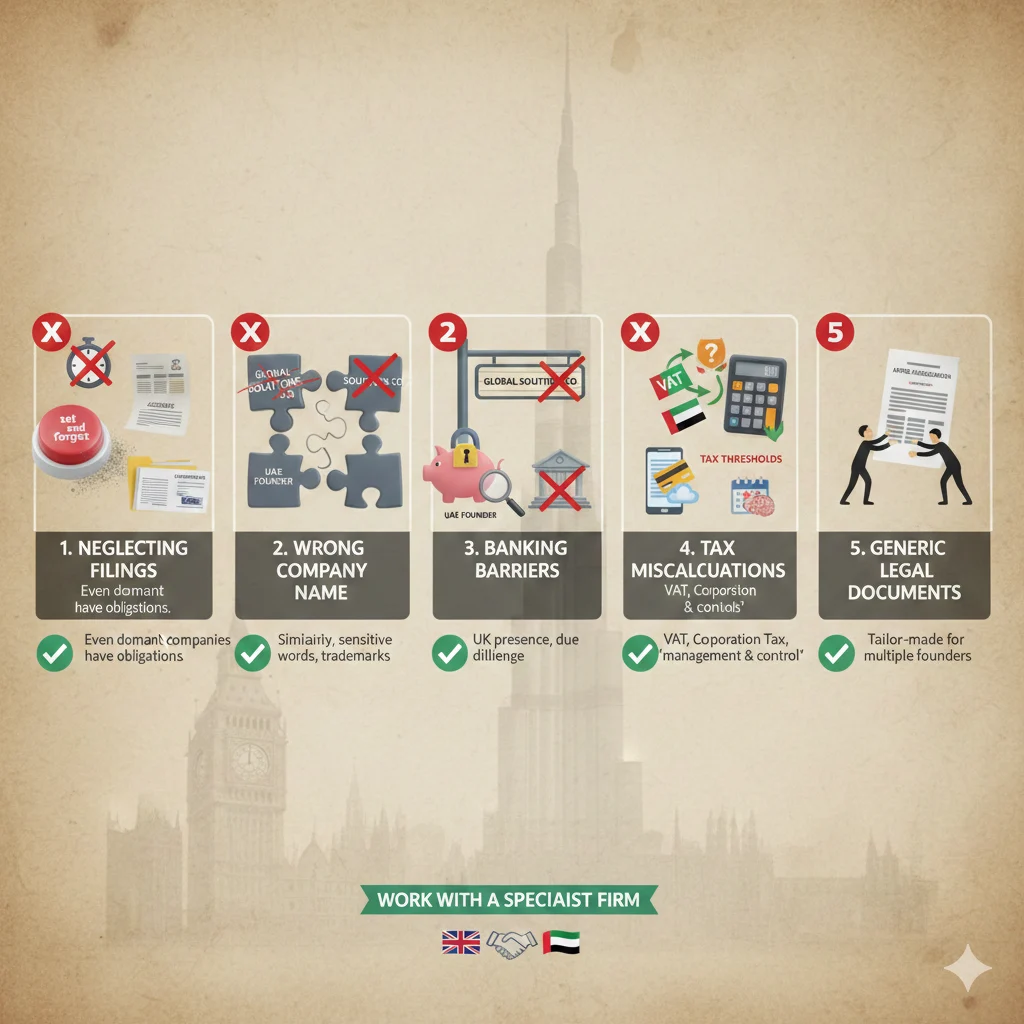
Many UAE‑based founders underestimate the differences between UK and local company regimes and fall into predictable traps. A common mistake is treating the UK entity as a “set and forget” structure: incorporating the company to open a payment gateway or Amazon seller account, then neglecting filings when the business is quiet. In the UK, even dormant companies must submit accounts and confirmation statements, and failure to do so can lead to penalties and eventual strike‑off. Another frequent error is using an inappropriate company name, either because it is too similar to an existing company, includes sensitive words without approval, or conflicts with a registered trademark. This can lead to rejected applications, rebranding costs, or legal disputes, all of which are avoidable with proper checks before filing.
Banking is another area where expectations can collide with reality. Some UAE founders assume that a UK incorporation automatically guarantees a UK bank account, only to discover that traditional banks require a UK presence or extensive due‑diligence, and may even insist on an in‑person visit. Without planning for alternative solutions such as reputable online business accounts and electronic money institutions, companies can be incorporated but unable to trade properly. On the compliance side, it is easy to misjudge tax thresholds and registration triggers. For example, waiting too long to register for VAT, misunderstanding when Corporation Tax is due, or failing to appreciate that “management and control” from the UAE may have tax implications in both countries. Finally, a subtle but serious mistake is using generic or unsuitable articles of association when you have multiple founders or investors: without tailored shareholder rights, decision‑making and share transfers can become contentious later. Working with a specialist formation firm that understands both UK rules and the needs of UAE entrepreneurs significantly reduces these risks.
Practical Tips and Best Practices for UAE Entrepreneurs
To get the most from your UK company formation, it is worth approaching the process strategically rather than merely administratively. Start by mapping how your UK entity fits into your overall structure: will it be your primary operating company, a sales and marketing arm, or a holding vehicle for intellectual property or investments? This will influence your SIC codes, banking choices and tax planning. Once that is clear, invest in a reputable UK registered office and virtual office service, ideally in a recognised business location; this not only keeps you compliant but also improves how your company appears to clients and counterparties. For directors and shareholders in the UAE, make sure your identity documents and proof of address are recent, clear and ready for digital submission, as this speeds up both incorporation and banking KYC checks. It is also good practice to standardise your share structure from day one – for example, creating a pool of ordinary shares that allows future allocation to partners, staff or investors without complex restructuring.
On the operational side, set up cloud‑based bookkeeping and compliance from the start. Use a UK‑compatible accounting platform, link it to your UK bank or payment provider, and establish a routine for reconciling income and expenses each month. This reduces the risk of year‑end surprises and supports accurate VAT and Corporation Tax calculations. If you plan to invoice clients from the UK company while living in the UAE, standardise your contracts and invoices to reflect UK company details, including company number and registered office, and keep clear records of where services are delivered for tax purposes. Consider appointing a UK‑based accountant or compliance partner early; the cost is modest compared to the penalties and stress of late filings or incorrect tax positions. Finally, commit to reviewing your structure annually. As your trade grows, you may need to register for VAT, register as an employer, or adapt your arrangements to evolving rules in both the UK and UAE. A proactive approach, supported by expert formation and compliance services, will keep your UK company robust, credible and ready to scale.
FAQs: Registering a UK Company from the UAE
1. Can a UAE resident be the sole director and shareholder of a UK company?
Yes. UK law allows a single individual to act as both sole director and sole shareholder of a private limited company, even if they live full‑time in the UAE. There is no requirement for a UK‑resident director or local shareholder. The key conditions are that the director is at least 16 years old, not disqualified from acting as a director, and that the company maintains a UK registered office address. As a UAE resident, you will still be subject to UK company law obligations, including filing accounts and tax returns, and you may also need to consider how the company’s management location affects tax residency and obligations under UAE rules.
2. Do I need to travel to the UK to register my company or open a bank account?
In most cases you do not need to travel to the UK to incorporate a company; the entire formation process can be completed online using a formation agent. For banking, some traditional high‑street banks still prefer or require an in‑person visit, particularly for higher‑risk sectors. However, a growing number of UK and European digital banks and payment institutions accept non‑resident directors and allow remote onboarding, provided you satisfy their AML and KYC checks. It is sensible to discuss your business model with your formation partner in advance so they can suggest realistic banking options for a UAE‑based owner.
3. What taxes will my UK company have to pay if I run it from the UAE?
A UK company is generally liable for UK Corporation Tax on its profits, regardless of where the directors live, although the exact position can be affected by where the company is “managed and controlled”. You must register for Corporation Tax and file annual returns. If your UK company’s taxable turnover exceeds the current VAT registration threshold, you must also register for VAT and file VAT returns, even if you are based in the UAE. If you employ staff in the UK, you will need to operate PAYE and pay employer National Insurance contributions. At the same time, your personal tax position in the UAE and any local entity there may also be relevant, so coordinated advice is important.
4. How long does it take to register a UK company from the UAE?
If your documents are in order and your company name is accepted first time, incorporation through an online formation service can often be completed within 24–72 hours. Delays are usually caused by issues with company names, incomplete director or shareholder details, or additional checks required by Companies House. Banking and payment account setup can take longer – sometimes several days or weeks – because financial institutions must perform thorough AML and KYC checks on non‑resident directors and shareholders. Planning ahead and working with an experienced formation provider helps minimise these delays.
5. Is a UK business bank account mandatory for my company to operate?
There is no strict legal requirement to hold a UK business bank account, but in practice it is highly advisable. A dedicated business account simplifies accounting, tax compliance and payment flows, and many suppliers and marketplaces expect to see a professional account in the company’s name. If a traditional UK bank is not suitable or available for your circumstances, you can often use a reputable digital business account or multi‑currency account that supports GBP and international transfers. Whichever option you choose, keep all business transactions separate from your personal finances and maintain clear records for accounting and tax purposes.
Registering a UK company from the UAE is entirely achievable and, when approached correctly, can become a powerful platform for international growth. By choosing the right structure, preparing accurate incorporation documents, securing a compliant registered office, and staying on top of tax and reporting obligations, UAE‑based founders can enjoy the credibility and flexibility of a UK limited company without leaving Dubai, Abu Dhabi or any other emirate. The key is to treat formation and compliance as a strategic investment in your business, rather than a one‑off administrative hurdle.
If you’re ready to register your company with confidence, Form My Company provides fast, fully online UK company formation tailored for UAE residents, with expert support on compliance, VAT and PAYE registration, virtual office services, and ongoing professional guidance. Get started today and let our specialists handle the paperwork while you focus on winning clients, scaling your operations and growing your business across the UK, Europe and beyond.