
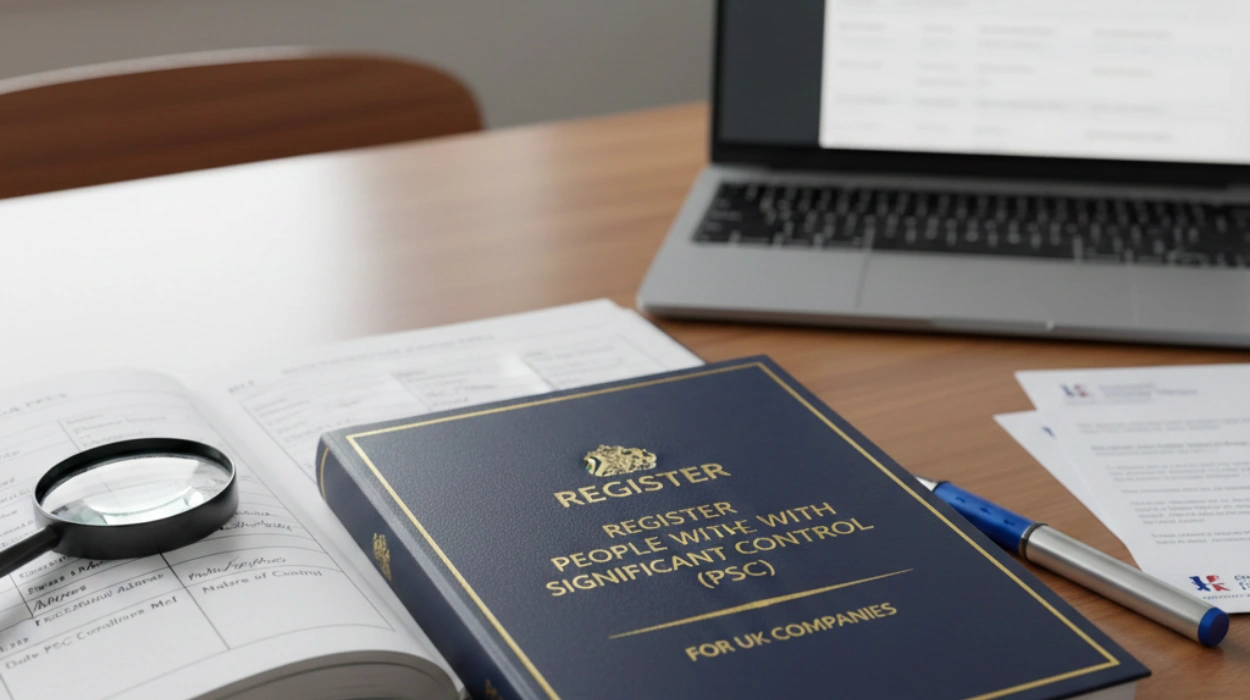
A PSC Register records the individuals who ultimately own or control a UK company. It’s a legal requirement that helps ensure corporate transparency and prevent misuse of companies for illicit purposes.
Understanding how this register works is essential for any business owner or company director in the UK. This article explains the purpose, structure, and maintenance of a People with Significant Control (PSC) Register, along with how professional services like Form My Company can help you stay compliant.
What Is a PSC Register?
A PSC Register (People with Significant Control Register) is a statutory record that every UK company and LLP must maintain. It lists the individuals who have significant control or influence over the business. This transparency measure stems from the UK government’s efforts to combat money laundering, tax evasion, and other financial crimes.
Put simply, it ensures that anyone examining a company’s details whether investors, regulators, or potential business partners can identify who truly controls the organisation.
Why the PSC Register Was Introduced
Before the PSC regime was introduced in 2016, it was often difficult to determine who controlled certain private companies. Shell structures and nominee shareholders could obscure ownership. The PSC framework addressed this by requiring businesses to disclose ultimate beneficial owners.
By documenting control relationships publicly, the system enhances corporate integrity and supports accountability across UK businesses. It also aligns with global transparency standards, reinforcing the UK’s position as a trusted jurisdiction for enterprise.

Who Qualifies as a “Person with Significant Control”?
An individual or legal entity qualifies as a Person with Significant Control (PSC) if they meet one or more of the following conditions:
- Owns more than 25% of the company’s shares.
- Holds more than 25% of the voting rights.
- Has the right to appoint or remove the majority of the board.
- Exercises significant influence or control over the company or its management.
- Controls a trust or firm that itself satisfies any of these conditions.
Each of these criteria reflects a meaningful level of ownership or strategic influence. A company may have one or multiple PSCs, depending on its structure.
What Information the PSC Register Must Contain
The PSC Register must include specific details about each qualifying individual or legal entity, such as:
- Full legal name
- Date of birth (month and year)
- Nationality and country of residence
- Service address and usual residential address (the latter not publicly displayed)
- The date they became a PSC
- Which control conditions apply
Companies must keep this register at their registered office or make it accessible electronically via Companies House. Public versions exclude sensitive residential data to protect privacy.
How a PSC Register Works in Practice
Every company must create its PSC Register upon incorporation or by a specified date after becoming active. The process involves:
- Identifying PSCs — Reviewing the shareholding, voting rights, and governance structure.
- Verifying Information — Contacting PSCs directly to confirm their details and consent.
- Recording Data — Entering accurate and complete information in the register.
- Filing with Companies House — Submitting the data via confirmation statements or updates as needed.
If a company cannot immediately identify its PSCs, it must still maintain an interim statement explaining the steps taken to find them. This ensures continuous compliance and transparency.
Common PSC Register Challenges
While the process seems straightforward, many small businesses encounter complexity in meeting the ongoing obligations. Common challenges include:
- Determining indirect control when ownership is spread through multiple layers.
- Managing timely updates when PSC details change.
- Correctly identifying relevant legal entities (RLEs) that hold control rights.
- Keeping internal and Companies House records synchronised.
Mistakes in the PSC Register may lead to penalties or invalidate company filings. For this reason, many companies rely on professional providers such as Form My Company to manage their PSC Register service accurately and consistently.
Why Maintaining Your PSC Register Matters
A well-maintained PSC Register protects your company’s reputation and supports compliance with statutory obligations. It also builds trust with clients, investors, and partners who rely on transparent ownership information.
Failure to keep the register accurate can result in criminal liability for directors or officers. Both the company and the individual PSCs may face fines or even prosecution if they fail to provide the required details.
From an operational standpoint, a properly maintained PSC Register streamlines due diligence processes, particularly during audits, mergers, and funding applications.
Filing Your PSC Information with Companies House
Companies must provide PSC details to Companies House, the UK’s official business registry. The initial submission occurs upon incorporation or within the first confirmation statement cycle. After that, any changes to PSC information must be reported within 14 days, with register updates completed within 28 days.
Changes may include alterations to ownership percentages, control rights, or the appointment of new PSCs. Submissions are made through the Companies House online service or authorized agents.
How to Keep Your PSC Register Up to Date
Maintaining compliance is an ongoing responsibility. To keep your PSC register accurate and current:
- Review your shareholding structure regularly.
- Document and date all communication with PSCs regarding ownership or control changes.
- Update the register before submitting your annual confirmation statement.
- Retain supporting evidence of all changes for internal records.
Many businesses simplify these tasks by using a PSC Register Service such as Form My Company’s professional PSC Register service, which ensures all updates align with government requirements and filing deadlines.
The Role of Digital Filing and AI Verification
In recent years, Companies House has integrated more digital processes, using automation and AI checks to verify beneficial ownership data. These enhancements aim to detect inconsistencies or fraudulent declarations more effectively.
Digital compliance systems rely on structured, reliable data submissions. Keeping your PSC information consistent across the register and Companies House prevents delays, rejection notices, or regulatory follow-up.
This makes professional support especially beneficial for entrepreneurs handling multiple entities or multi-level ownership structures.
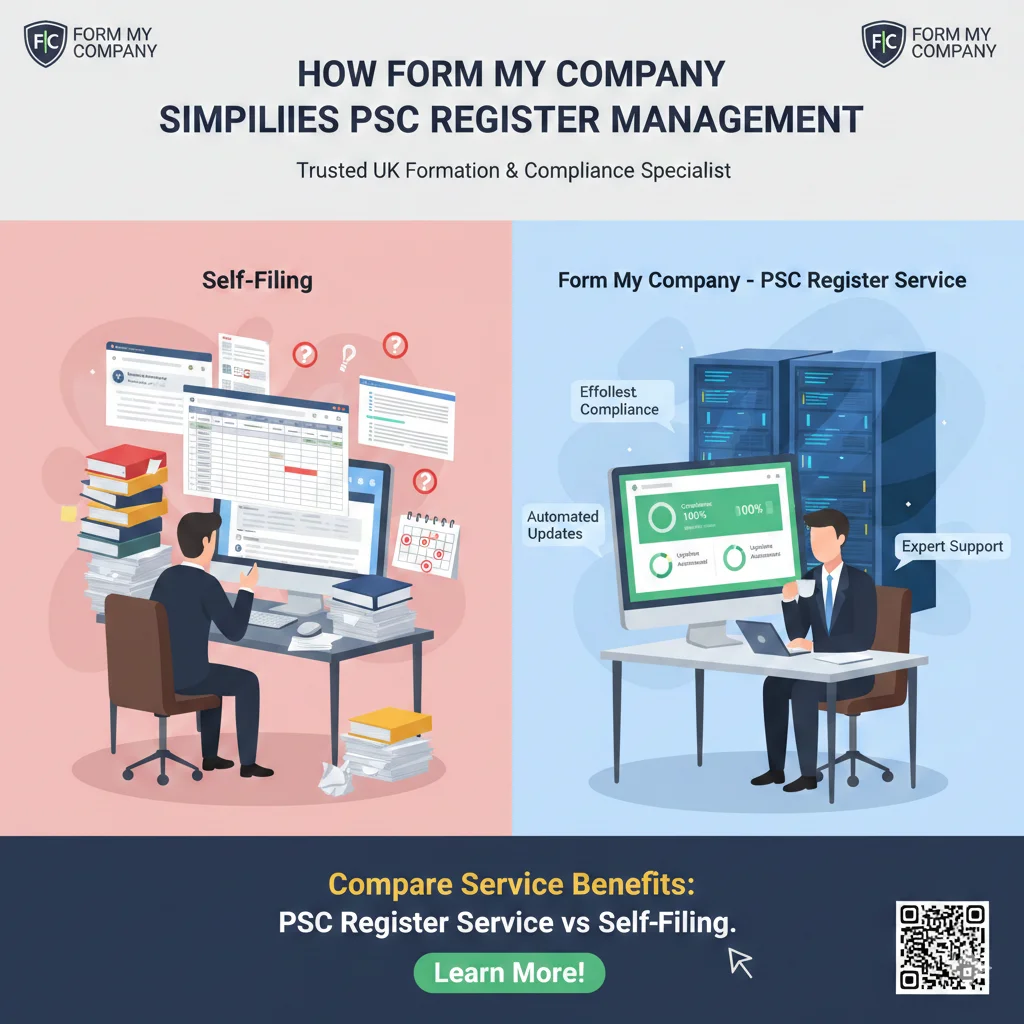
How Form My Company Simplifies PSC Register Management
Form My Company is a trusted UK formation and compliance specialist that offers tailored support for maintaining statutory registers. Their PSC Register Service goes beyond basic recordkeeping by delivering precise, compliant documentation and automated updates through secure systems.
By engaging professionals, businesses avoid the administrative burden of manual filing and benefit from continuous oversight. This approach helps eliminate errors, manage ongoing amendments, and stay compliant with ever-evolving Companies House policies.
For readers exploring the topic further, you can compare service benefits in this related resource PSC Register Service vs Self-Filing: Which Is Better?
which discusses efficiency, risk reduction, and long-term reliability.
What Happens if You Fail to Maintain a PSC Register?
UK companies that neglect PSC duties may face legal and financial consequences, including:
- Monetary penalties or daily fines for non-compliance.
- Rejection of confirmation statements or incorporation documents.
- Director liability and potential disqualification.
- Difficulty during audits, fund-raising rounds, or ownership verification.
Companies House and HMRC treat transparency seriously, and repeated non-compliance can trigger investigations or freeze company accounts. A professional compliance partner reduces this risk through continuous monitoring and corrective updates.
The Broader Importance of PSC Transparency
The PSC Register forms part of a global initiative toward financial integrity. It aligns closely with standards set by the Financial Action Task Force (FATF) and the European Union’s anti-money-laundering directives.
For UK companies, maintaining a transparent ownership record not only satisfies domestic law but also enhances confidence among international investors. It signals that the business operates with ethical integrity and robust governance standards an advantage in today’s transparency-driven economy.
How to Manage Complex Ownership Structures
For companies owned through corporate layers, trusts, or offshore holdings, identifying the underlying PSCs requires careful analysis. Every entity in the chain must be examined until a natural person with ultimate control is found.
This complexity makes outsourcing your PSC register to professional providers beneficial. Providers like Form My Company have tools to trace ownership hierarchies, verify identity documentation, and ensure compliance across all levels of control.
If your company has undergone changes in ownership recently, updating your PSC records is critical. You can explore the best way to do this with professional support in Update Your PSC Register with Professional Help Now.
Final Thoughts: Why a Professional PSC Service Is Worth It
While creating a PSC Register is mandatory, managing it properly requires diligence, accuracy, and awareness of regulatory updates. Errors or omissions can cause delays, penalties, and reputational harm.
Form My Company offers experienced guidance through its fully managed PSC Register Service, providing peace of mind and ensuring that your company remains compliant at all times. With expert help, you can focus on growing your business while maintaining a transparent and trusted corporate identity.
What is a PSC Register and why is it required?
A PSC Register, or People with Significant Control Register, records individuals who own or control a UK company. It’s required by law to improve corporate transparency and help prevent financial crimes such as money laundering and tax evasion.
Who needs to maintain a PSC Register in the UK?
Every UK limited company and LLP must maintain a PSC Register, regardless of size or industry. The register identifies anyone with more than 25% ownership, voting rights, or control over company decisions.
How do you update a PSC Register?
To update a PSC Register, the company must record any changes in ownership or control and report them to Companies House within 14 days. Using a specialist service like From My Company’s PSC Register service ensures the updates are accurate and timely.
What happens if a company fails to keep its PSC Register updated?
Failure to maintain an accurate PSC Register can lead to fines and legal penalties for both the company and its directors. It may also delay filings with Companies House and affect a business’s credibility.
Can a professional service manage your PSC Register for you?
Yes, professional providers such as From My Company offer a dedicated PSC Register service to handle identification, documentation, and filing. This helps UK businesses remain compliant and reduces the risk of administrative errors or missed deadlines.