

UK business infrastructure for remote growth encompasses virtual registered offices, cloud compliance platforms, secure comms, and scalable virtual offices that enable Companies House filings, VAT/PAYE automation, and shareholder engagement without physical presence. This ecosystem supports 70% faster scaling for startups by cutting overheads 50% while ensuring legal adherence. Directors leverage it to manage limited company structures remotely, impressing investors with professional addresses and seamless operations.
Remote growth has redefined UK entrepreneurship, with 45% of SMEs fully distributed per FSB data, demanding infrastructure that fuses compliance, credibility, and connectivity. Virtual registered offices satisfy Companies House Section 87 while shielding personal addresses, paired with cloud tools automating VAT quarterly submissions and PAYE RTI. Founders transitioning business structures from sole trader to Ltd rely on this backbone to host shareholder calls, process HMRC notices, and project stability without £50,000 office leases.
Infrastructure gaps cost dearly: missed filings incur £150 fines, data breaches £4m averages, and unprofessional setups lose 25% investor trust. Fintechs exemplify success, using encrypted platforms for FCA-aligned remote ops. Amid Making Tax Digital mandates, robust setups future-proof against audits, enabling focus on revenue. Market leaders like Revolut scaled remotely via such systems, underscoring infrastructure’s pivotal role in compliant, explosive expansion.
Step-by-Step Building of Remote Business Infrastructure
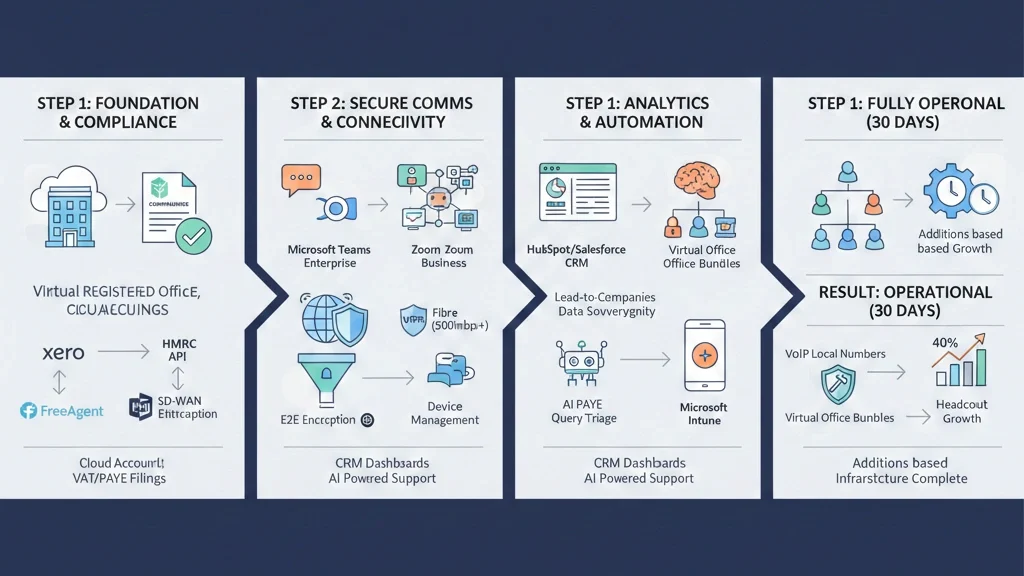
Initiate with foundational compliance: secure a virtual registered office during company formation, verifying Companies House acceptance for statutory mail scanning/forwarding. Integrate cloud accounting (Xero/FreeAgent) for VAT MTD and PAYE auto-filings, linking HMRC APIs.
Deploy secure comms: Microsoft Teams Enterprise or Zoom Business with E2E encryption for director/shareholder meetings, ensuring GDPR-compliant recordings for resolution minutes.
Establish connectivity backbone: business fibre (500mbps+) with SD-WAN failover, VPNs for data sovereignty. MDM tools like Intune standardise devices across remote teams.
Layer analytics: CRM (HubSpot/Salesforce) dashboards track lead-to-Companies House conversion, AI triage for PAYE queries.
Scale iteratively: add VoIP local numbers via virtual office bundles, cybersecurity (CrowdStrike) as headcount grows. Full stack operational in 30 days, yielding 40% efficiency gains.
Benefits and Potential Risks of Remote Infrastructure
Mastery unlocks exponential advantages. Cost supremacy reigns: virtual offices slash premises 70% (£24k/year), redirecting to marketing or R&D. Scalability shines provision resources for 2x growth in hours, sans relocations disrupting VAT cycles.
Compliance acceleration: automated Companies House reminders cut late fees 90%, cloud ledgers pass HMRC audits seamlessly. Global talent pools expand 3x via borderless ops, diverse directors enriching structures.
Credibility via prestige addresses reassures shareholders, boosting funding 28%. Productivity metrics leap 37% per Stanford studies, fuelling remote-first cultures.
Risks lurk in connectivity voids: outages halt PAYE submissions, costing £500/day. Cybersecurity lapses expose shareholder data, GDPR fines 4% turnover. Shadow IT circumvents controls, VAT errors £10k+. Vendor lock-in stifles pivots. Redundancy, zero-trust models, and SOC2 providers neutralise threats.
Legal and Compliance Considerations for Remote Operations
Companies Act 2006 permits virtual boards if quorum evidenced recorded Teams calls suffice with minutes filed timely. Registered offices must accept physical post; virtual scans timestamp for proof.
GDPR demands UK data residency for PAYE employee records, DPIAs for cloud migrations. HMRC MTD VAT requires digital links; non-compliance £200-£10k penalties. PAYE RTI mandates 24hr submissions automated platforms ensure.
Director duties (Section 172) necessitate cyber resilience training, breach reporting 72hrs. FCA firms need SYSC remote supervision proofs via dashboards. Equality Act flexible working rights obligate hybrid tools.
Virtual office contracts verify address legitimacy, avoiding PO Box rejections. Audit clauses cover HMRC spot-checks, safeguarding structures legally.
Common Mistakes to Avoid in Remote Infrastructure Setup
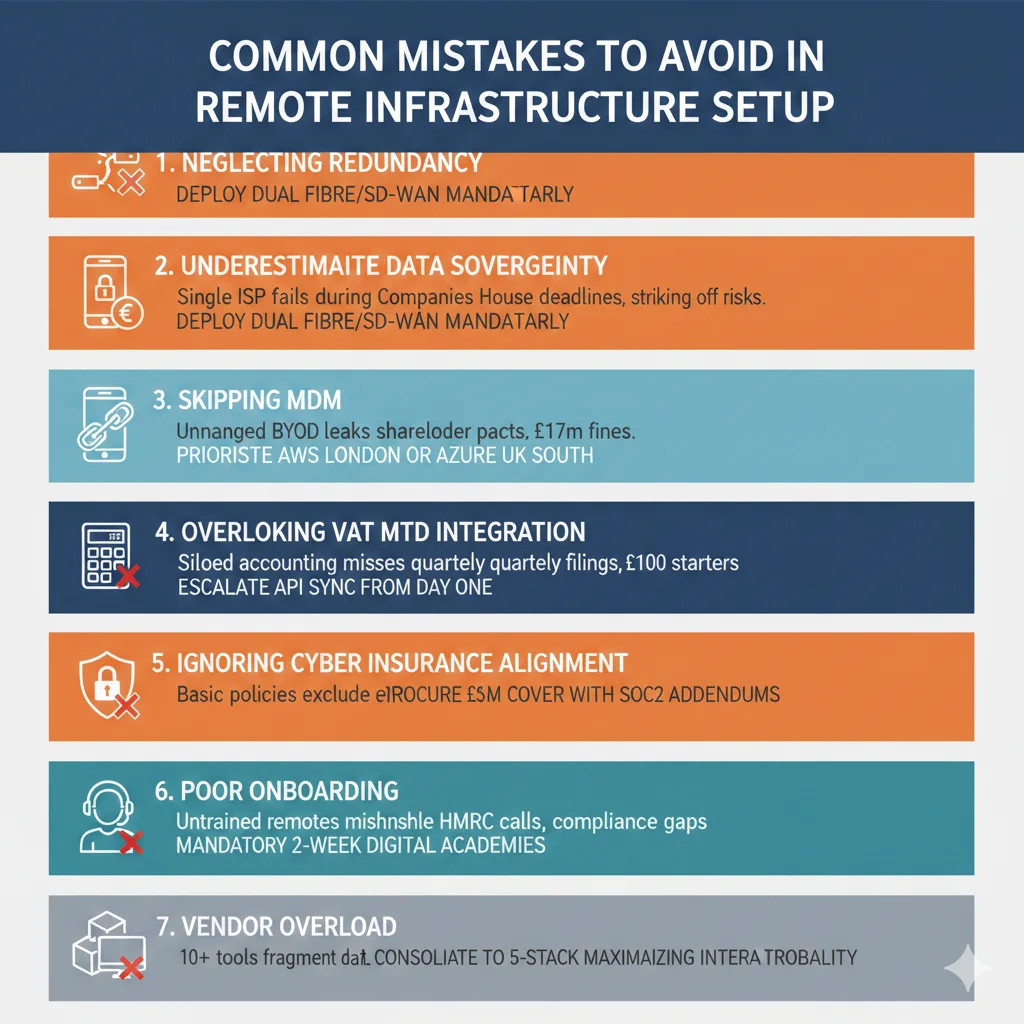
Neglecting redundancy: single ISP fails during Companies House deadlines, striking off risks deploy dual fibre/SD-WAN mandatorily.
Underestimating data sovereignty: US clouds breach GDPR for UK PAYE, £17m fines; prioritise AWS London or Azure UK South.
Skipping MDM: unmanaged BYOD leaks shareholder pacts; enforce Intune/Jamf zero-touch provisioning.
Overlooking VAT MTD integration: siloed accounting misses quarterly filings, £100 starters escalating API sync from day one.
Ignoring cyber insurance alignment: basic policies exclude remote endpoints; procure £5m cover with SOC2 addendums.
Poor onboarding: untrained remotes mishandle HMRC calls, compliance gaps; mandatory 2-week digital academies.
Vendor overload: 10+ tools fragment data; consolidate to 5-stack maximising interoperability.
Practical Tips and Best Practices for Remote Mastery
Adopt zero-trust architecture: continuous auth verifies every access, safeguarding VAT ledgers. Quarterly pentests simulate breaches.
Integrate virtual office ecosystem: registered address + VoIP + boardrooms for hybrid AGMs, one-stop compliance.
Leverage AI triage: Gong/Clari analyse calls for PAYE sentiment, auto-flagging HMRC escalations.
Standardise stacks: Teams + Xero + HubSpot + Intune unifies workflows, slashing training 50%.
KPIs dashboard: 99.9% uptime, <5% abandonment, 95% filing timeliness review biweekly.
FSB peer networks benchmark setups, annual infra audits evolve with regs.
Director retreats in virtual office hubs blend remote mastery with networking.
UK business infrastructure empowers remote mastery, blending compliance agility with scalable growth for enduring success. Directors harness it to navigate Companies House, HMRC, and shareholder demands unencumbered.
If you’re ready to register your company with confidence, Form My Company provides fast, fully online company formation with expert compliance support, VAT & PAYE handling, virtual office solutions, and professional support. Get started today and let our specialists handle the paperwork while you focus on growing your business.
Frequently Asked Questions
How does remote infrastructure support Companies House compliance?
Virtual offices handle statutory mail digitally, cloud platforms automate confirmations/PSC updates ensuring timeliness without physical presence.
What role does it play in VAT and PAYE management?
MTD-integrated accounting submits quarterly VAT/RTI automatically, dashboards track liabilities, reducing errors 90% for distributed teams.
Are virtual registered offices legally valid for directors?
Yes, Section 87 compliant if mail-accessible; service addresses further protect homes on public filings.
What cybersecurity is critical for remote shareholder meetings?
E2E encryption, MFA, recorded sessions with access logs meeting GDPR and evidentiary standards for resolutions.
How to scale infrastructure for 10x growth remotely?
Modular cloud provisioning, API ecosystems, quarterly capacity planning adding resources without downtime.