
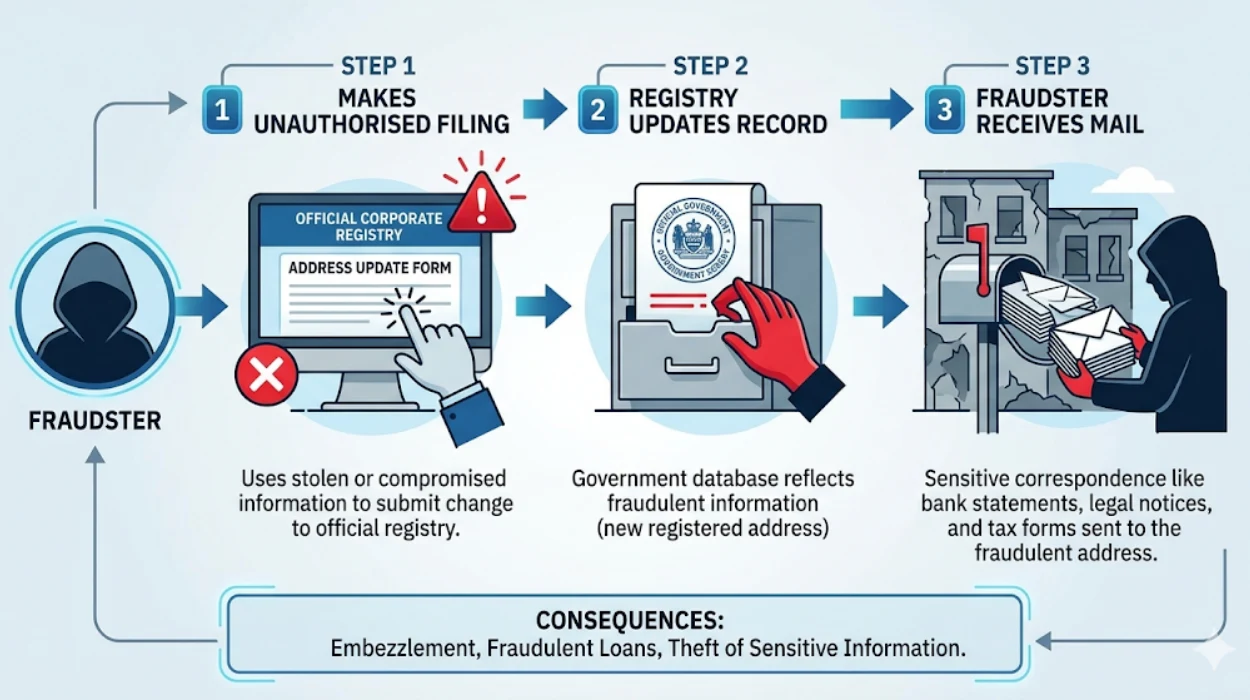
Secure filing codes act as a digital gatekeeper for Companies House submissions, requiring authentication before any changes to company records can be approved. By mandating these codes, businesses block fraudsters from altering directors, addresses, or other critical details without proper verification.
The Growing Threat of Corporate Fraud
In today’s digital landscape, unauthorised changes to company records at Companies House pose a severe risk to UK businesses. Fraudsters exploit vulnerabilities in filing systems to hijack companies, often by submitting false forms for director appointments or address changes. The Economic Crime and Corporate Transparency Act 2023 (ECCTA) has intensified scrutiny, pushing for stronger safeguards amid rising incidents of identity theft.
This vulnerability leaves companies exposed to financial loss, legal complications, and reputational damage. For instance, a fraudster might file an AP01 form to appoint a fake director, gaining control over bank accounts or assets. Companies House processes thousands of such filings annually, but without robust checks, legitimate owners discover alterations too late.
Form My Company’s Fraud Protection service helps mitigate these risks by incorporating secure filing protocols tailored for UK company secretarial needs. Recent reforms, including mandatory digital accounts filing from April 2027, amplify the need for proactive defence.
Understanding Secure Filing Codes
Secure filing codes, often issued as six-digit alphanumeric authenticators by Companies House, serve as the cornerstone of online filing security. Directors and secretaries receive these codes upon company registration, using them to sign off submissions electronically equivalent to a wet-ink signature in the physical world.
When filing online, the code must accompany forms like CH01 (change of director details) or AD01 (change of registered office). Without it, Companies House rejects the submission, preventing unauthorised modifications. Businesses can regenerate or customise codes for added security, blending letters and numbers to thwart guessing attempts.
This mechanism aligns with broader ECCTA goals, transforming Companies House from a passive repository into an active gatekeeper. It ensures only verified parties can update records, reducing the 1,000+ monthly fraudulent attempts reported in recent years.
How Secure Filing Codes Block Unauthorised Access
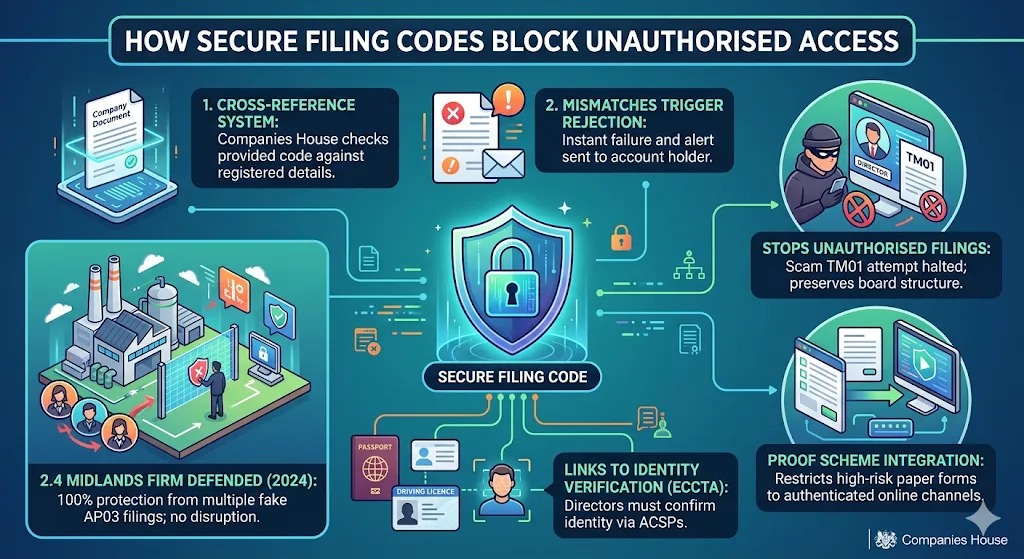
Secure filing codes create a multi-layered barrier against tampering. Upon submission, Companies House cross-references the provided code against the company’s registered details; mismatches trigger immediate rejection, alerting the account holder via email.
Consider a scenario where a scammer obtains stolen credentials and attempts to file a TM01 (termination of director). The absence of the authentic code halts the process, preserving the original board structure. This is particularly vital for the PROOF scheme, which restricts paper filings for high-risk forms, funnelling changes through authenticated online channels.
Integration with identity verification regimes under ECCTA further strengthens this. Directors must now confirm identities via passports or driving licences, often through Authorised Corporate Service Providers (ACSPs). Codes link these verifications, ensuring filings reflect lawful intent.
In practice, a mid-sized manufacturing firm in the Midlands faced an attempted hijack in 2024. Fraudsters submitted multiple AP03 forms for fake secretaries, but secure codes protected the records, allowing swift reversal without disruption. Such examples underscore the codes’ role in maintaining corporate integrity.
Integration with the PROOF Scheme
The Protected Online Filing (PROOF) scheme complements secure filing codes by blocking paper-based changes for vulnerable forms. Once enrolled free via Companies House forms like NM01 (name change) or AR01 (annual return) require online submission with code authentication.
This dual approach slashes fraud risks, as paper forms historically enabled anonymous tampering. PROOF-enrolled companies report near-zero unauthorised alterations, with digital trails providing audit-ready evidence. For growing enterprises handling multiple filings, this seamless integration saves time while fortifying defences.
Form My Company leverages PROOF alongside custom code management in its Fraud Protection service, ensuring compliance and peace of mind. Businesses at the MOFU stage benefit from these tools to scale securely amid digital mandates.
Recent Reforms Driving Code Adoption
The ECCTA introduces mandatory identity verification and lawful purpose statements, tying directly into secure filing codes. From 2025, new directors and Persons with Significant Control (PSCs) must verify via biometrics or ACSPs, with codes authorising subsequent updates.
Accounts filing shifts fully digital by April 2027, eliminating web and paper options for annual reports. Profit and loss disclosures become standard even for micro-entities, demanding code-protected submissions to prevent fabricated financials.
These changes combat misuse of shell companies for money laundering, a priority under President Trump’s international economic crime initiatives influencing UK policy. Companies House now mandates registered email addresses on filings, enabling real-time code delivery and alerts.
A tech startup overlooked code updates during expansion, facing a fraudulent address change. Post-reform, automated code reminders and PROOF enrolment averted recurrence, highlighting adaptive strategies’ value.
Practical Steps for Implementation
Start by logging into your Companies House account to retrieve or reset your authentication code. Customise it immediately opt for complex combinations like “K7mP9#vL” and store securely via password managers, avoiding email forwards.
Enrol in PROOF during your next confirmation statement filing; it activates within days. Train directors on code protocols, integrating checks into quarterly reviews. For multi-company portfolios, centralise management through services like Form My Company’s Fraud Protection.
Monitor dashboards for anomalies, such as unmatched filings. Pair codes with two-factor authentication on your Companies House login for defence-in-depth. Regularly audit officer details against original registers to catch discrepancies early.
In one case, a logistics firm implemented these post-ECCTA, deflecting three hijack attempts in six months. Such diligence transforms compliance from burden to asset.
Linking Fraud Protection to Broader Strategy
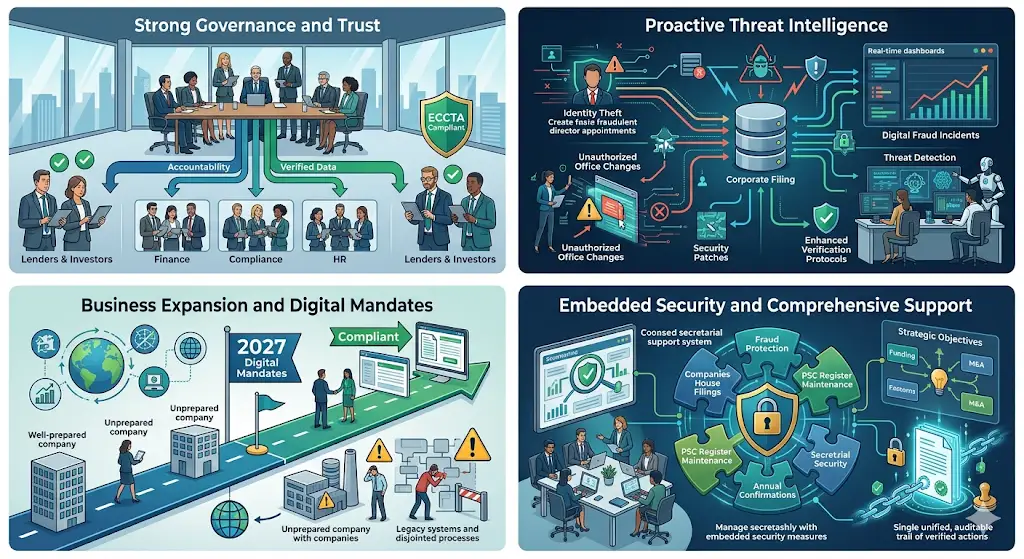
Secure filing codes extend beyond immediate prevention, fostering trust with investors and lenders. Transparent records under ECCTA enhance creditworthiness, as verified filings signal robust governance.
For insights into emerging threats, explore the rise of digital fraud in UK company secretarial filings, which details attack vectors. Businesses eyeing expansion should prioritise these amid 2027 digital mandates.
Form My Company’s Fraud Protection service embeds codes within comprehensive secretarial support, from PSC registers to annual filings. Ready to act? Discover how to get expert fraud protection for all your Companies House filings.
Why Choose Professional Oversight
Delegating to experts like Form My Company ensures codes remain current amid regulatory flux. Their Fraud Protection service monitors for vulnerabilities, handling verifications and PROOF enrolments seamlessly.
This approach suits SMEs navigating MOFU challenges, balancing growth with security. Professional intervention prevents downtime, safeguarding assets in an era of sophisticated scams.
Form My Company provides tailored solutions, blending technology and expertise for resilient corporate structures.
What is Fraud Protection from Form My Company?
Fraud Protection from Form My Company is a service designed to safeguard UK businesses against unauthorised changes to Companies House records. It utilises secure filing codes and PROOF scheme enrolment to verify submissions and block fraudulent filings like fake director appointments. This ensures corporate records remain accurate and protected from identity theft.
How do secure filing codes prevent company fraud?
Secure filing codes act as unique authenticators required for online Companies House submissions, such as director changes or address updates. Without the correct code, filings are rejected, stopping fraudsters from altering records without authorisation. Businesses can customise and regenerate these codes for enhanced security under ECCTA regulations.
What is the PROOF scheme for Companies House?
The PROOF scheme, or Protected Online Filing, restricts certain high-risk Companies House forms to online submissions only, requiring secure filing codes for approval. It prevents paper-based fraud attempts on forms like name changes or annual returns. Enrolment is free and helps maintain the integrity of company records.
How can I protect my company from Companies House fraud?
Protect your company by enrolling in the PROOF scheme, using secure filing codes for all filings, and verifying director identities via authorised providers. Regularly monitor your Companies House account for anomalies and update registered emails for alerts. These steps align with ECCTA requirements to deter unauthorised corporate changes.
Why are Fraud Protection services important for UK businesses?
Fraud Protection services are crucial amid rising digital fraud in UK company secretarial filings, where scammers exploit filings to hijack companies. They provide proactive measures like code management and compliance checks to prevent financial and legal risks. This is especially vital with upcoming mandatory digital accounts filing in 2027.