

Forming a company in the UK involves a clear, digital process through Companies House: choose your structure and name, appoint directors and shareholders, secure a registered office, and file online for incorporation within 24 hours. This streamlined step-by-step company formation UK process ensures legal status, limited liability, and compliance from launch, with fees starting at £12.
Step-by-step company formation in the UK empowers entrepreneurs to establish a legitimate business entity swiftly, leveraging one of Europe’s most business-friendly environments. Governed by the Companies Act 2006 and administered via Companies House, the process transitions sole traders or partnerships into robust limited companies, unlocking tax efficiencies, investor appeal, and liability protection. In 2026, with digital filings mandatory for efficiency, over 800,000 new companies form annually, from tech startups in Cambridge to e-commerce ventures in Manchester.
Primary keywords like company formation UK highlight the appeal: private limited companies (Ltd) dominate, offering share-based funding and Corporation Tax at 19-25%. Secondary elements—directors’ duties, shareholders’ rights, registered office requirements—ensure compliance amid HMRC’s VAT (£90,000 threshold) and PAYE obligations. Semantic terms such as SIC codes, memorandum of association, and PSC register (Persons with Significant Control) underpin filings.
For international founders, post-Brexit rules simplify UK establishment without residency barriers, aiding global trade via the TCA. Risks like non-compliance fines (£1,500+) underscore the need for precision. This authoritative guide, informed by years of UK formation expertise, demystifies each phase, equipping business owners with practical insights to avoid pitfalls and capitalise on reliefs like SEIS/EIS. Whether scaling a consultancy or launching a SaaS product, mastering these steps positions your enterprise for sustainable growth in a competitive landscape.
Step-by-Step Company Formation Process
Begin with structural choice: opt for a private company limited by shares for flexibility, where liability caps at unpaid shares. LLPs suit professional services; PLCs demand £50,000 capital for public trading—unsuitable for most startups.
Step 1: Verify and reserve your company name using Companies House’ webCHeck. It must end in “Ltd” or “Limited,” avoid identical existing names, and steer clear of restricted terms like “Olympic” without consent. Example: “TechFlow Solutions Ltd” passes if unique—cross-check trademarks via IPO.gov.uk.
Step 2: Appoint directors (minimum one, natural person over 16) and shareholders (one suffices). Directors owe duties of care under s.172 Companies Act; provide full names, DOB, nationality, and service addresses. Shareholders subscribe to shares (e.g., 100 at £1 each).
Step 3: Designate a UK-registered office for statutory mail—virtual addresses comply if c/o-enabled. Avoid PO Boxes.
Step 4: Select SIC codes (e.g., 47910 retail via mail order) from the 1,000+ list, accurately reflecting activities for HMRC.
Step 5: Draft memorandum and articles—use model articles for simplicity or customise for veto rights.
Step 6: File digitally via GOV.UK portal (web incorporation service). Upload IN01-equivalent data, pay £12-£100. Receive CRN and incorporation certificate instantly.
Step 7: Post-formation, register for Corporation Tax (CT41G within 3 months), VAT if applicable, and PAYE for payroll.
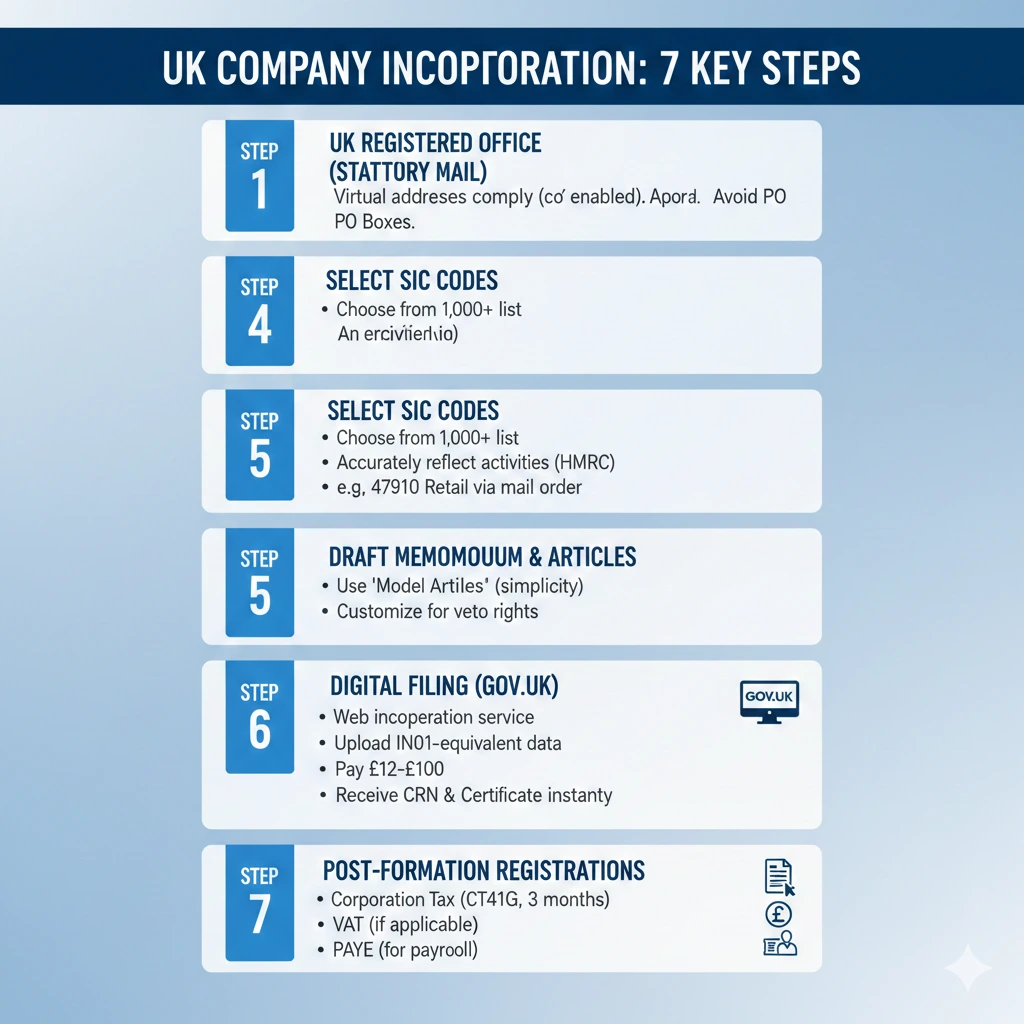
A London-based app developer completes this in 45 minutes: names “UrbanApps Ltd” (SIC 62012), one director/shareholder, virtual office, files Tuesday morning, trades Wednesday. This sequence minimises delays, ensuring seamless bank onboarding.
Benefits of Company Formation and Potential Risks
Formation delivers liability limitation, safeguarding personal assets from creditors—crucial for ventures like construction (SIC 41201). Professionalism via “Ltd” boosts B2B trust; banks prioritise incorporated entities for overdrafts. Tax perks include 19% Corporation Tax on profits under £50,000, dividend allowances (£500), and R&D credits up to 33% spend.
Scalability shines: issue shares for venture capital, qualifying for SEIS (50% relief) if <2 years old. Public registers enhance transparency, attracting suppliers. Post-formation, HMRC’s Making Tax Digital mandates quarterly VAT updates, but compliance unlocks refunds.
Risks include director disqualification (2-15 years) for misconduct like fraudulent trading. Strike-off looms for dormant non-filers (£150 restoration fee). Public exposure of addresses invites spam—mitigate with service addresses. Over-allocation of shares dilutes control; VAT pitfalls hit at £90,000 retrospectively.
Case: A Bristol retailer forms Ltd, claims SEIS for £100k investment, deducts startup costs. Contrast: A neglected Confirmation Statement incurs £1,500 fine, halting loans. Benefits outweigh risks with diligent setup, fostering long-term viability. (212 words)
Legal and Compliance Considerations
Post-formation, annual Confirmation Statements (£13) affirm unchanged details; lapses suspend banking. Accounts filing varies: micro-entities (<£632k turnover) submit balance sheets only. PSC register mandates disclosing >25% influencers—publicly filed, non-compliance fines £500+.
HMRC demands CT600 returns 12 months post-year-end, tagged in iXBRL. PAYE/RTI submits payroll weekly/monthly; VAT quarterly via MTD software. Directors’ fiduciary duties (ss.170-177) prohibit conflicts—breaches invite shareholder suits.
GDPR/UK GDPR requires data policies; ICO registration (£40/year) for controllers. AML checks via formation agents verify directors. Brexit mandates UK VAT for EU sales >£135k.
Example: A Manchester Ltd files abridged accounts via accountant, registers PSCs (founder 100%), sets PAYE—audit-ready. Neglect risks winding-up petitions. Agents ensure adherence, from dormant filings to HMRC notifications, building EEAT-compliant operations.
Common Mistakes to Avoid in Company Formation
Name clashes top errors—choosing “Premier Bank Ltd” invites rejection; pre-check thoroughly. Incorrect SIC (e.g., 56101 for non-restaurant catering) misaligns HMRC, triggering audits. Incomplete forms, like omitting director nationality, cause 20% rejections—use previews.
Non-UK offices breach s.87; fines apply. Forgetting PSCs post-CRN exposes £1,500 penalties. Delaying CT registration (3 months grace) accrues 7.75% interest.
Sole traders overlook liability shifts; disputes personalise debts. Custom articles without legal review spark governance rows. VAT blindness: exceeding £90k mid-year demands backdated registration.
Real incident: A Leeds startup misspells SIC, refiles costing £50+ time. Another skips PAYE, faces £2k arrears. Checklists and previews avert 85% issues—pre-plan share allotments too.
Practical Tips and Best Practices
Use Companies House’ sandbox for practice filings. Engage agents for packages (£20+) including multi-name checks. Brand-aligned names: short, memorable, .co.uk available.
Virtual offices (£15/month) provide prestige, mail scanning. Multiple directors ensure continuity; IoD training hones duties. Integrate FreeAgent (£19/month) for MTD-compliant books.
Pre-allocate shares via agreement templates. Non-UK founders: apostille passports. File Confirmation early quarterly. FSB membership (£150/year) networks peers.
Example: A Cardiff consultancy forms Friday, banks Monday via Starling (CRN-only). Alerts via Crunch software flag deadlines. These streamline formation UK, enabling focus on revenue.

Frequently Asked Questions (FAQs)
How long is step-by-step company formation in the UK?
Digital: 24 hours standard, minutes same-day (£36). Postal: 10 days. Name issues extend 3-5 days—agents fast-track approvals.
Can non-residents handle company formation UK?
Yes; no residency needed. Provide verified ID, UK office. Agents file remotely, enabling global access to UK banking.
What costs step-by-step company formation?
£12 online, £34 postal. Agents £10-£150. Annual: £13 CS, VAT/PAYE free. Total year 1: £200-£500. (38 words)
Do shareholders need UK residency?
No; worldwide OK. Declare holdings accurately for PSC.
When to register VAT/PAYE post-formation?
VAT at £90k; voluntary earlier. PAYE pre-first employee. HMRC auto-notifies CT.
Step-by-step company formation UK transforms ideas into compliant entities, blending speed with safeguards. From naming to filings, precision unlocks growth.
If you’re ready for seamless step-by-step company formation UK, Form My Company offers fast online registration, compliance, VAT & PAYE setup, virtual offices, and expert support. Get started today—let our specialists manage bureaucracy while you build your business.