

Opening a corporate bank account outside of the UK requires specific business documentation, including proof of company registration and properly apostilled corporate records. The process ensures your UK business can operate internationally, receive payments, and comply with local banking regulations abroad.
Expanding your business beyond the UK is an exciting step toward international growth. Yet one of the most critical and often misunderstood aspects of global expansion is setting up a compliant corporate bank account overseas. Whether your company is diversifying into Europe, Asia, or the Middle East, understanding the legal and documentation requirements makes the process far smoother.
In this article, we explore the complete process of opening a corporate bank account outside the UK, including what documents are required, why apostilled documents are essential, and how Form My Company supports your business through reliable Apostilled Documents services.
Understanding the Purpose of an Overseas Corporate Bank Account
A corporate bank account outside the UK allows a company registered in Britain to transact, hold currency, and manage business operations in another jurisdiction. This account type is used by UK-based entities seeking international trade flexibility or by global entrepreneurs operating through UK structures like Limited Companies (Ltd).
Key benefits include:
- Easier cross-border payments and currency management
- Access to local clients and partners in foreign markets
- Improved tax planning and financial diversification
- Enhanced business credibility in the host jurisdiction
For international institutions, compliance is non-negotiable. Banks abroad require legal proof that your company is legitimate, authorised to open an account, and recognized by the UK government which is why certified and apostilled corporate documents become a mandatory part of the application.
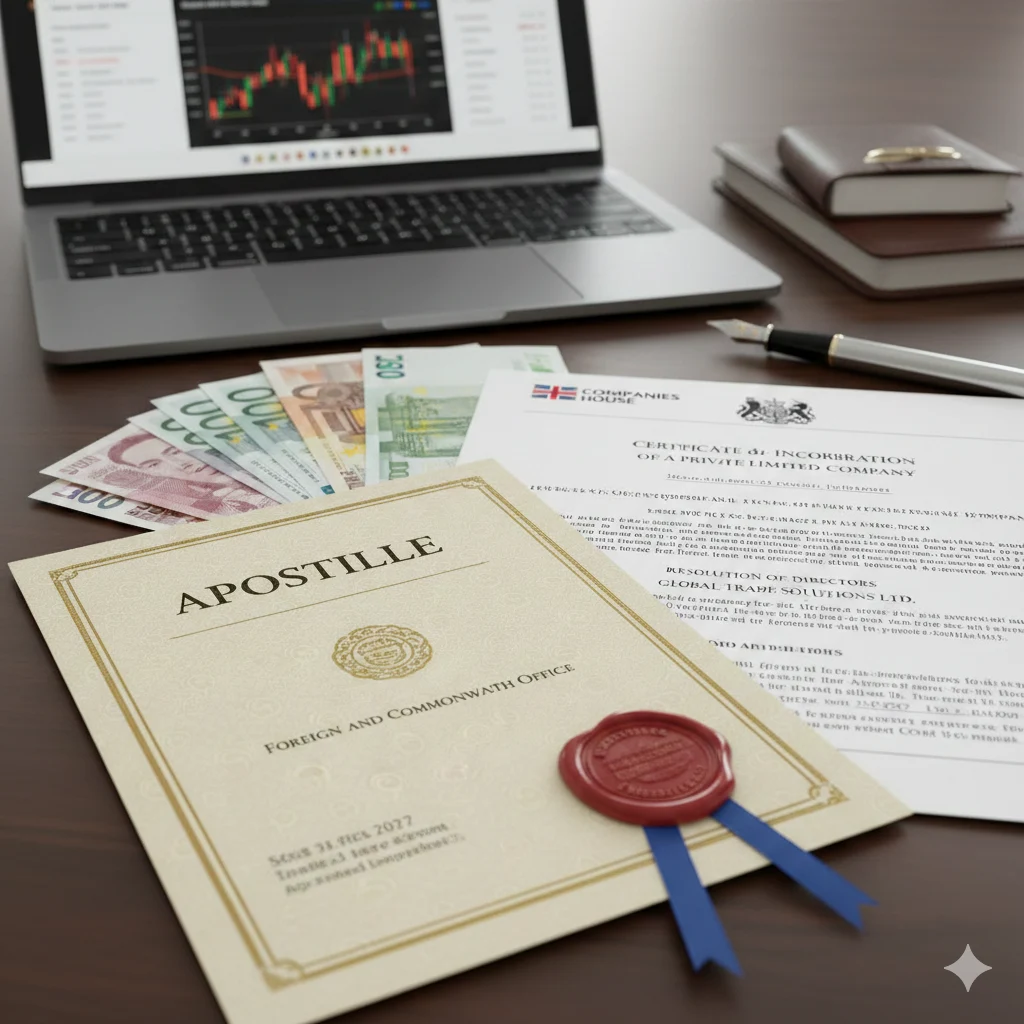
What Documents You Need to Open a Corporate Bank Account Abroad
Every jurisdiction has its own specific banking regulations. However, certain core documents are almost always required for a UK company to open an overseas corporate account.
Typically, banks ask for:
- Certificate of Incorporation
- Memorandum and Articles of Association
- Certificate of Incumbency or Share Register
- Business Plan and Proof of Address
- Directors’ and Shareholders’ Passports
- Recent Utility Bill or Business Address Verification
- Bank Reference Letter (in some cases)
To be valid for use abroad, these documents must undergo an authentication process usually, apostille certification.
Why Apostilled Documents Are Crucial for International Banking
International banks must ensure that all submitted documents come from an authentic and legally recognized source. In cross-border banking, this verification happens through an apostille.
An apostille is an official certificate issued by a government authority (in the UK, typically the Foreign, Commonwealth & Development Office – FCDO) confirming that a document is genuine. It verifies the signature and authority of the person who signed or issued the document, and the seal attached to it.
For instance, if your company provides its Certificate of Incorporation to a bank in Singapore or Dubai, that document must be apostilled before the local institution will accept it. Without the apostille, even legitimate UK documents may be rejected due to local compliance rules.
For an in-depth explanation of why certain certificates require apostilling, see our related article: Why Your Certificate of Incumbency Needs an Apostille Stamp.
Step-by-Step: The Process of Opening a Corporate Bank Account Abroad
While procedures vary slightly by country and bank, the general process follows these steps:
Identify Your Jurisdiction and Bank Requirements
Before starting, research which countries and banking institutions accept UK-registered entities. Some jurisdictions such as Cyprus, Malta, and the UAE are particularly accessible for European and Middle Eastern trade connections. Confirm whether the bank requires in-person verification or allows remote onboarding.
Prepare and Apostille Your Corporate Documents
You’ll need to ensure your core company documents are certified and apostilled in advance. Using a professional provider such as Form My Company’s Apostilled Documents service can simplify this process, ensuring your paperwork meets foreign compliance standards.
By submitting properly apostilled documentation, you demonstrate official recognition of your company’s UK registration and management structure a standard expectation for all legitimate foreign account openings.
Submit Application and Supporting Information
After preparing the documentation set, the next step involves completing a detailed application form. This often includes declaring your business activity, ownership structure, and expected transaction volumes. Many banks now require proof of physical or virtual presence (for example, a local office or branch license).
Bank Compliance and Verification Checks
International banks conduct anti-money laundering (AML) and Know Your Customer (KYC) checks as part of their due diligence. This process can take from a few weeks to several months, depending on the jurisdiction.
Banks frequently request follow-up documentation such as updated apostilles or certified translations which is why it’s important to work with a service provider familiar with international documentation standards.
Account Approval and Activation
Once all documents pass verification, the bank will open the account and issue the necessary credentials for international transfers. The account will allow businesses to hold multiple currencies, send and receive payments, and manage international contracts efficiently.
Common Challenges When Opening an Overseas Bank Account
Even legitimate UK companies may find the process slower or more complex than expected. Key challenges include:
- Document rejection: Caused by missing or incorrectly certified papers.
- Name or ownership discrepancies: Mismatched records on the Certificate of Incumbency.
- Jurisdiction restrictions: Some nations prohibit high-risk industries or non-resident entities.
- Time delays: Authentication or translation backlogs in both the UK and host country.
The solution is preparation. Having a complete, apostilled document set ready in advance prevents costly delays or outright banking rejection.
The Role of Apostilled Documents in International Compliance
Apostilled corporate documents are not merely optional formalities. They prove that your company’s legal identity has been verified by a recognized UK authority. Banks, government agencies, and notaries across the world rely on this stamp as a universal indicator of trust.
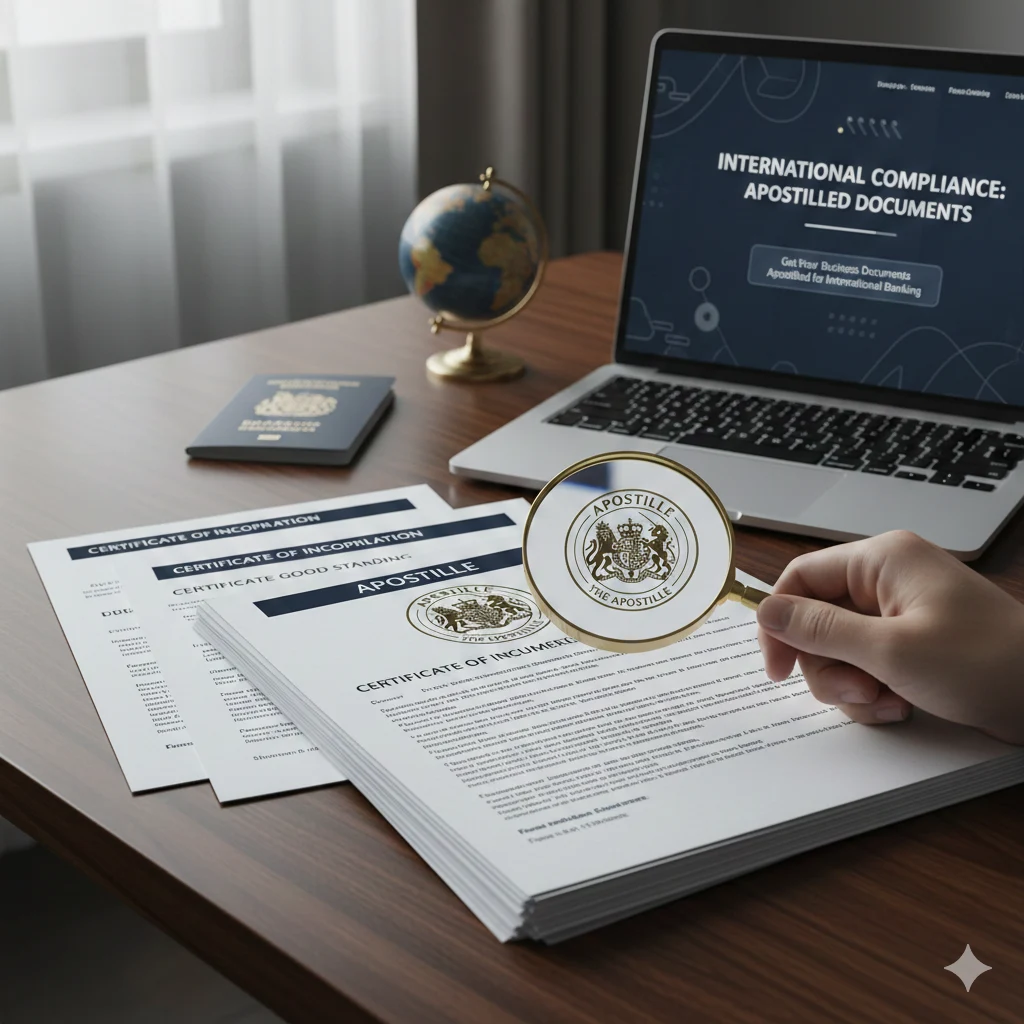
The types of documents typically requiring apostillation include:
- Certificate of Incorporation
- Certificate of Good Standing
- Certificate of Incumbency
- Memorandum and Articles of Association
- Power of Attorney for international operations
Each serves a distinct purpose. For instance, a Certificate of Incumbency identifies current company officers and shareholders. When combined with an apostille, it signals to foreign authorities that the individuals listed are officially recognized representatives something often required before opening a business account abroad. You can read more about this compliance link in our related piece: Get Your Business Documents Apostilled for International Banking.
How Form My Company Simplifies the Apostille Process
Form My Company assists UK businesses looking to operate internationally through seamless preparation of Apostilled Documents. This service ensures all required corporate paperwork is authenticated for global recognition, compliant with both UK and foreign banking standards.
Working with a professional provider eliminates guesswork about formatting, seals, and submission standards. Form My Company coordinates directly with the FCDO and ensures documents are officially validated and ready for overseas presentation.
By partnering with experts familiar with foreign compliance requirements, businesses save considerable time particularly when banks demand rapid document verification for onboarding or cross-border transfers.
Building International Banking Confidence
Opening a corporate bank account outside the UK requires more than a simple application form it demands legal transparency through authenticated corporate documentation. Apostilled records are the universal language that allows UK companies to do business with banks abroad confidently and compliantly.
Whether your company is expanding trade routes, managing offshore operations, or establishing a regional presence, ensuring your corporate documents are correctly validated is essential.
With Form My Company’s Apostilled Documents service, UK businesses can meet international banking standards smoothly enabling secure, compliant, and credible financial operations worldwide.
What are apostilled documents and why are they required?
Apostilled documents are official UK-issued papers that have been certified by the Foreign, Commonwealth & Development Office (FCDO) for use abroad. They confirm a document’s authenticity so it is legally recognised in countries that are part of the Hague Apostille Convention.
How long does it take to get apostilled documents in the UK?
The processing time for apostilled documents in the UK typically ranges from 1 to 5 working days, depending on the submission method. From My Company provides support throughout the process to ensure all documents meet FCDO and international legalisation standards.
Which business documents need to be apostilled for international use?
Key corporate records such as the Certificate of Incorporation, Certificate of Good Standing, and Certificate of Incumbency often require apostilling. From My Company helps verify and prepare these documents for foreign banking, registration, and legal compliance.
Are apostilled documents the same as notarised documents?
No, notarised documents are verified by a UK notary public, while apostilled documents are certified by the FCDO for international use. From My Company can help businesses understand when both legalisation types are needed for cross-border operations.
Can apostilled documents expire or become invalid?
Apostilled documents do not have a formal expiry date, but some institutions may require recently issued certificates. From My Company advises renewing key corporate apostilles if business ownership or company details have changed.