

Companies House registration creates a UK private limited company (Ltd) in 24–48 hours via online Form IN01 submission, requiring a unique name, director/shareholder details, UK registered office, and identity verification for £50 fee. This process grants immediate limited liability, a company number, and access to corporation tax, VAT, and PAYE setups through HMRC. Non-UK residents qualify fully, making it ideal for global entrepreneurs seeking credibility and scalability.
Companies House serves as the UK’s official registrar under the Companies Act 2006, processing over 1 million incorporations yearly to form legal entities like private limited companies (Ltd) the preferred structure for liability protection and growth. This digital gateway demands minimal barriers: no residency rules, no minimum capital, just precise documentation submitted online for swift approval. Semantic searches such as “Companies House registration guide 2026,” “how to register limited company UK,” and “Companies House step by step” surge as founders target English law prestige, tax planning via 19–25% corporation tax, and seamless banking.
For sole traders scaling to £50k+ profits, international traders, or tech startups eyeing SEIS funding, registration unlocks perpetual existence and share issuance. Post-Brexit, it facilitates 140+ trade deals. With 2026 updates like £50 fees and mandatory director ID checks via GOV.UK One Login, precision matters. This authoritative guide details every phase, compliance, risks and best practices, ensuring your “InnovateTech Ltd” launches compliantly drawing on official protocols for EEAT trust.
Step-by-Step Companies House Registration Process
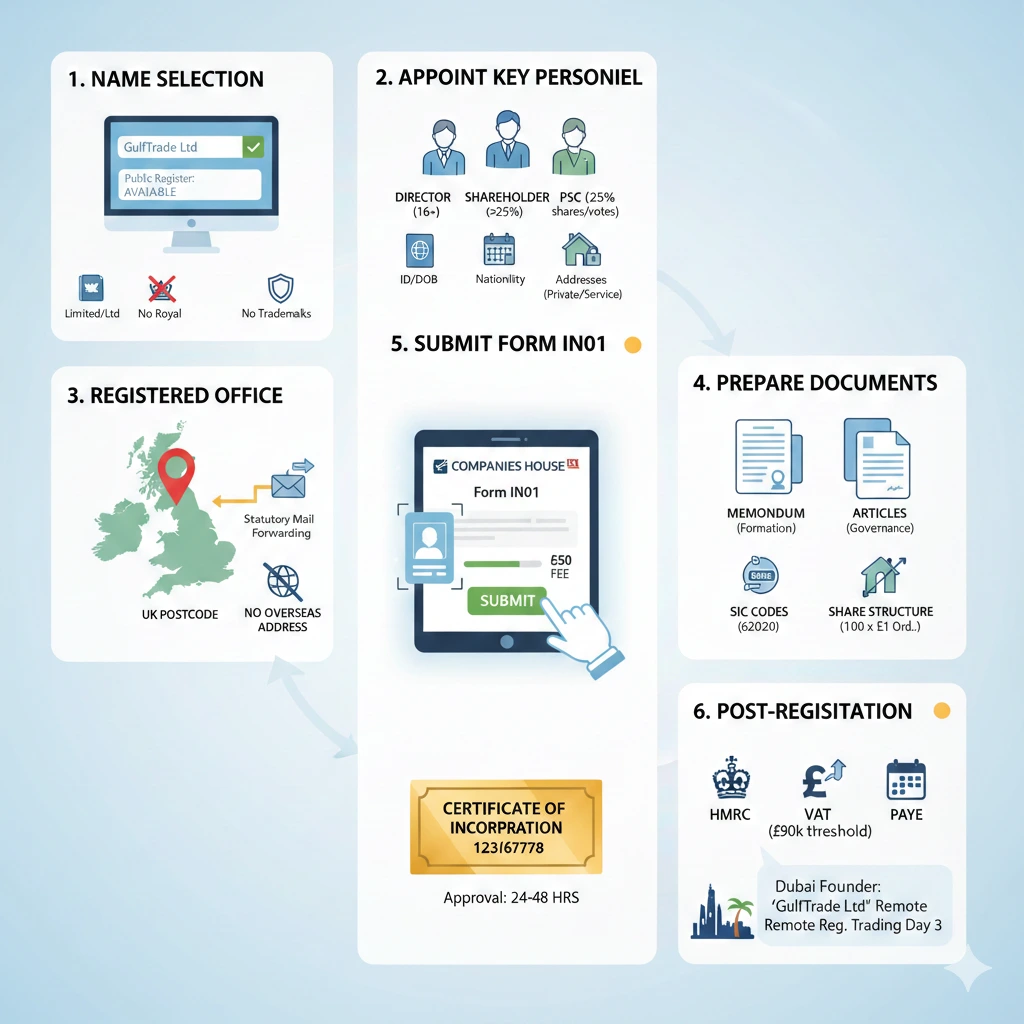
Companies House registration commences with name selection and availability check. Search the public register to confirm uniqueness names must include “Limited” or “Ltd,” exclude sensitive terms like “Royal” without approval, and avoid trademark conflicts via UK IPO database. Prepare 2–3 options; rejections hit 20% from oversights.
Appoint key personnel: Designate at least one director (age 16+, any nationality/location) and shareholder (can be identical). Collect full names, dates of birth, nationalities, occupations, residential addresses (kept private), and service addresses (public record). Identify People with Significant Control (PSC) those with >25% shares, votes or influence.
Establish registered office: Secure a physical UK postcode for statutory mail (virtual services £50–£150/year with forwarding) non-residents cannot use overseas addresses.
Prepare documents: Draft memorandum of association (initial shareholders’ formation agreement) and articles of association (governance model articles standard). Specify SIC codes (e.g., 62020 consultancy), share structure (100 ordinary £1 shares typical).
Submit Form IN01: File digitally via WebFiling account (£50 fee 2026), upload ID for verification. Approval delivers Certificate of Incorporation with unique number in 24–48 hours.
Post-registration: Notify HMRC for Corporation Tax UTR, assess VAT (£90k threshold), initiate PAYE. A Dubai founder registers “GulfTrade Ltd” remotely, trading Day 3.
Benefits and Potential Risks of Companies House Registration
Registration yields immediate limited liability company assets alone bear debts, safeguarding personal homes/savings unlike sole traders. Professional credibility: “Ltd” status accelerates bank accounts (Starling in days), client trust, and investor appeal via SEIS/EIS 50–30% reliefs. Tax optimisation: Pay 19–25% corporation tax on profits, extract via low-rate dividends (no NI). Scalability: Issue shares, employ via PAYE, reclaim VAT inputs.
Risks encompass compliance overhead annual filings or £150–£1,500 fines leading to strike-off. Costs: £300–£800 yearly accounting plus office fees. Transparency: PSC details public. Admin time: Quarterly VAT/PAYE for scaling firms. Benefits dominate for growth; micro-operations weigh simplicity.
Legal and Compliance Obligations After Registration
Post-registration, the Companies Act 2006 governs as a distinct entity: directors uphold fiduciary duties of care, skill and loyalty failures risk personal fines/disqualification. Submit annual confirmation statement (£34) updating officers/PSCs, statutory accounts (micro-entity <£632k turnover), and CT600 return (9 months after accounting period).
VAT registration mandatory exceeding £90k taxable turnover (quarterly Making Tax Digital submissions); voluntary below enables input reclaims. PAYE requires real-time RTI reporting for salaries, NI and pensions. Maintain registered office displaying company name/number. Comply with UK GDPR for data processing. 2026 mandates director verification via secure digital ID. Breaches dissolve companies. Form My Company manages seamless compliance from formation.
Common Mistakes During Companies House Registration
Name validation failures identical/similar names or missing “Ltd” reject 20% instantly; always pre-search public register and trademarks. Invalid registered office PO Boxes or non-physical addresses trigger dissolution; verify service capabilities. Incomplete IN01 fields omitted SIC codes, PSCs or share details halt processing.
ID verification errors low-quality scans fail 2026 GOV.UK checks, delaying weeks. Post-registration oversights 40% neglect HMRC CT notification within 3 months, incurring penalties. Assuming instant banking overlooks KYC rigour. A startup loses a month refiling PSC inaccuracies. Agent pre-submission audits avert.
Practical Tips and Best Practices for Registration Success
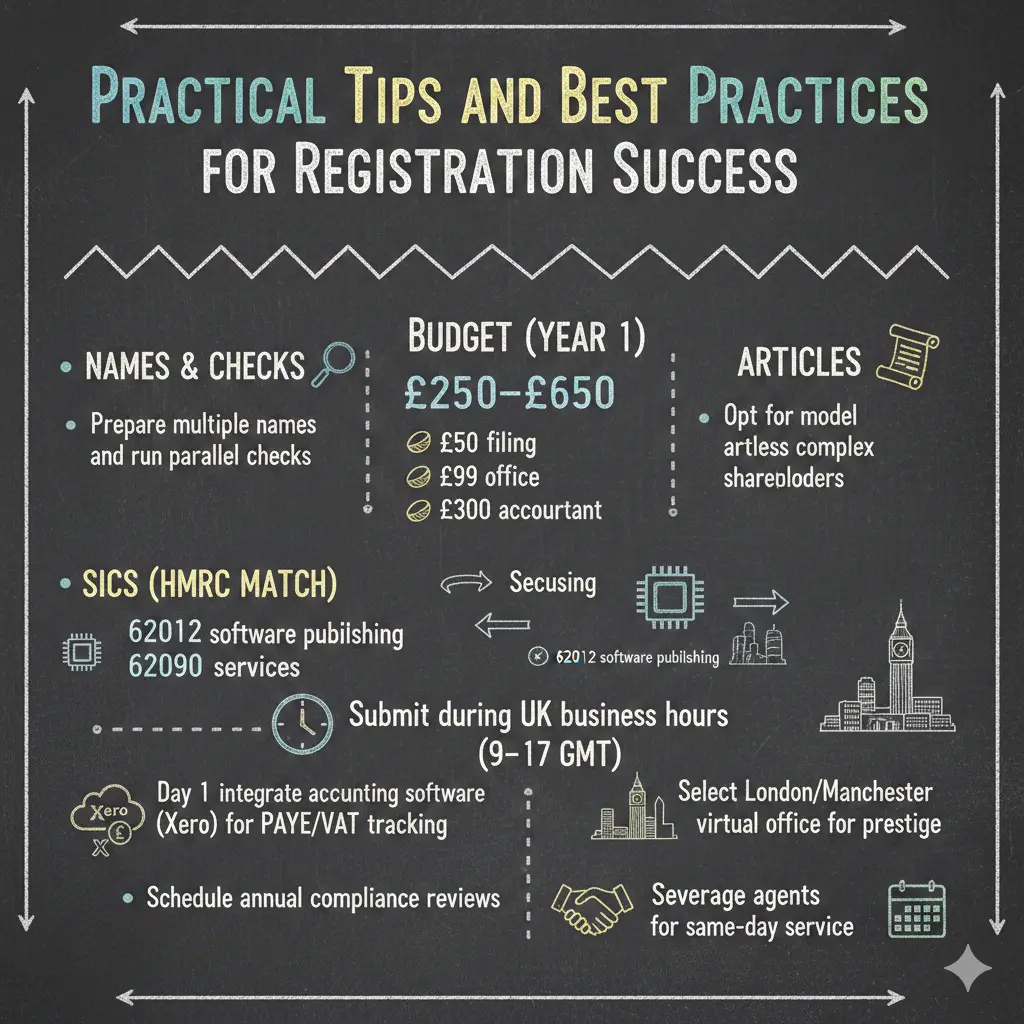
Prepare multiple names and run parallel checks. Budget £250–£650 Year 1 (£50 filing, £99 office, £300 accountant). Opt for model articles unless complex shareholders. Choose precise SICs matching HMRC (62012 software publishing vs 62090 services). Submit during UK business hours (9–17 GMT). Day 1 integrate accounting software (Xero) for PAYE/VAT tracking. Select London/Manchester virtual office for prestige. Schedule annual compliance reviews. Leverage agents for same-day service.
FAQs: Companies House Registration Guide
How long until approval?
24–48 hours standard; same-day options available.
Is Companies House registration free for non-residents?
No—£50 fee applies universally; no residency required.
What documents for IN01?
Memorandum, articles, director details, SIC, shares, PSC.
Do I need a UK bank account first?
No—open post-incorporation; registration precedes.
What if my name gets rejected?
Resubmit new name same day; pre-check avoids.
Companies House registration launches credible, protected UK companies efficiently.
If you’re ready to register your company with confidence, Form My Company provides fast, fully online company formation with expert compliance support. Get started today and let our specialists handle the paperwork while you focus on growing your business.