
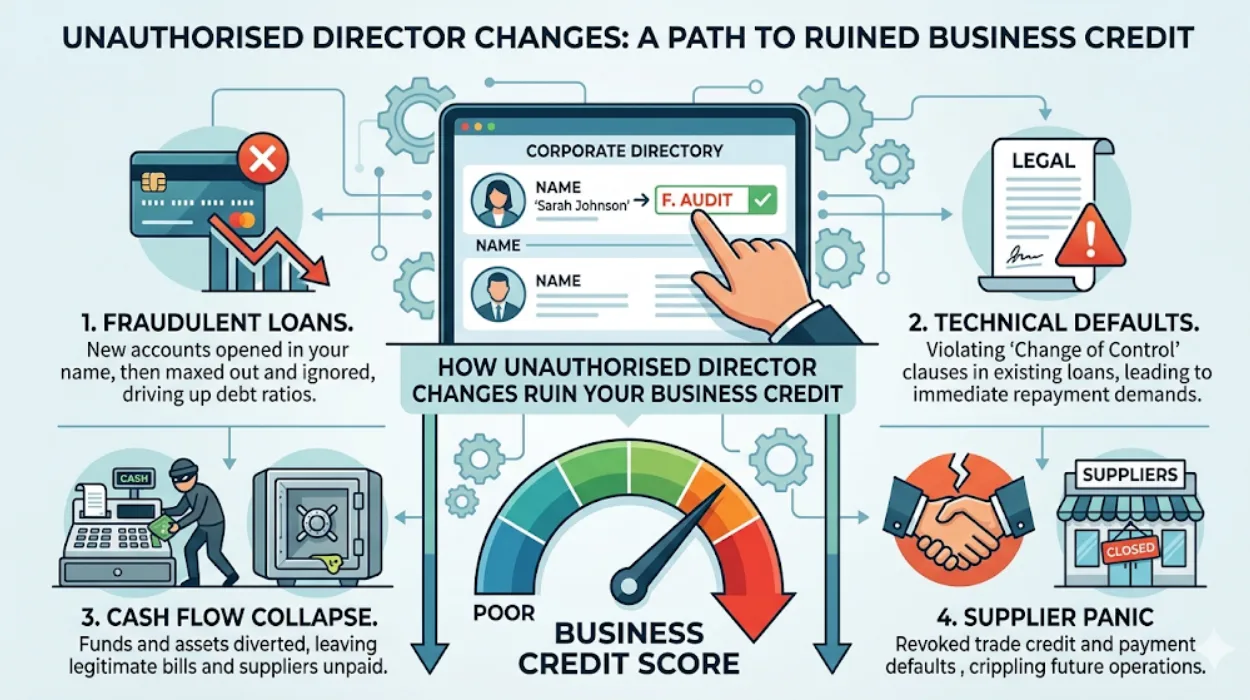
Unauthorised director changes occur when individuals alter Companies House records without proper authority, often through identity theft or fraudulent filings, directly damaging your business credit score. These illicit actions trigger red flags with credit agencies, leading to frozen accounts, denied loans, and long-term financial restrictions that can cripple operations.
Understanding Unauthorised Director Changes
Unauthorised director changes represent a serious breach in corporate governance, where someone fraudulently files paperwork to add or remove directors on your company’s official registry at Companies House. This typically happens via form DS01 for resignations or AP01 for appointments, submitted with forged documents or stolen identities, bypassing verification processes that rely on digital signatures and confirmation statements.
The consequences unfold rapidly as Companies House updates public records within days, making the false information visible to banks, suppliers, and credit bureaus like Experian and Equifax. Businesses in the UK face this risk especially during economic uncertainty, as fraudsters target solvent companies to exploit their credit lines. Without immediate detection, a single unauthorised change can cascade into broader compliance failures under the Companies Act 2006.
Mechanisms of Damage to Business Credit
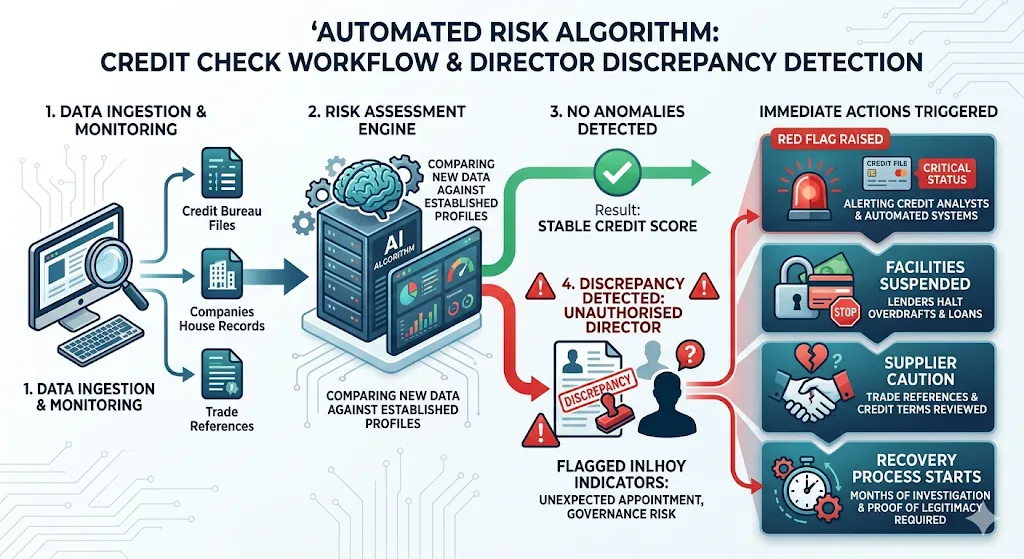
When an unauthorised director appears on your records, credit agencies interpret it as instability or potential fraud, prompting immediate scrutiny of your credit file. Lenders halt facilities, demanding proof of legitimacy, while trade references sour as suppliers question your governance. For instance, a manufacturing firm might see its £500,000 overdraft suspended overnight, forcing cash flow disruptions.
This damage stems from automated risk algorithms that flag director discrepancies as high-risk indicators, similar to how personal credit scores drop from identity theft. Insolvency risks escalate if debts go unpaid during the freeze, potentially leading to personal liability for legitimate directors under the Insolvency Act 1986. Recovery timelines stretch months, with elevated interest rates on future borrowing reflecting the tarnished profile.
Legal and Regulatory Fallout
Companies House mandates reporting changes within 14 days, but fraudulent filings evade initial checks, leaving legitimate directors to file objections via form RP03 or court interventions. Failure to resolve promptly incurs fines up to £5,000 per director, compounding credit woes as legal fees drain reserves. Courts have ruled that such breaches can trigger director disqualifications lasting up to 15 years, further eroding lender confidence.
Regulatory bodies like the Insolvency Service investigate persistent fraud, linking it to money laundering under the Proceeds of Crime Act 2002. A real-world parallel involves a logistics company where an unauthorised director filing led to a frozen credit facility; resolution required six months of affidavits and audits, during which competitors gained market share. Proactive verification with Companies House statements prevents this regulatory quagmire.
Financial Repercussions in Detail
Business credit scores, scored from 0-100 by agencies like Equifax, plummet 20-50 points from unauthorised changes, equating to rejected trade credit and supplier demands for cash-on-delivery terms. Banks reassess risk profiles, often increasing collateral requirements by 50% or denying renewals outright. Consider a retail business facing holiday peak; an undetected change blocks seasonal financing, resulting in £100,000 in lost sales.
Long-term, these incidents haunt credit reports for six years, inflating insurance premiums and venture capital scrutiny. Semantic keywords like “fraud prevention in director filings” highlight how early intervention preserves scores above 80, essential for competitive financing. Maintaining Your Business Credit Score Through Fraud Prevention offers deeper strategies on this front.
Operational Disruptions from Fraud
Beyond credit, unauthorised changes paralyse daily operations as banking mandates fail updates, blocking payments and payroll. Suppliers withhold goods pending director verification, stalling supply chains in sectors like construction where just-in-time delivery is critical. A tech startup, for example, lost a key contract after an investor flagged the anomaly during due diligence, derailing a £2 million funding round.
Internal chaos ensues with board resolutions invalidated, halting strategic decisions like mergers or expansions. Staff morale dips amid uncertainty, with key talent departing for stable environments. Form My Company’s Fraud Protection service monitors these vulnerabilities, alerting you to filings in real-time to maintain seamless operations.
Real-World Case Study Insights
Examine a mid-sized engineering firm in the Midlands: an ex-employee, resentful after termination, filed an unauthorised resignation for the CEO using stolen details. Within weeks, the primary lender flagged the record, suspending a £1.5 million facility and demanding full repayment. Credit score dropped from 92 to 45, forcing asset sales to cover gaps; recovery took 18 months and cost £75,000 in fees.
Another case involved a hospitality group hit by identity theft; fraudulent directors linked to high-risk entities tanked supplier confidence, shifting terms from 60 to zero days. These scenarios underscore patterns: small businesses suffer most, with 30% facing insolvency risks post-incident. Structured monitoring, as in Fraud Protection, averts such disasters by validating every filing.
Preventive Measures for Protection
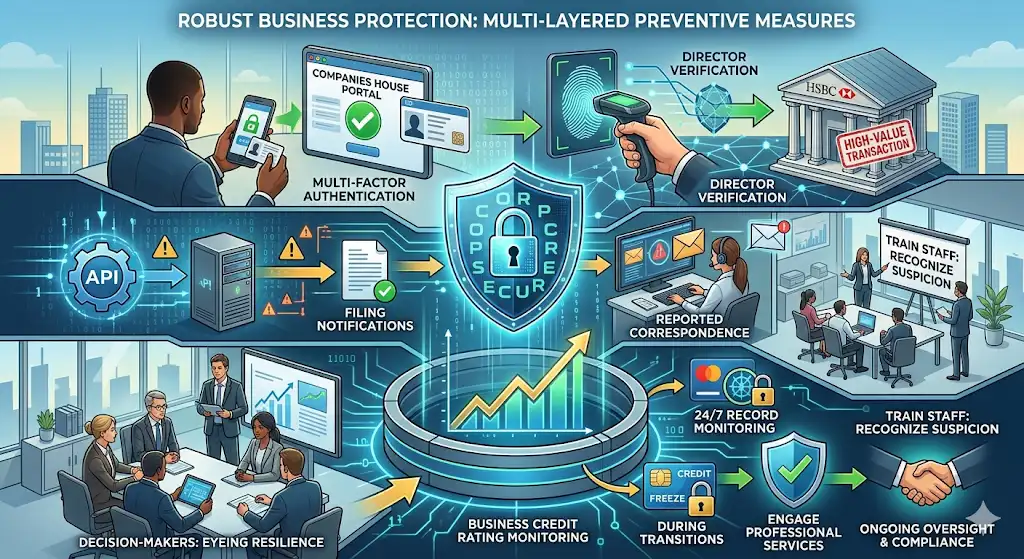
Robust internal controls start with multi-factor authentication on Companies House portals and routine director confirmations during annual returns. Train staff to report suspicious correspondence, and integrate API alerts for filing notifications. Banks like HSBC now require director scans for high-value transactions, emphasising verification layers.
Engage professional services for ongoing oversight, ensuring compliance without daily burden. For decision-makers eyeing resilience, Secure Your Business Credit Rating with 24/7 Record Monitoring details advanced tools. Layer these with credit freezes at agencies during transitions for airtight defence.
Role of Fraud Protection Services
Form My Company specialises in Fraud Protection, deploying automated scans of Companies House data to detect anomalies within hours. This service flags unauthorised attempts, providing objection templates and liaison support to restore records swiftly. Businesses using such tools report 40% fewer incidents, safeguarding credit integrity amid rising cyber threats.
Integration with accounting software amplifies benefits, syncing director data for holistic risk management. Unlike basic alerts, Form My Company‘s approach includes forensic reviews, preventing recurrence through entity-based safeguards like director identity protocols.
Long-Term Recovery Strategies
Post-incident, file urgent rectifications with evidence packs, including board minutes and ID proofs, to expedite Companies House corrections. Rebuild credit via consistent trade payments and diversified references, targeting scores above 85 within a year. Legal audits confirm no lingering liabilities, reassuring stakeholders.
Monitor progress quarterly with agency reports, adjusting strategies like debt consolidation for stability. Form My Company’s Fraud Protection empowers this recovery, offering tailored plans that restore trust and financial agility.
Unauthorised director changes erode business credit through flags, freezes, and lasting scars, but vigilance via professional Fraud Protection from Form My Company fortifies your defences. Proactive measures ensure stability, letting you focus on growth.
What is Fraud Protection from Form My Company?
Fraud Protection from Form My Company is a monitoring service that scans Companies House records for unauthorised changes, such as fraudulent director appointments or resignations. It alerts businesses instantly to potential identity theft or filing fraud, enabling swift objections to protect company integrity. This service uses automated tools to maintain accurate public records essential for compliance.
How does unauthorised director changes affect business credit?
Unauthorised director changes trigger red flags with credit agencies like Equifax and Experian, often freezing credit facilities and lowering scores by 20-50 points. Lenders view these discrepancies as instability risks, leading to denied loans or stricter terms until records are corrected. Fraud Protection from Form My Company helps detect these issues early to minimise credit damage.
How can I prevent fraud on my Companies House filings?
Prevent Companies House fraud by enabling multi-factor authentication, conducting regular confirmation statements, and subscribing to filing alerts. Services like Fraud Protection from Form My Company provide real-time notifications of suspicious activity, allowing quick RP03 objections. Routine director verifications during annual returns further safeguard against identity theft.
What should I do if I discover an unauthorised director on my records?
Immediately file an objection using form RP03 with Companies House, supported by ID proofs and board minutes to remove fraudulent entries. Contact credit agencies to flag the issue and protect your business profile during resolution. Fraud Protection from Form My Company offers templates and support for faster rectification.
How long does it take to remove unauthorised director changes?
Companies House typically processes RP03 objections within 2-5 working days if documentation is complete, though complex cases may take weeks. Credit agencies update files shortly after official corrections, but full recovery can span months. Form My Company’s Fraud Protection service accelerates this by providing pre-vetted evidence packs.