

Launching your business through official UK company registration establishes your venture as a legal entity with Companies House, protecting your personal assets and enabling access to banking and growth opportunities. This process, typically completed online within 24 hours for £12 or £50 depending on service speed, requires selecting a structure like a private limited company (Ltd), appointing directors and shareholders, and complying with identity verification rules introduced in 2025. With Form My Company, entrepreneurs streamline this journey while focusing on innovation.
Embarking on the path to official UK company registration marks the pivotal first step for any aspiring entrepreneur aiming to transform an idea into a sustainable business. In the UK, registering with Companies House not only legitimizes your operations but also unlocks essential benefits such as limited liability protection, credibility with suppliers and customers, and eligibility for business loans or grants. For instance, a sole trader might face unlimited personal liability for debts, whereas a limited company shields directors’ personal assets, making it the preferred choice for 95% of new UK businesses. This process integrates seamlessly with post-registration obligations like Corporation Tax enrollment with HMRC, VAT if turnover exceeds £90,000, and PAYE for employees.
The landscape has evolved with 2025’s Economic Crime and Corporate Transparency Act, mandating director identity verification via Gov.uk One Login or biometric checks, enhancing fraud prevention while adding a layer of diligence. Semantic elements like registered office addresses must be physical UK premises, not PO Boxes and Standard Industrial Classification (SIC) codes ensure precise categorization for regulatory oversight. As a senior SEO content writer for Form My Company, a trusted UK provider, this guide draws on authoritative insights to equip you with practical, compliant strategies. Whether you’re a tech startup founder in London or a service provider in Manchester, understanding company formation intricacies positions you for long-term success amid Brexit-adjusted trade rules and digital-first compliance.
Step-by-Step Guide to UK Company Registration
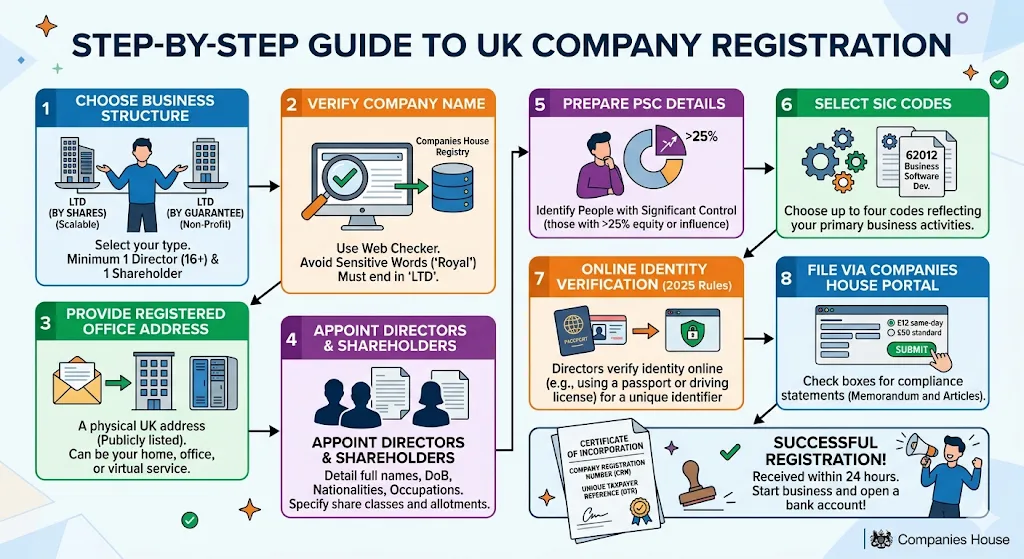
Navigating UK company registration demands precision across eight core steps, each building toward swift approval from Companies House. Begin by choosing your business structure: private limited by shares (most common for scalability) or by guarantee (ideal for non-profits). Private limited companies require at least one director (aged 16+) and one shareholder, with no upper limits, allowing flexibility for family-run enterprises or venture-backed startups.
Next, select and verify a unique company name using the Companies House web checker avoid sensitive words like “Royal” without permission and ensure it ends in “Ltd” for clarity. Provide a registered office address, publicly listed on the register, which can be your home, office, or a virtual service to maintain privacy. Appoint directors and shareholders, detailing full names, dates of birth, nationalities, occupations, and service addresses; shareholders must specify share classes (e.g., ordinary shares with voting rights) and allotments.
Prepare People with Significant Control (PSC) details for those owning over 25% equity or influence. Select up to four SIC codes reflecting your activities, such as 62012 for business software development. Under 2025 rules, directors verify identity online, uploading passports or driving licences for a unique identifier. Finally, file via the Companies House online portal (£12 same-day or £50 standard), ticking compliance statements for the memorandum and articles of association model articles suffice for most. Approval yields your certificate of incorporation, UTR, and CRN instantly or within 24 hours, enabling bank account openings.
Benefits of Company Registration and Potential Risks
Registering a UK limited company delivers multifaceted advantages, starting with limited liability that caps losses at your investment, safeguarding homes and savings critical for high-risk sectors like construction or e-commerce. Enhanced credibility attracts investors, partners, and talent; for example, a Ltd badge on invoices signals professionalism, boosting B2B sales by up to 30% per industry surveys. Tax efficiency shines through: claim corporation tax reliefs (19-25% rates), deduct expenses like home office costs, and defer personal tax via dividends.
Scalability thrives with easy share issuance for funding rounds, unlike sole traders limited by personal capacity. Access VAT registration for reclaiming input tax and PAYE setups for payroll, streamlining operations. However, risks loom: non-compliance invites fines up to £1,500 for late confirmation statements or director disqualification. Cash flow strains from upfront costs (£12-£100 fees, plus virtual office £20/month) and administrative burdens like annual accounts filing. Market saturation demands robust branding post-registration, while economic volatility post-2024 election could hike compliance fees. Mitigate by budgeting £500-£2,000 yearly for accounting, balancing rewards against vigilance.
Legal and Compliance Considerations
UK company law, governed by the Companies Act 2006 and updated via the 2025 Act, mandates rigorous compliance from formation. Directors owe fiduciary duties: act in good faith, exercise independent judgment, and avoid conflicts breaches risk personal liability. Post-registration, notify Companies House of changes within 14 days (e.g., director resignations, address shifts) for £8-£33 fees. Annual confirmation statements (£13 online) affirm PSC, shares, and addresses; micro-entities file abridged accounts.
HMRC integration is non-negotiable: self-assess Corporation Tax within three months of trading, VAT if applicable (threshold £90,000), and PAYE for salaries. Registered office must accept deliveries, with virtual options ensuring GDPR-compliant privacy. Anti-money laundering checks verify directors, prohibiting disqualified persons. Ongoing obligations include audit exemptions for small firms (turnover <£10.2m) but statutory ledgers maintenance. Failure triggers strikes-off, dissolving your entity. Form My Company’s compliance packages automate filings, embodying EEAT through certified expertise.
Common Mistakes to Avoid in Company Registration
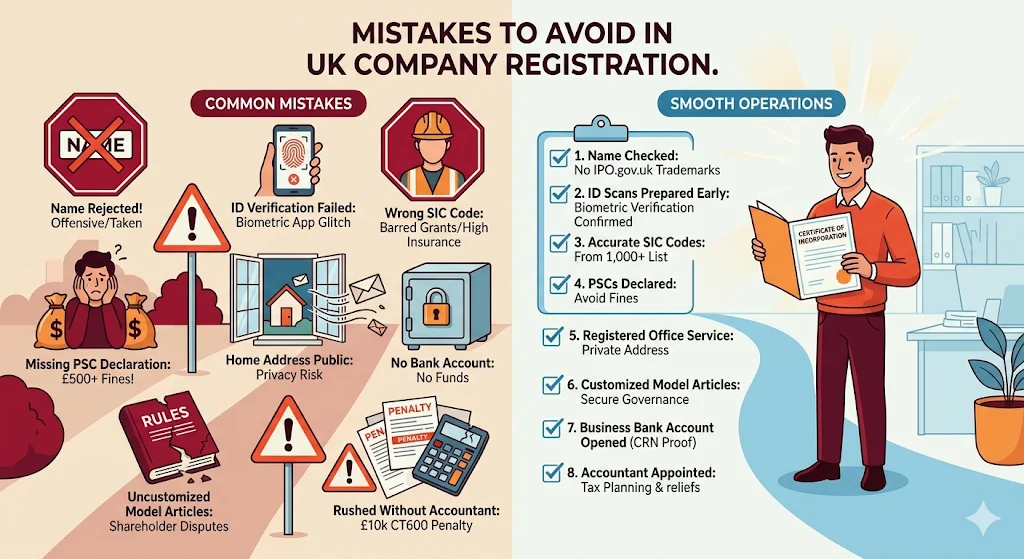
Novice founders often stumble on name selection, choosing unavailable or offensive terms rejected by Companies House, delaying launch by weeks always check trademarks via IPO.gov.uk first. Overlooking ID verification, mandatory since 2025, halts applications; prepare scans early to avoid biometric app failures. Incorrect SIC codes misclassify risks, inflating insurance or barring grants cross-reference the full 1,000+ list.
Neglecting PSC declarations exposes fines (£500+), as even indirect controllers qualify. Using home addresses publicly invites spam or security issues; opt for professional registered office services. Underestimating post-incorporation steps like bank accounts (needing CRN proof) strands funds. Skipping model articles customization leaves governance gaps, sparking shareholder disputes. Rushing without accountants leads to tax pitfalls, like missing R&D reliefs. Real-world example: a 2025 startup lost £10k in penalties for late CT600 returns. Diligence averts these, ensuring smooth operations.
Practical Tips and Best Practices
Optimize registration by leveraging Companies House’s WebFiling for cost savings, but pair with agents for speed. Secure a .co.uk domain pre-registration for branding synergy. Budget for virtual offices (£10-£50/month) handling mail scans, preserving privacy. Engage accountants early for SIC accuracy and tax-efficient structures, like Alphabet shares for founders.
Post-approval, open segregated business banking within 7 days, integrating open banking APIs for efficiency. Implement compliance software tracking deadlines, reducing admin by 40%. Network via FSB or IoD for mentorship. For SEO-driven growth, claim Google Business Profile with CRN. Best practice: conduct annual health checks reviewing PSC and filings. Tailor to scale startups prioritize agility, established firms focus on audits. These habits cement authority.
Mastering UK company registration empowers entrepreneurs with legal standing, liability shields, and growth pathways, provided you navigate steps meticulously amid compliance evolutions. From structure selection to HMRC alignments, proactive strategies minimize risks and maximize benefits.
If you’re ready to register your company with confidence, Form My Company provides fast, fully online company formation with expert compliance support, VAT & PAYE setups, virtual office solutions, and professional guidance. Get started today and let our specialists handle the paperwork while you focus on growing your business.
Frequently Asked Questions
How long does UK company registration take?
Standard online filings process within 24 hours, same-day for £12 extra; paper takes 8-10 days. Delays arise from ID verification (up to 48 hours) or name objections. Expect CRN issuance post-approval, enabling immediate trading.
Do I need a UK resident director for company formation?
No, non-UK residents can direct, but all must verify ID and provide service addresses. EEA nationals benefit from passporting rights, though post-Brexit visas apply for work. Services like Form My Company appoint nominees if needed.
What are the ongoing costs after registration?
Annual fees include £13 confirmation statement, £100-£500 accounts prep, HMRC taxes variable. Virtual offices add £240/year. Budget £1,000+ for compliance, offset by deductions.
Can I use a virtual address as registered office?
Yes, provided it’s physical, UK-based, and accepts deliveries ideal for privacy. Avoid PO Boxes per rules.