

Using a professional PSC Register service ensures legal accuracy, ongoing compliance, and expert handling, while self-filing may suffice for simple setups but carries higher risk of errors. The best choice depends on your company’s complexity, time resources, and compliance confidence.
Understanding the PSC Register and Its Legal Role
In the UK, every limited company must maintain a People with Significant Control (PSC) Register a core element of corporate transparency legislation under the Companies Act 2006. This register records individuals or legal entities who ultimately control the company, such as those holding over 25% of shares or voting rights.
The PSC Register clarifies ownership structures and meets anti-money laundering (AML) and corporate governance requirements. A completed and accurately updated register demonstrates full compliance with Companies House obligations and safeguards directors against statutory penalties.
When companies file or maintain this record, they can either self-file the information with Companies House or use a professional provider such as Form My Company that offers a dedicated PSC Register Service ensuring compliance accuracy and legal alignment.
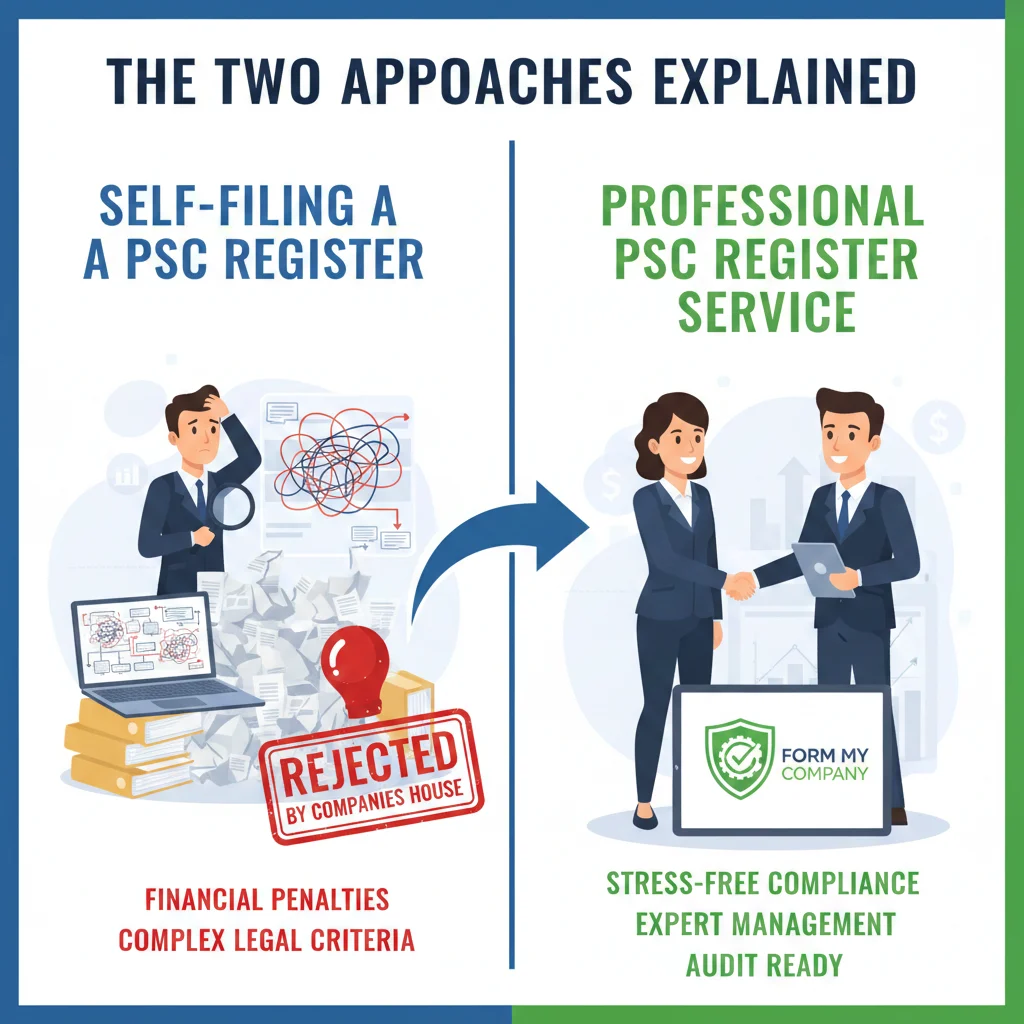
The Two Approaches Explained
Self-filing a PSC Register
Self-filing means the company’s directors or secretaries gather, verify, and submit the required PSC information themselves through Companies House or internal documentation. This approach grants business owners direct control and might seem cost-effective at first.
However, the legal criteria for declaring and maintaining PSCs are detailed and sometimes complex. Information must be verified, recorded, and updated in real-time when ownership changes occur. Missing steps such as failing to send notices to potential PSCs or misinterpreting control thresholds can lead to Companies House rejections or financial penalties.
Professional PSC Register Service
A professional PSC Register service, like the one provided by Form My Company, manages every administrative and compliance step for you. From identifying qualifying individuals to updating Companies House filings, this service ensures that all statutory obligations are continuously met.
Professionals interpret ownership structures correctly, manage timely submissions, and maintain digital copies for audit readiness. In effect, this service transforms a regulatory requirement into a managed compliance solution, freeing directors to focus on operations rather than regulations.
Compliance Responsibilities: What the Law Requires
Every UK company must keep its PSC Register up to date. The three critical obligations include:
- Identifying the individuals or legal entities with significant control.
- Verifying their details, such as name, date of birth, nationality, and nature of control.
- Submitting accurate information to Companies House and updating any changes promptly.
Failure to meet these duties constitutes a criminal offence for both the company and its officers. Even minor inaccuracies can attract fines or investigation.
That’s why companies at the middle-of-funnel (MOFU) stage, those aware of PSC requirements but still comparing solutions, often weigh PSC Register service vs self-filing carefully before deciding how to manage ongoing compliance.
Comparing Accuracy and Error Risk
Many directors assume self-filing is simpler, but the margin for error is larger than it appears. Common mistakes include inconsistent declaration formats, incomplete PSC notices, or listing incorrect entities as controllers. These errors often delay incorporation, trigger correction notices, or affect banking and shareholder verification processes.
In contrast, professional service providers use structured templates and legal verification tools that reduce the likelihood of rejection or fines. They maintain records aligned with Companies House standards and notify clients when updates are due ensuring continuous compliance without oversight.
Example:
Consider a small trading firm with multiple shareholders one individual indirectly controls 30% through a holding company. Without professional support, self-filing might incorrectly list only the holding entity, missing the ultimate beneficial owner. A managed PSC Register service would identify and document both, maintaining legal accuracy and transparency.
Cost Considerations and Long-Term Value
At first glance, self-filing a PSC Register appears cheaper since there’s no external service fee. But this calculation overlooks hidden costs: time spent learning the legal criteria, risk of non-compliance, and potential penalties. Each update or annual return requires manual entries and verification that consume administrative resources.
A PSC Register Service, while carrying a modest professional fee, removes these recurring burdens. For small and medium businesses, especially those with evolving ownership structures, the value lies in accuracy, time efficiency, and peace of mind. Over time, outsourcing ensures compliance continuity far more cost-effectively than repeated self-corrections.
Integration with Other UK Compliance Requirements
The PSC Register interacts with several other corporate obligations, including:
- Confirmation Statements submitted to Companies House annually.
- Anti-Money Laundering (AML) checks when opening business accounts or acquiring assets.
- Director and shareholder updates, especially during structural changes.
A professional PSC service provider integrates these aspects into a single compliance workflow. Form My Company, for example, manages PSC updates in line with annual filing schedules and guides businesses on broader formation requirements such as registered office addresses and changes to shareholdings.
Companies handling this internally must cross-reference their records manually each year increasing the possibility of oversight or mismatch between filings and actual control.
For readers seeking a foundational understanding of how the register functions before evaluating service options, the article How Does a PSC Register Work for UK Companies? provides a detailed overview.

Record Keeping and Audit Preparedness
Proper PSC maintenance extends beyond initial filing. UK companies must retain and make PSC details available for inspection. Law enforcement and investors often request PSC data to confirm authenticity and integrity during audits or acquisitions.
Professional providers maintain secure digital storage of PSC data and offer certified extracts for legal or investor verification. This readiness protects companies from delays during due diligence or compliance reviews.
Self-filing companies, by contrast, often rely on spreadsheets or ad hoc records. Without updates tied to filing deadlines, these records can quickly fall out of sync with Companies House data, creating compliance gaps detectable in audits.
Scalability and Future Updates
As a company grows, its shareholder and control structures evolve. New investors, holding entities, or restructuring events change PSC details. For multi-entity setups or venture-funded startups, self-filing becomes increasingly difficult to manage.
Professional PSC services include scalable frameworks that handle multiple updates per year under one compliance dashboard. Form My Company’s PSC Register Service helps clients track control changes in real time and executes the required filings swiftly ensuring ongoing alignment with statutory expectations.
This level of controlled scalability is especially critical for fast-growing companies looking to maintain investor confidence and corporate legitimacy.
When Self-Filing May Still Work
Self-filing remains a viable option for micro-entities or dormant companies with straightforward ownership typically one shareholder and director who are the same person. In such cases, the details are static, and updates are infrequent.
Even then, it’s crucial to review the register annually. Any share transfers, new company loans, or joint ventures could trigger PSC status changes, requiring updates. Directors must stay alert to these legal triggers to avoid non-compliance.
However, as soon as the ownership chain becomes layered, or control involves voting rights or partnership agreements, professional oversight becomes advisable.
Making the Right Choice for Your Business
Ultimately, the decision between PSC Register service vs self-filing depends on two factors: complexity and risk tolerance. If your company has multiple shareholders, investors, or changing structures, a professional service offers the safest, most efficient route.
If simplicity and direct control are priorities for instance, a small single-director company self-filing may suffice, provided you remain vigilant about updates and record accuracy.
For businesses ready to delegate compliance tasks to specialists and avoid regulatory risk, Form My Company’s PSC Register Service offers an efficient, fully compliant solution.
And for those ready to take action immediately, the article Update Your PSC Register with Professional Help Now outlines how to initiate a professional update process and secure ongoing compliance management.
The Value of Expert Oversight
In an evolving regulatory environment, maintaining transparent control records fosters trust with regulators, banks, and stakeholders. Expert management of your PSC Register turns a legal requirement into a strategic advantage demonstrating reliability and governance maturity.
Form My Company enables UK businesses to meet these standards with precision and professional support. Whether managing one company or an entire group, delegating your PSC compliance ensures accuracy, security, and peace of mind.
What is a PSC Register and why is it important for UK companies?
A PSC Register, or People with Significant Control Register, records individuals who ultimately control a company. It is required by UK law to ensure transparency and prevent financial misconduct. Maintaining an accurate PSC Register helps companies comply with Companies House regulations.
How does From My Company’s PSC Register service work?
From My Company’s PSC Register service manages the identification, filing, and updating of all People with Significant Control details for your business. The service ensures compliance with Companies House requirements and keeps your corporate records legally accurate.
When should a company update its PSC Register?
A PSC Register must be updated whenever there are changes to ownership, voting rights, or controlling interests. Companies are legally required to report these updates to Companies House promptly to remain compliant and avoid penalties
Can I maintain my PSC Register myself without using a professional service?
Yes, company directors can self-manage their PSC Register, but they must follow strict legal criteria and update information accurately. Many businesses use professional services like From My Company to ensure ongoing compliance and reduce administrative errors.
What happens if my PSC Register is incomplete or incorrect?
An incomplete or inaccurate PSC Register can lead to Companies House rejections, fines, or investigations. Using a professional PSC Register service from From My Company ensures the record remains complete, compliant, and legally valid at all times.