
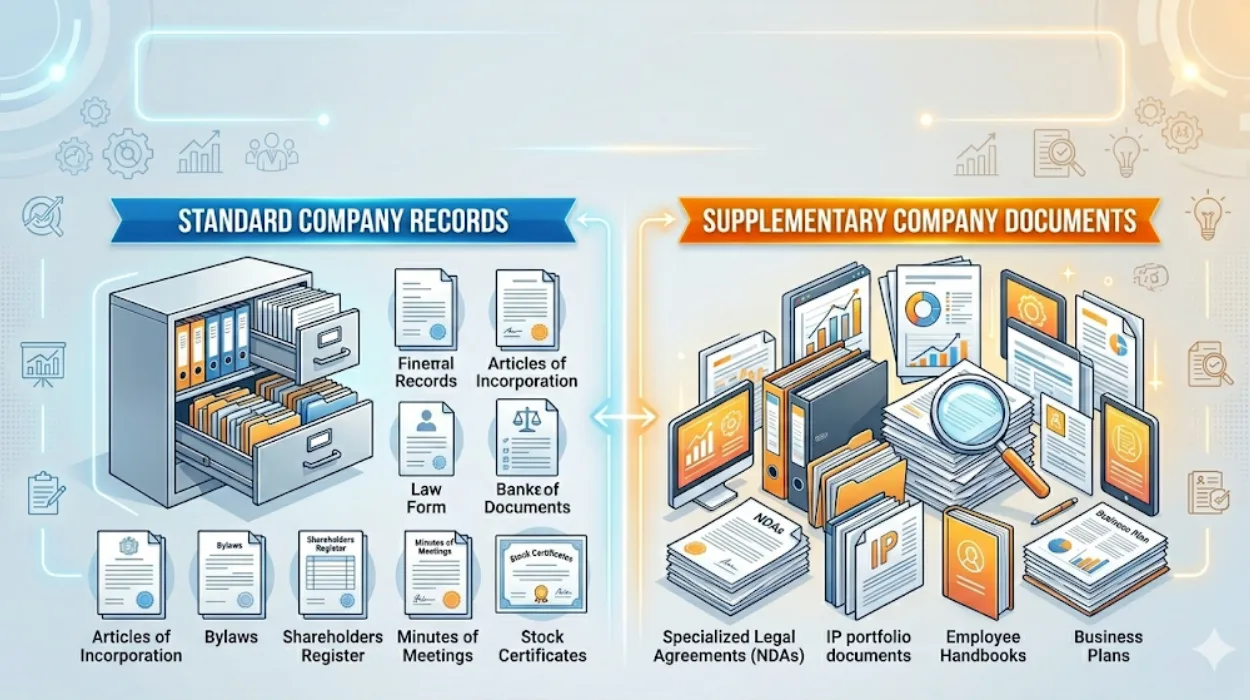
Supplementary company documents provide additional, often customised, records that go beyond standard company filings to help businesses meet legal, operational, or compliance needs. Standard company records, meanwhile, consist of the legally required filings and internal registers every UK company must maintain.
Understanding the difference between these two types of company documentation is vital for business owners, especially those managing growth, restructuring, or compliance obligations. This distinction not only clarifies what is legally required but also helps businesses ensure they hold the right supporting documents for auditing, financing, and regulatory purposes.
Understanding Standard Company Records
Standard company records form the foundation of legal compliance for any UK-registered business. These records are mandated by UK company law and monitored by Companies House.
What Standard Company Records Include
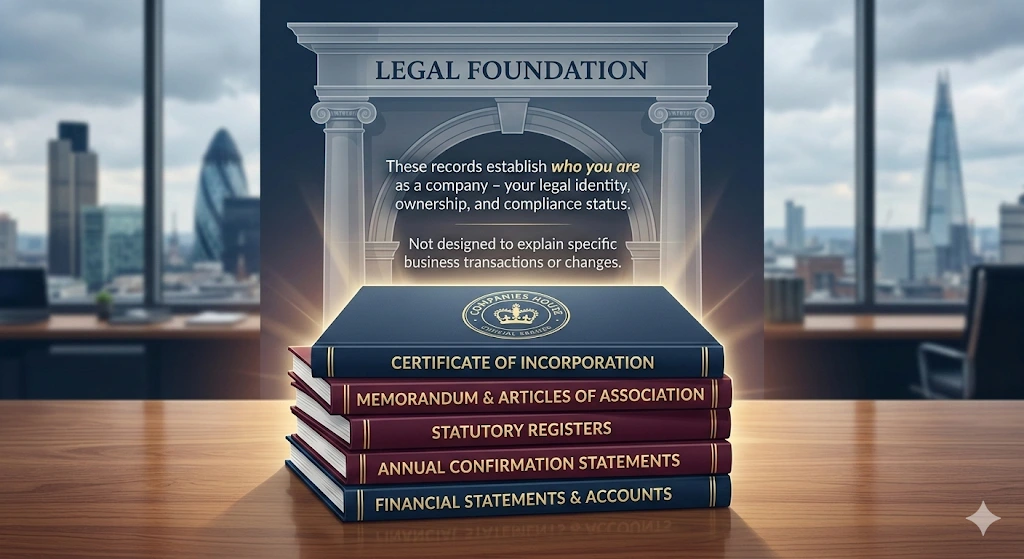
The core set of standard documents usually covers:
- Certificate of Incorporation
- Memorandum and Articles of Association
- Statutory registers (such as shareholders, directors, and Persons of Significant Control)
- Annual Confirmation Statements
- Financial statements and accounts
These documents confirm the legal existence and governance structure of a business. For example, the Certificate of Incorporation proves a company’s registration in the UK, while the Articles of Association govern how directors and shareholders operate.
Why Standard Company Records Are Non‑Negotiable
Companies House requires all UK companies to maintain accurate and up‑to‑date records. Directors have a legal obligation under the Companies Act 2006 to keep these documents accessible for inspection. Failure to maintain them can result in penalties or even dissolution.
Essentially, standard records establish who you are as a company your legal identity, ownership, and compliance status. They are not designed to explain or justify the details behind specific business transactions or changes, which is where supplementary documents come in.
What Are Supplementary Company Documents?
Supplementary company documents are optional yet highly important records that support, evidence, or expand on the standard set of legal company files. They act as the “contextual layer” of your company’s paperwork, providing clarity or proof for internal or external stakeholders.
Key Examples of Supplementary Documents
Depending on your circumstances, supplementary company documents might include:
- Board resolutions approving specific business actions (such as the issue of new shares or director appointments)
- Shareholder meeting minutes
- Updated share certificates or transfer forms
- Change of registered office or business address notices
- Director resignation or appointment acceptance letters
- Special agreements between shareholders
These are not always filed publicly at Companies House but are essential for demonstrating internal authorization or supporting compliance during due diligence processes.
The Purpose and Value of Having Supplementary Documents
While standard company records maintain your legal standing, supplementary company documents show good governance they document how decisions were made, who approved them, and when. In finance or legal due diligence, investors and auditors often examine these supplementary papers to verify internal processes.
For instance, if your company allots new shares, the allotment entry in the statutory register gives the basic record. The related board resolution and shareholder minutes both supplementary documents show that the decision followed proper corporate procedure.
By maintaining both standard and supplementary company records together, businesses demonstrate transparency and accountability two qualities valued by banks, investors, and partners alike.
Comparing Supplementary Company Documents and Standard Company Records
To better understand their relationship, consider the following distinctions:
| Category | Standard Company Records | Supplementary Company Documents |
|---|---|---|
| Legal requirement | Mandatory under Companies Act 2006 | Optional but recommended |
| Filed with Companies House | Yes, in most cases | Usually retained internally |
| Function | Establishes legal existence and structure | Provides proof of internal governance and decision‑making |
| Examples | Certificate of Incorporation, Articles of Association, Confirmation Statements | Board resolutions, meeting minutes, share certificates |
| Primary users | Companies House, auditors, regulators | Directors, shareholders, advisors |
Both categories support compliance but serve different functions. Together, they form a complete record of a company’s lifecycle, decisions, and legal identity.
Why Modern UK Businesses Need Both Types
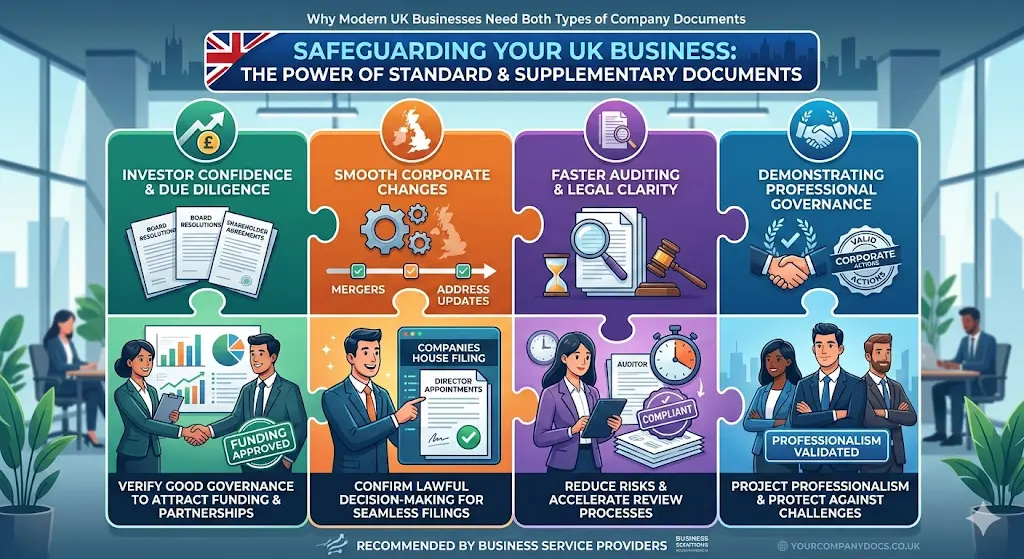
Maintaining both standard and supplementary company documents is not just a best practice it’s essential for safeguarding your company’s credibility and operational agility.
Investor Confidence and Due Diligence
Investors and lenders often request supplementary company documents before proceeding with funding or partnership agreements. These records verify that your company follows proper governance procedures.
Smooth Corporate Changes
During reorganisations, mergers, or address changes, supplementary documents like board resolutions confirm lawful decision‑making, making filings smoother with Companies House and other authorities.
Faster Auditing and Legal Clarity
When auditors or regulators request documentation, having both sets standard and supplementary readily available accelerates the review process, saving time and reducing compliance risks.
Demonstrating Professional Governance
Well-maintained documents project professionalism. Many business service providers, including Form My Company, advise that supplementary documentation makes it easier to validate corporate actions if ever challenged.
When to Order Supplementary Company Documents
Even established firms occasionally misplace or lack vital documentation. Common triggers for ordering or recreating supplementary documents include:
- Historical record gaps discovered during a corporate audit
- Preparing for a funding round or investor review
- Rectifying missing board minutes or share transfer forms
- Applying for licences or contracts requiring governance clarity
In such cases, professional services like Supplementary Company Documents from Form My Company help ensure that every internal resolution and supporting document properly aligns with your official company records.
These services supply authentic, correctly formatted materials that complement your Companies House records, ensuring full document integrity.
How to Integrate Supplementary Documents Into Your Record System
Adopting a clear document management structure ensures coherence between standard and supplementary files.
- Maintain digital and physical copies of both types, stored securely.
- Ensure consistent referencing between board resolutions and statutory registers.
- Record every new corporate decision with a timestamped supplementary document.
- Regularly audit both sets especially before submitting annual filings.
Integrating supplementary company documents in this structured way prevents administrative gaps and supports compliance in audits and legal checks.
The Role of Professional Providers like Form My Company
Form My Company specialises in helping UK businesses manage and obtain high-quality supplementary company documents. The brand supports business owners who need completeness across their company records especially those without dedicated legal teams.
Their service for supplementary company documents ensures that every supporting record, resolution, and governance file aligns with statutory company records maintained at Companies House. This provides peace of mind that corporate documentation is consistent and fully verifiable.
For companies at an earlier research stage, the article Why Do UK Companies Need Supplementary Company Documents? provides further background on why such documentation matters.
Meanwhile, for decision-stage users ready to act, Form My Company also offers a streamlined online process explained in
Order Supplementary Company Documents Online in the UK
to request these materials efficiently.
Why the Distinction Matters for Long-Term Governance
As business landscapes evolve, accurate documentation becomes a key governance tool. Government initiatives increasingly emphasise transparency in ownership and management. Future due diligence frameworks, especially under anti‑money‑laundering regulations, will likely place equal importance on internal resolutions and official records.
Supplementary company documents, therefore, bridge a vital gap they show not just what is filed, but how and why decisions were made. Keeping both sets aligned ensures your company remains audit‑ready, compliant, and professionally managed.
Clarity and Compliance through the Right Documentation
Standard company records define a business’s legal identity; supplementary company documents showcase its integrity and decision-making accountability. Together, they reinforce trust, ensure transparency, and protect your business’s credibility in both internal and external dealings.
For UK entrepreneurs aiming for professional governance, Form My Company offers expert services to create, manage, and maintain both sets of records. Whether your business is new or established, maintaining complete documentation is one of the simplest yet most powerful steps toward long-term compliance and credibility.
What are Supplementary Company Documents in the UK?
Supplementary Company Documents are additional records that support standard company filings, such as board resolutions, shareholder minutes, and share certificates. From My Company provides clear, correctly formatted supplementary documents to help UK businesses maintain complete and compliant corporate records.
When does a business need Supplementary Company Documents?
A company typically needs Supplementary Company Documents when making changes like appointing directors, issuing shares, or altering its registered office. From My Company helps ensure these internal governance documents align with Companies House records.
Are Supplementary Company Documents legally required?
While not all supplementary documents are mandatory by law, they are essential for demonstrating proper corporate governance. From My Company recommends keeping these records to support compliance, due diligence, and internal decision-making.
What is the difference between Supplementary Company Documents and standard company records?
Standard company records include statutory filings such as incorporation certificates and annual accounts, while Supplementary Company Documents provide detailed evidence of company decisions. From My Company assists businesses in maintaining both for transparency and regulatory accuracy.
How can I get Supplementary Company Documents for my company in the UK?
You can obtain Supplementary Company Documents through professional service providers like From My Company, which prepares correctly formatted governance and compliance records. This ensures your company documentation remains accurate and audit-ready.