
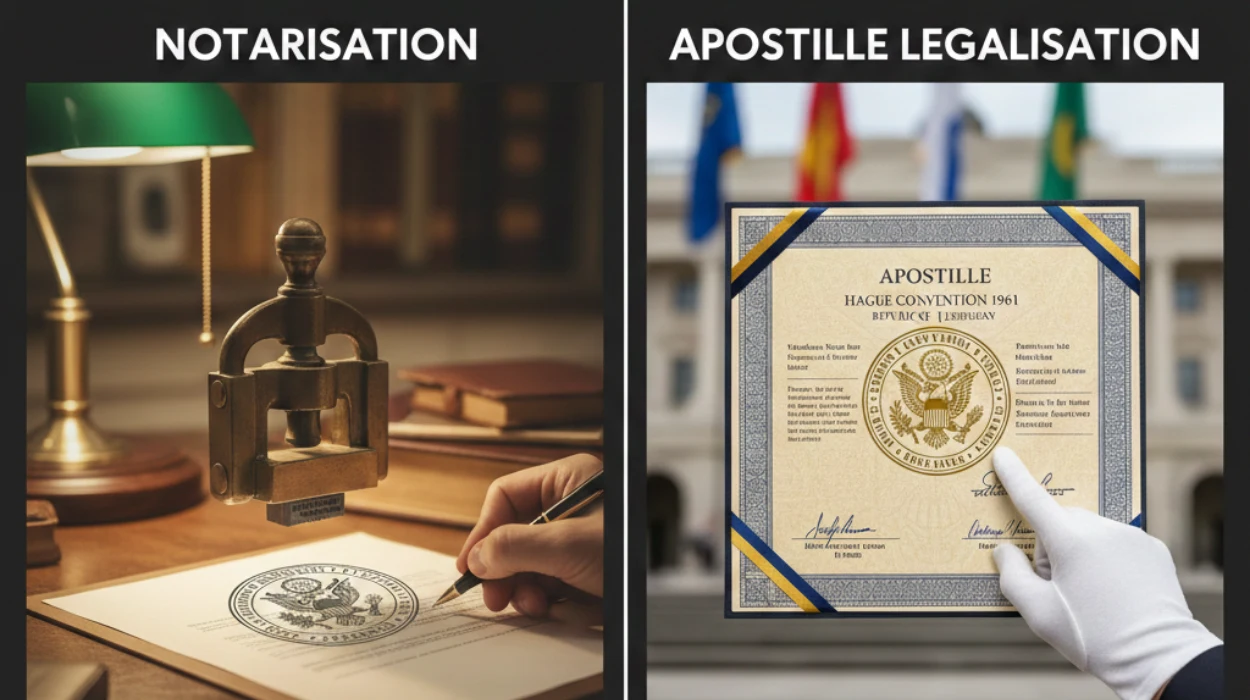
Notarisation verifies the authenticity of a document or signature by a licensed notary public. Apostille legalisation, meanwhile, certifies that notarised or official documents are valid for international use under the Hague Apostille Convention of 1961.
Both processes confirm authenticity but for different purposes. Notarisation ensures a document’s credibility within a country, while apostille legalisation allows it to be accepted in other member states. Understanding when and why you need each one can help prevent legal complications and delays, especially in business or immigration matters.
Understanding What Notarisation Means
Notarisation is the process of having a document certified by a notary public, a professional authorised by the state to confirm identity, witness signatures, and verify that a document is genuine.
A notary does not provide legal validation of the document’s contents but affirms that the signature and identity are authentic. This is especially critical in commercial agreements, property transfers, and formal declarations where impartial verification is required.

Common Purposes of Notarisation
- To confirm that the individual signing a document has done so willingly and knowingly.
- To add legal reliability to contracts, affidavits, or consent letters.
- To prevent forgery and detect identity fraud.
- To provide a traceable certification that adds trust to business and personal documentation.
For instance, if a UK entrepreneur signs an international supply agreement, notarising the signature provides confidence to foreign partners that the deal has been executed by a legitimate representative.
What Apostille Legalisation Involves
Apostille legalisation goes a step beyond notarisation. It is a government-level certification that confirms the authenticity of a UK-issued document so it can be legally recognised in another country that is a party to the Hague Apostille Convention.
The apostille confirms the authority and signature of the official who originally notarised or issued the document. In the United Kingdom, this process is handled by the Foreign, Commonwealth & Development Office (FCDO).
When an Apostille Is Required
Apostille legalisation is typically required for documents intended for use abroad, such as:
- Birth, marriage, or academic certificates being submitted to foreign authorities.
- Business formation papers or powers of attorney used in international trade.
- Legal contracts, tenders, or property transactions across borders.
This additional verification ensures that the document will be accepted abroad without further embassy legalisation saving time and potential rejection.
For example, when a UK-based company is expanding operations to France, its corporate registration or directorship documents often need an apostille to be legally recognised by French authorities.
The Core Difference: Domestic vs. International Validity
The essential difference between notarisation and apostille legalisation lies in jurisdiction and recognition:
- Notarisation validates a document within the same jurisdiction (e.g., within the UK).
- Apostille legalisation validates a document internationally under the Hague Convention framework.
In short, notarisation authenticates the signer; an apostille authenticates the notary or public official.
These layers of verification work together when handling documents across borders: a document is first notarised, then apostilled to extend its recognition abroad.
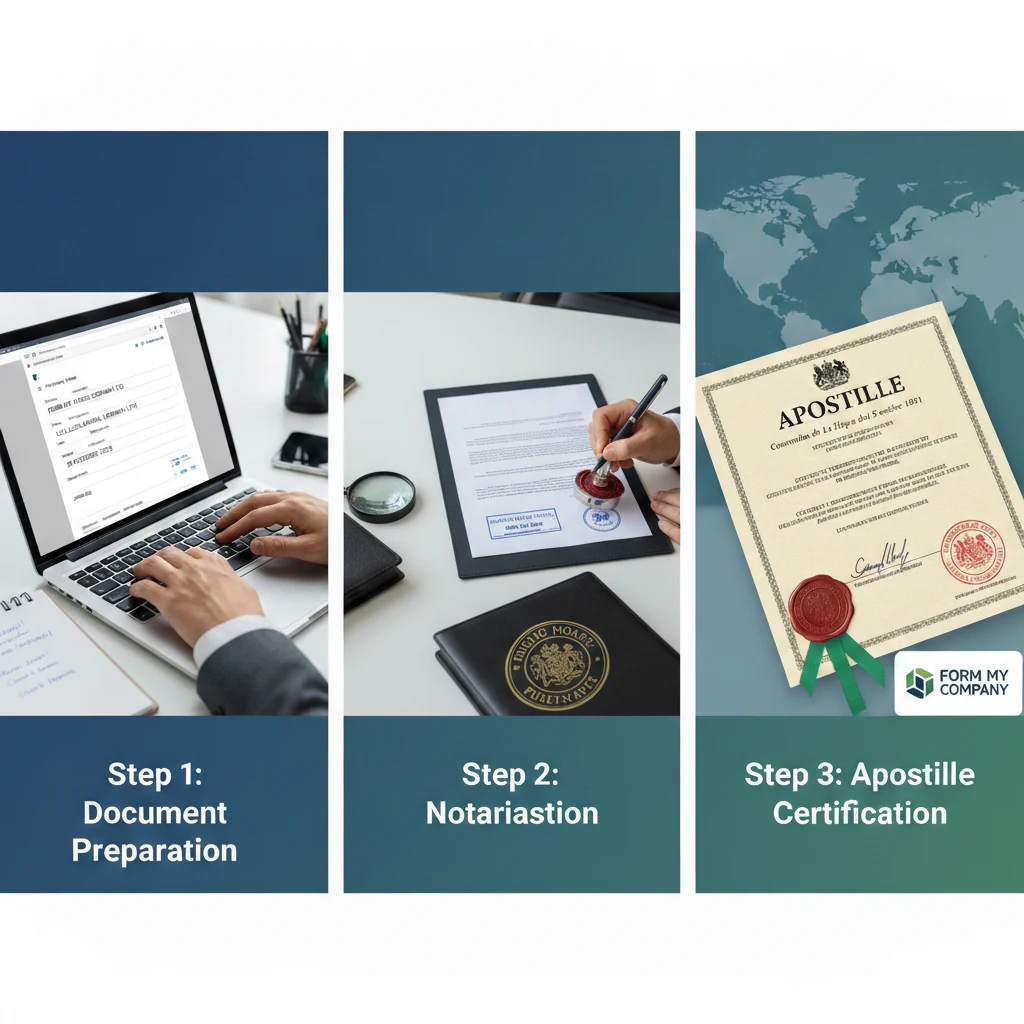
Step-by-Step Example: From Notarisation to Apostille Legalisation
Document Preparation
A document must first be correctly drafted accurate names, addresses, and dates are essential. Any inaccuracies at this stage can result in rejection later in the process.
Notarisation
A notary public checks the identity of the signatory, witnesses the signature, and attaches their seal or stamp. This establishes trust and legal traceability.
Apostille Certification
The notarised document is then sent to the FCDO for apostille certification. The apostille certifies the notary’s authority and the authenticity of their seal or signature.
This two-step verification ensures your documental chain of legality is traceable from the signer to the issuing authority, making it acceptable under international law.
For UK businesses frequently sending corporate or legal documentation abroad, using a reliable Apostilled Documents service such as the one offered by Form My Company ensures accuracy, compliance, and timely delivery of certifications for international acceptance Apostilled Documents service.
Legal Framework: The Hague Apostille Convention
The Hague Apostille Convention of 1961 simplified international document legalisation between participating countries. It eliminates the need for embassy or consular stamps when documents are exchanged between member nations.
Today, over 120 countries including France, Spain, the United States, and Australia recognise apostilles as sufficient proof of authenticity.
Documents sent to nations outside the Convention, however, still require “full legalisation,” meaning additional verification by the receiving country’s embassy or consulate.
This framework ensures predictability in international trade and personal legal affairs while reducing administrative burdens.
The Importance of Credential Integrity in Business Documentation
In global business contexts, notarisation and apostille legalisation uphold credential integrity the standard that documents must meet to be legally valid across jurisdictions. Professionals often underestimate the impact of incomplete verification until their applications or contracts are rejected abroad.
Without notarisation, a document’s authenticity may be challenged in court. Without an apostille, the same document may be rejected by foreign authorities, even if it’s perfectly valid in the UK.
For companies expanding overseas, missing or improperly legalised paperwork can delay deal closings, investor onboarding, or visa approvals. Legalisation is therefore a compliance requirement, not just a formality.
Comparison Table: Notarisation vs. Apostille Legalisation
| Aspect | Notarisation | Apostille Legalisation |
|---|---|---|
| Authority | Notary Public | Foreign, Commonwealth & Development Office (FCDO) |
| Scope | Domestic (within the UK) | International (Hague countries) |
| Purpose | Verify signature and identity | Verify notary’s authority and document origin |
| Requirement | For domestic contracts, affidavits, declarations | For documents used abroad |
| Typical Documents | Business contracts, declarations, consent forms | Company formations, degrees, birth certificates |
| Recognition | Legal within the country | Legal across apostille member states |
Understanding this distinction streamlines international processes and helps businesses operate globally with fewer administrative setbacks.
How Form My Company Simplifies the Process
Form My Company provides a professional solution for business owners and individuals needing verified international documentation. Our Apostilled Documents service covers both notarisation and apostille stages, ensuring that everything is legally compliant and accepted across jurisdictions.
We manage end-to-end verification reviewing documentation, identifying notarisation requirements, coordinating with certified notaries, and obtaining Apostille certificates from the FCDO. This streamlined service is ideal for companies registering subsidiaries, submitting tenders, or verifying corporate records abroad.
Our team ensures:
- Proper sequencing between notarisation and apostille certification.
- Compliance with the latest FCDO standards.
- Fast turnaround times to meet international submission deadlines.
Businesses looking for further insight into the roles of document verification and international compliance can read our 5 Common Reasons Foreign Authorities Reject UK Documents for more context at the middle-of-funnel (MOFU) stage.
When to Seek Professional Apostille Support
While it’s possible to complete notarisation and apostille procedures independently, professional support is highly recommended when:
- Handling time-sensitive or multilingual business documents.
- Preparing official paperwork for international trade, immigration, or incorporation.
- Ensuring every document meets the precise requirements of both the UK and the receiving country.
Professional assistance not only expedites the process but also minimises rejection risk, which is crucial for corporate compliance, visa applications, and cross-border transactions.
For users looking for end-to-end solutions that help avoid rejections and ensure correct certification, explore Form My Company’s expert document verification and apostille service a commercial, decision-focused option at the bottom of the funnel (BOFU).
Choosing the Right Process for Your Documents
Notarisation and apostille legalisation are equally important but serve different legal layers. Notarisation validates who signed a document; apostille legalisation makes that verification internationally acceptable. Together, they secure the global integrity of your paperwork.
Whether you’re expanding operations, engaging in international trade, or managing personal certifications abroad, accuracy and compliance are key. Form My Company helps you navigate these complexities confidently through a structured Apostilled Documents service that ensures your paperwork is both legally sound and globally recognised.
What are apostilled documents used for?
Apostilled documents are used to verify the authenticity of UK-issued papers for official use in countries that are members of the Hague Apostille Convention. From My Company’s Apostilled Documents service ensures your legal, business, or academic documents are accepted abroad without additional embassy legalisation.
How long does it take to get an apostille in the UK?
Obtaining an apostille in the UK typically takes 1 to 3 working days once the document is correctly notarised and submitted to the Foreign, Commonwealth & Development Office (FCDO). From My Company assists clients in preparing and processing Apostilled Documents efficiently to avoid delays in international submissions.
Do I need notarisation before getting an apostille?
In most cases, yes documents often need to be notarised before they can receive an apostille. From My Company reviews each case to confirm whether notarisation is required as part of its comprehensive Apostilled Documents service to ensure compliance with FCDO standards.
Are apostilled documents valid in every country?
Apostilled documents are recognised only in countries that are signatories to the Hague Apostille Convention of 1961. For countries outside the Convention, additional embassy legalisation is required even after obtaining an apostille; From My Company advises clients accordingly when preparing Apostilled Documents.
Which UK documents can be apostilled?
Common UK documents eligible for apostille certification include birth and marriage certificates, company records, degrees, and power of attorney forms. From My Company helps clients identify which documents qualify and manages the complete Apostilled Documents process for international acceptance.