
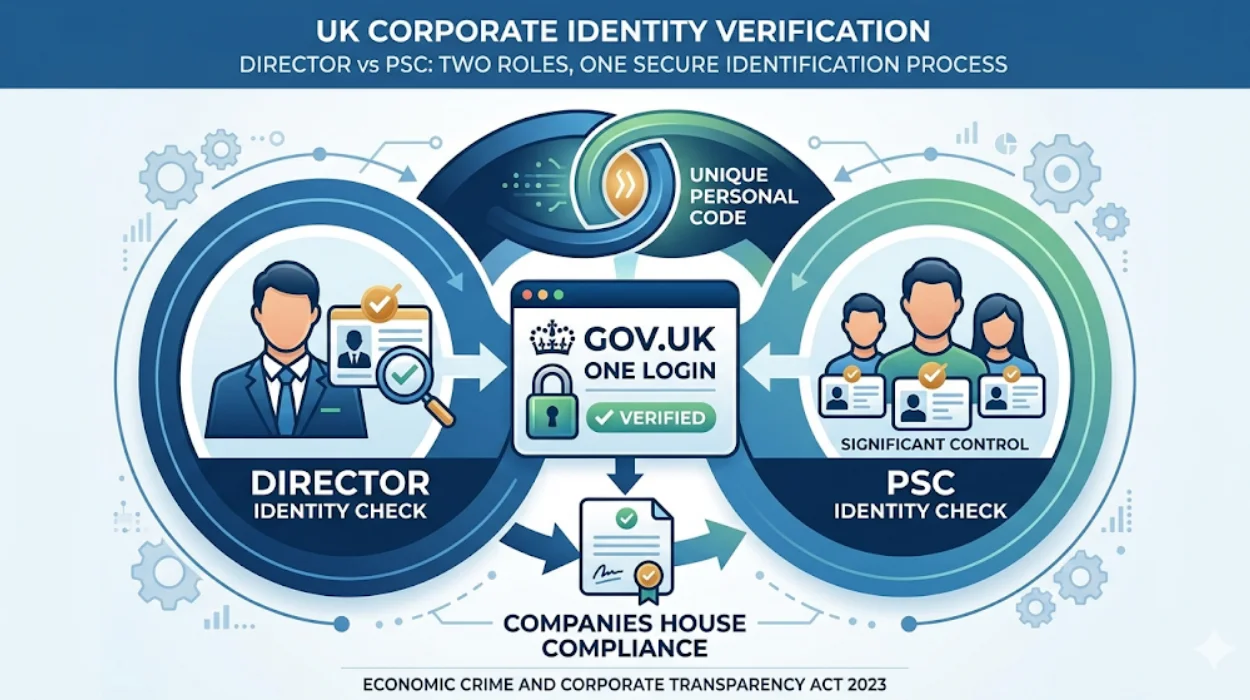
For most UK companies, director identity checks come first because Companies House mandates them during incorporation to verify the primary controller. PSC checks follow if your structure involves persons with significant control, ensuring compliance without delays.
This sequence aligns with the Economic Crime and Corporate Transparency Act (ECCTA) 2023 updates, which prioritise director verification to combat fraud. As businesses navigate these rules, understanding the order prevents rejection of filings and fines up to £30,000. In this article, we’ll break down the differences, legal triggers, and practical steps, helping you prioritise effectively for seamless setup with services like Form My Company’s Identity Verification Service: Director or PSC.
Understanding UK Director Identity Requirements
Directors hold executive responsibility in a UK limited company, making their identity verification a foundational step. Under Companies House guidelines, every private limited company must appoint at least one director aged 16 or over, and their details including full name, date of birth, nationality, occupation, and a UK service address require corroboration through ID checks.
These checks confirm the director’s real-world identity against official documents like passports or driving licences. The process scans for mismatches that could signal fraud, a rising concern with corporate criminality reports up 20% in 2025 per UK government data. For instance, imagine forming a tech startup where the sole director submits incorporation forms without verified ID; Companies House rejects it outright, delaying operations by weeks.
Why prioritise this? Directors sign legal documents and represent the company, exposing it to liability if unverified. ECCTA enforces biometric-level scrutiny, often via digital platforms that cross-reference electoral rolls and credit files. Form My Company streamlines this with their Identity Verification Service: Director or PSC, processing scans in under 24 hours to meet filing deadlines.
- Key documents for director checks: Valid passport, UK photocard driving licence, or biometric residence permit.
- Common pitfalls: Expired IDs or poor-quality scans, which trigger manual reviews.
Beyond basics, directors face ongoing duties like annual confirmations, where ID re-verification may apply if details change. This front-loaded approach ensures your company launches compliantly from day one.
Decoding PSC Identity Verification in the UK
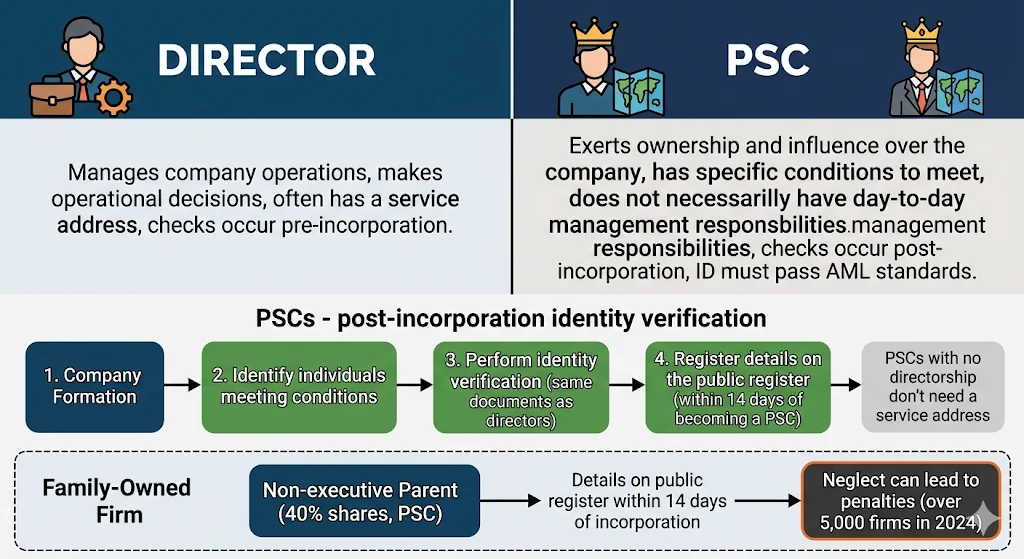
A Person with Significant Control (PSC) differs from a director by focusing on ownership or influence rather than day-to-day management. Companies House defines a PSC as anyone meeting one of five conditions: owning more than 25% shares, voting rights, or significant influence, or holding the right to appoint/remove directors.
PSC checks verify these individuals’ identities similarly to directors, using the same document suite, but they activate post-incorporation if applicable. For example, in a family-owned firm where a non-executive parent holds 40% shares, that parent qualifies as a PSC, requiring their details on the public register within 14 days of incorporation.
Unlike directors, PSCs don’t need a service address if not directors themselves, but their ID must still pass anti-money laundering (AML) standards. Neglecting this exposes companies to enforcement, as seen in 2024 cases where over 5,000 firms faced penalties for incomplete PSC registers. The verification process integrates with the PSC confirmation statement, filed annually.
This secondary status means PSC ID often follows director checks, especially in simple structures with director-owners doubling as PSCs. However, complex setups like trusts or nominees demand early PSC mapping to avoid retroactive filings.
Director vs PSC: Key Differences and Compliance Triggers
Distinguishing director from PSC checks hinges on roles and thresholds. Directors manage operations and bear fiduciary duties under the Companies Act 2006, triggering ID at incorporation via form IN01. PSCs reflect control, verified through ownership disclosures on form PSC01.
| Aspect | Director Checks | PSC Checks |
|---|---|---|
| Timing | During incorporation | Post-incorporation if >25% control |
| Documents | Passport/driving licence + proof of address | Same, plus ownership evidence |
| Public Register | Yes, with service address | Yes, anonymised if protected |
| Penalties for Non-Compliance | Rejection of formation docs | Fines up to £5,000 per omitted PSC |
Consider a scenario: A consultant sets up a sole-director company owning 100% shares. They perform director ID first, then log themselves as PSC seamlessly. In contrast, a partnership with silent investors requires director verification upfront, followed by PSC scans for those over 25% stakes.
Companies House data shows 15% of 2025 incorporations flagged for ID issues, mostly director-related. Semantic overlaps exist many PSCs are directors but prioritising director checks covers 80% of cases initially.
For deeper context on emerging rules, explore our informational guide on whether new UK company laws require director ID verification. For more information also explore, New UK Company Law: Do Directors Really Need ID Verification?
When to Prioritise Director Checks Over PSC
Start with director identity checks if forming a new company, as they’re non-negotiable for approval. This applies universally, even for single-person setups where the director is also PSC. Delaying risks form rejections, stalling bank accounts and trading.
Triggers include:
- New incorporations.
- Director changes mid-year.
- ECCTA-mandated reconfirmations.
Practical insight: A Cambridge-based retailer in 2025 rushed PSC details first, only for Companies House to bounce the filing due to unverified directors. Switching order resolved it in days. Tools like automated ID platforms flag discrepancies early, integrating with formation services.
In multi-director firms, verify all at once to synchronise filings. Address mismatches proactively e.g., name variations on IDs using supporting letters from HMRC.
Scenarios Requiring PSC Checks First (Rare Cases)
PSC prioritisation is uncommon but arises in pre-existing structures or acquisitions. For dormant companies reactivating with new controllers, PSC registers update before director shifts if ownership changes precede management.
Case-study style: An investor acquires 30% of a UK firm. PSC verification precedes any director appointment to reflect the shift accurately. Still, baseline director IDs must exist.
Threshold calculations matter: Multiple PSCs (e.g., two at 26% each) require joint verification, but directors remain primary. Use Companies House’s PSC finder tool for mapping.
Step-by-Step Process for Both Verifications
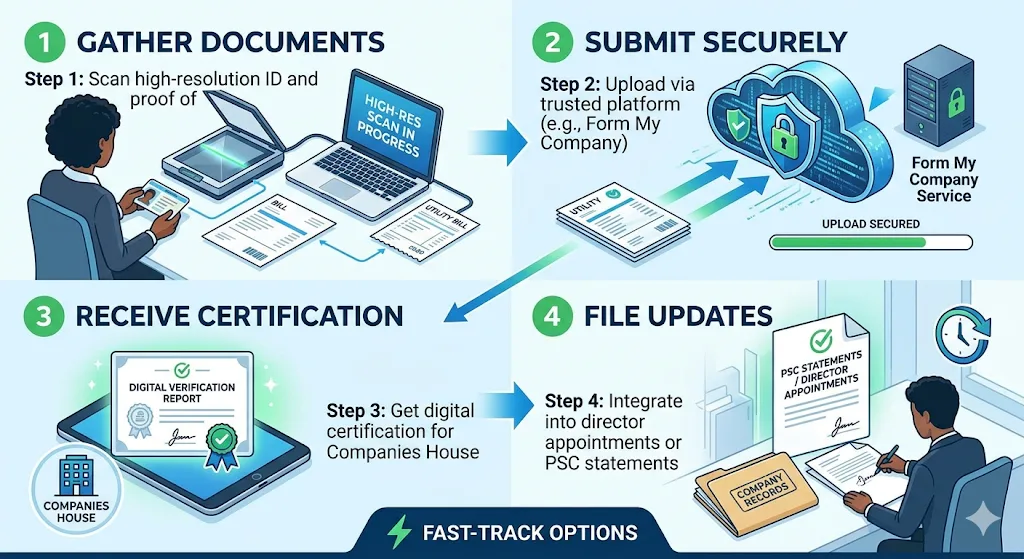
- Gather documents: Scan high-res ID and proofs.
- Submit via trusted provider: Platforms like Form My Company’s service handle uploads securely.
- Receive certification: Digital reports for Companies House.
- File updates: Integrate into PSC statements or director appointments.
This narrative flow ensures compliance without overwhelm. For urgent needs, check our fast-track options for director verification in minutes.
Streamlining with Professional Identity Services
Professional services bridge gaps in DIY verification, offering encrypted processing compliant with UK GDPR. Form My Company excels here, with their Identity Verification Service: Director or PSC tailored for UK firms handling director first, then PSC, with 99% approval rates.
Benefits include real-time status tracking and expert reviews for edge cases, like overseas directors using non-UK IDs. Costs average £20-50 per check, far below penalties. For more information also explore, Fast Identity Verification for UK Directors: Get Verified in Minutes. Mastering UK director vs PSC identity checks starts with directors for most, scaling to PSCs as control emerges. This order safeguards against ECCTA pitfalls, enabling focus on growth.
Form My Company delivers professional solutions through their Identity Verification Service: Director or PSC, ensuring your filings succeed. Contact them at their dedicated service page for seamless director and PSC verification to get started today.
What is the difference between director and PSC identity checks in the UK?
Director identity checks verify the person managing the company during incorporation, requiring ID like passports for Companies House approval. PSC checks confirm persons with over 25% control or influence, often filed post-incorporation. Form My Company’s Identity Verification Service: Director or PSC handles both to ensure compliance with ECCTA rules.
Do UK company directors need ID verification?
Yes, all UK directors must provide verified ID during company formation and updates, using documents like driving licences or passports. This prevents fraud and meets Companies House requirements under the Economic Crime and Corporate Transparency Act. Services like Form My Company’s Identity Verification Service: Director or PSC process these quickly for seamless filings.
When do I need to verify PSC identity for my UK company?
Verify PSC identity if anyone holds more than 25% shares, voting rights, or significant influence, within 14 days of incorporation or changes. It’s secondary to director checks but mandatory for the public PSC register. Form My Company’s Identity Verification Service: Director or PSC identifies and verifies PSCs accurately to avoid fines.
How long does director ID verification take with Companies House?
Director ID verification typically takes 24-48 hours via digital services, with instant approvals for clear scans. Delays occur with mismatches, but automated checks speed up incorporation. Form My Company’s Identity Verification Service: Director or PSC delivers certified results in under a day for most cases.
What documents are required for UK PSC verification?
PSC verification needs the same ID as directors passport, UK driving licence, or biometric permit plus proof of control like share certificates. Submit high-quality scans to Companies House via approved providers. Form My Company’s Identity Verification Service: Director or PSC guides document selection for compliance.