

Yes, updating your PSC Register with professional help ensures compliance within the 14+14 day legal timeline, eliminates errors, and maintains ongoing accuracy.
Services like Form My Company‘s PSC Register handle identification, filing, and verification for you, reducing director liability and regulatory risk.
What Triggers a PSC Register Update?
UK companies must update their People with Significant Control (PSC) Register whenever ownership, shares, voting rights, or control structures change. The Companies Act 2006 mandates recording these shifts within 14 days of awareness, followed by notification to Companies House within another 14 days known as the “14+14 rule.” This applies to events like new shareholders acquiring over 25% interest, director resignations affecting control, or changes in trust arrangements influencing beneficial ownership.
Failure to act promptly exposes directors to fines or criminal penalties, as the register forms a cornerstone of corporate transparency. Professional assistance identifies these triggers early, ensuring updates align with broader filings like confirmation statements. For businesses with complex structures, such as holding companies or multiple investors, timely updates prevent disruptions during audits or funding rounds.
Legal Timelines and Compliance Deadlines
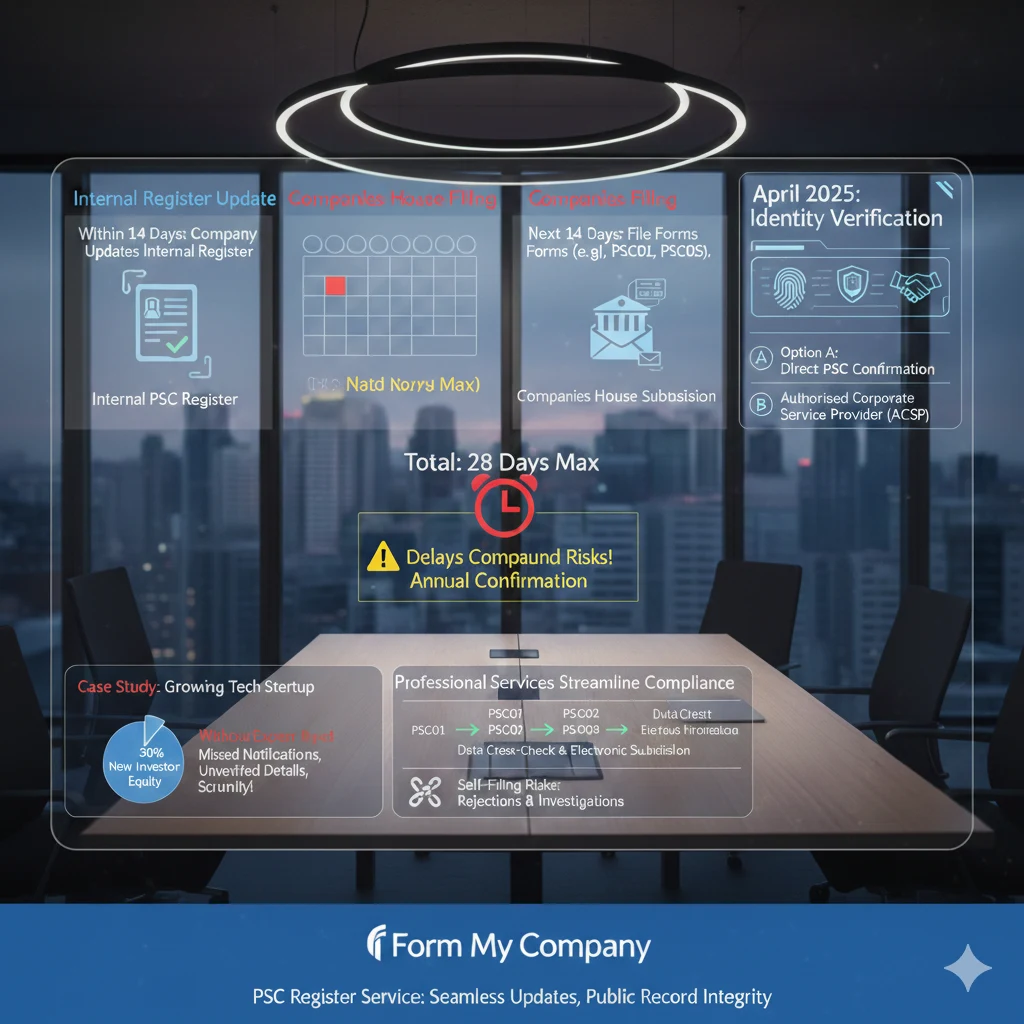
The PSC Register requires immediate action upon any relevant change. Companies first update their internal register within 14 days, then file forms like PSC01 (new PSC) or PSC05 (cessation) with Companies House in the next 14 days. This dual deadline totals 28 days maximum, but delays compound risks, especially with annual confirmation statements verifying PSC accuracy.
From April 2025, identity verification adds complexity PSCs must confirm details directly or via an Authorised Corporate Service Provider (ACSP). Professional services streamline this by managing forms PSC01 through PSC09, cross-checking data, and submitting electronically. Directors relying on self-filing often miss these steps, leading to rejections or investigations.
Consider a growing tech startup: a new investor takes 30% equity, shifting PSC status. Without expert input, the company might overlook notifying the previous controller or verifying the investor’s details, inviting scrutiny. Form My Company’s PSC Register service processes these updates seamlessly, maintaining public record integrity.
Identifying Who Qualifies as a PSC
A PSC holds more than 25% shares or voting rights, significant influence, or the right to appoint/remove directors. This includes individuals behind trusts or entities — “beneficial owners” — not just registered shareholders. Legal entities can qualify as Relevant Legal Entities (RLEs) if they meet similar thresholds and keep their own PSC records.
Professionals dissect ownership chains to confirm status accurately. For example, if Person A controls 40% through a partnership, they qualify despite no direct shares. Self-managed updates risk under- or over-reporting, affecting AML checks or investor due diligence. Expert verification ensures all details name, service address, control nature, and dates match Companies House standards.
Step-by-Step Professional Update Process
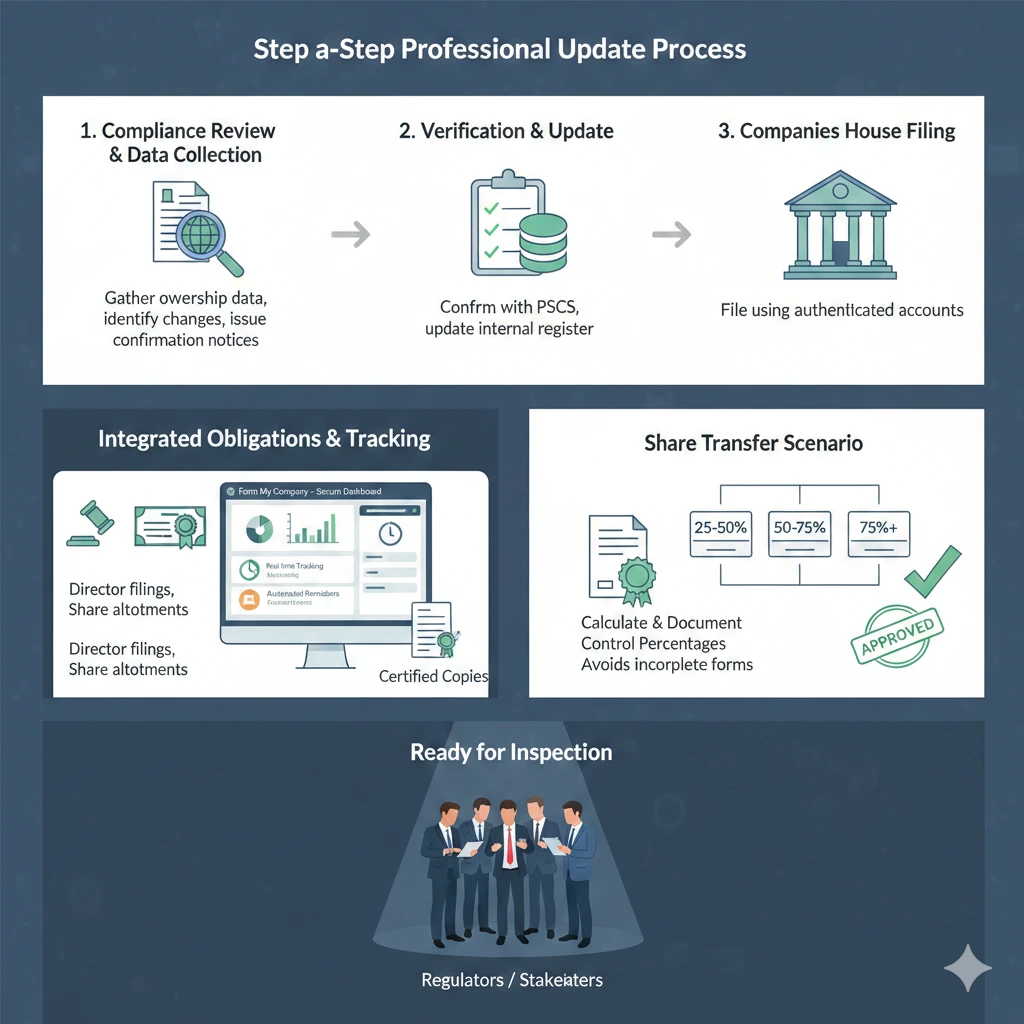
Engaging a PSC Register service begins with a compliance review. The provider collects current ownership data, identifies changes, and issues notices to potential PSCs for confirmation. Once verified, they update the internal register and file with Companies House using authenticated accounts.
This process integrates with other obligations, like director filings or share allotments. Form My Company’s PSC Register service, for instance, uses secure dashboards for real-time tracking and automated reminders. Clients receive certified copies for records, ready for inspections by regulators or stakeholders.
In a scenario involving share transfers, professionals calculate exact control percentages (25-50%, 50-75%, or 75%+) and document nature of control precisely. This precision avoids common pitfalls like incomplete forms, ensuring approval without queries.
Risks of Delayed or Incorrect Updates
Non-compliance carries severe consequences. Companies House can issue fines, strike off entities, or refer cases for prosecution directors face personal liability up to unlimited fines or imprisonment. Incorrect PSC data also hampers banking, loans, or mergers, as third parties rely on public records for verification.
Public PSC details, excluding protected residential addresses, aid transparency against money laundering. Errors erode trust, delaying transactions. Professional help mitigates this by double-checking against statutory criteria and retaining audit trails.
Benefits of Delegating to Experts
Professional PSC Register updates save time and reduce administrative burden. Services handle verification, filing, and storage, freeing directors for core operations. They provide scalability for groups with multiple entities, ensuring uniform compliance.
Costs outweigh penalties: a single fine exceeds service fees manifold. Ongoing support includes annual reviews tied to confirmation statements. For detailed mechanics of PSC registers, explore How Does a PSC Register Work for UK Companies?, which breaks down foundational requirements.
Common Challenges in PSC Updates
Complex structures pose hurdles layered ownership through trusts or overseas entities requires tracing ultimate control. Date-specific details, like entry dates or control nature, demand precision. Self-filing directors often struggle with forms PSC04 (changes) or PSC07 (RLEs), leading to rejections.
Professionals use specialised software for accuracy. They manage 2025+ identity rules, where PSCs verify via Companies House or ACSPs within 14 days of appointment. This forward-compliance prepares businesses for economic substance reporting.
Imagine a family business restructuring: parents transfer shares to children, altering PSCs. Experts notify all parties, update percentages, and file promptly, avoiding family disputes or regulatory flags.
Integration with Confirmation Statements
PSC data must align with annual CS01 filings, confirming public records’ accuracy. Professionals synchronise updates, preventing discrepancies that trigger audits. They advise on protection statements if no PSCs exist, maintaining compliance.
This holistic approach covers related registers like members or directors. PSC Register Service vs Self-Filing: Which Is Better? weighs options for decision-makers evaluating long-term strategies.
Preparing Documents for Professional Help
Gather shareholder agreements, cap tables, and recent filings. Note changes like new investments or exits. Services like Form My Company’s PSC Register compliance solution request minimal input, then handle verification and submission.
Digital submission speeds processing, with status tracking. Retain copies for six years minimum, as required.
Future-Proofing Your Compliance
Economic Substance Regulations and AML directives evolve, demanding robust PSC management. Professionals monitor changes, like central PSC registers from November 2025, where Companies House holds primary records. Early adoption via experts positions companies advantageously.
Why Choose Form My Company Now
Form My Company delivers precise PSC Register updates, leveraging expertise in UK corporate law. Their service ensures filings meet deadlines, with secure handling of sensitive data. Businesses gain confidence, focusing on growth while compliance runs smoothly.
How do I update my PSC Register with From My Company?
Updating your PSC Register with From My Company involves submitting current ownership details and changes via their secure platform. They handle verification, form filing with Companies House, and internal record updates to ensure full compliance.
What are the penalties for not updating a PSC Register on time?
Failing to update a PSC Register within the 14+14 day legal timeline can result in fines, director disqualification, or criminal prosecution by Companies House. Accurate and timely updates via services like From My Company’s PSC Register prevent these risks.
Who needs to be listed on a company’s PSC Register?
Individuals or entities with over 25% shares, voting rights, or significant influence must be listed on the PSC Register. From My Company’s PSC Register service verifies these details to meet UK transparency requirements.
Can From My Company help with PSC Register changes for multiple companies?
Yes, From My Company’s PSC Register service manages updates across multiple entities, including complex structures like holding companies. They ensure consistent compliance and integration with confirmation statements.
How long does it take to update a PSC Register professionally?
Professional PSC Register updates through From My Company typically complete within days, including verification and Companies House filing. This meets statutory deadlines while avoiding self-filing delays or rejections.