

UK company directors must promote company success, exercise independent judgment, and ensure reasonable care, skill, and diligence. Directors face personal liability for breaches under the Companies Act 2006.
These duties apply from appointment. The Companies Act 2006 codifies seven key duties in sections 170-177.
What Are the Seven Statutory Duties of UK Company Directors?
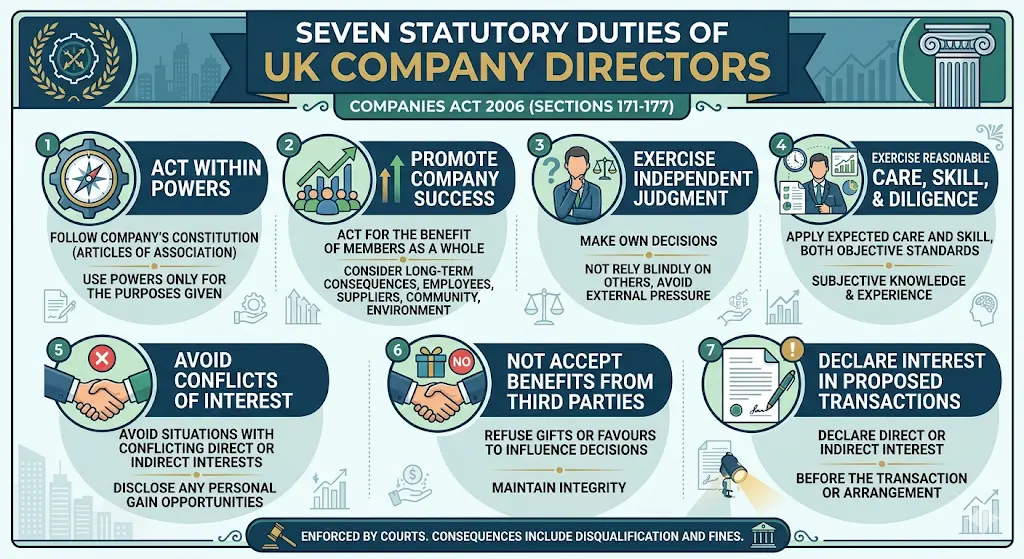
The seven duties require directors to act within powers, promote success, exercise judgment, avoid conflicts, declare interests, use powers properly, and maintain care and skill.
Section 170 mandates directors follow these duties. Courts enforce them strictly.
Duty one limits actions to company powers. Directors check articles of association first.
Duty two demands long-term success promotion. Directors consider stakeholders like employees and suppliers.
Duty three requires independent judgment. Directors base decisions on evidence, not external pressure.
Duty four bans conflicted interests. Directors disclose any personal gain opportunities.
Duty five obligates proper power use. Directors advance company interests only.
Duty six demands care, skill, and diligence. Directors apply objective and subjective standards.
Breaches trigger disqualification or fines.
How Do Directors Promote Company Success Under UK Regulations?
Directors promote success by considering long-term consequences, stakeholder relationships, business reputation, and company impacts during decisions.
Section 172 details this duty. Directors weigh six factors explicitly.
First, assess long-term consequences. A 2024 ICAEW report shows 72% of director disputes involve short-termism failures.
Second, maintain business relationships. Suppliers and customers sustain operations.
Third, protect company reputation. Negative publicity erodes value; 85% of FTSE 250 firms prioritize this per PwC surveys.
Fourth, ensure compliance with laws. Directors verify tax filings and health safety rules.
Fifth, minimize creditor harm in distress. Insolvency rules activate here.
Sixth, prevent environmental damage. Regulations demand impact assessments.
Directors document deliberations. Boards record minutes with evidence.
What Independent Judgment Must Directors Exercise?
Directors exercise independent judgment by making decisions based on their knowledge and experience, free from undue influence or delegation abuse.
Section 173 enforces autonomy. Directors own choices.
They evaluate options objectively. Evidence guides rational processes.
Directors avoid blind delegation. Appointing agents requires oversight.
Conflicts compromise judgment. Disclosure prevents bias.
A 2023 High Court case fined a director £150,000 for yielding to shareholders.
Boards foster debate. Dissent strengthens outcomes.
Directors train regularly. IoD courses build decision skills.
How Do Directors Avoid Conflicts of Interest in UK Law?
Directors avoid conflicts by not exploiting company property, opportunities, or information for personal gain and by disclosing all interests promptly.
Section 175 prohibits self-dealing. Directors prioritize company first.
They identify potential conflicts early. Board approval resolves some.
Authorization needs independent votes. Quorum excludes interested parties.
Transactions require shareholder ratification if conflicted.
Directors resign if conflicts persist. 41% of disqualifications stem from this, per Insolvency Service data.
Companies maintain conflict registers. Annual reviews ensure compliance.
Seek legal advice routinely. Solicitors clarify gray areas.
What Disclosure Rules Apply to Directors’ Interests?
Directors declare interests in proposed transactions or arrangements to the board before decisions occur.
Section 177 mandates immediate notice. Verbal or written forms suffice.
Declarations specify nature and extent. Vague notices fail.
Boards minute disclosures. Records prove compliance.
Ongoing interests demand updates. Changes trigger new notices.
Failure invites remedies. Shareholders rescind deals.
Companies use standing agendas. Directors review at meetings.
Training reinforces protocols. New directors learn on day one.
How Must Directors Use Company Powers Correctly?
Directors use powers only for company purposes, avoiding personal benefits or improper diversions.
Section 171 binds directors to constitutional limits. Powers serve objectives.
They reject unrelated uses. Courts void abusive actions.
Distributions follow strict tests. Solvency statements validate dividends.
Share issuances comply with pre-emption rights.
Proxy fights test power use. Directors defend legitimate interests.
Audits verify adherence. External reviews flag deviations.
What Care, Skill, and Diligence Standards Apply to Directors?
Directors apply the care, skill, and diligence of a reasonably diligent person with general knowledge plus their specific expertise.
Section 174 sets dual tests. Objective baseline meets subjective skills.
Qualified directors face higher bars. Accountants audit rigorously.
They delegate with supervision. Committees report back.
Due diligence precedes major deals. 2025 FRC guidance demands data rooms.
Insurers scrutinize claims. Policies exclude negligence.
Training sustains competence. 92% of directors complete 20+ hours yearly, per Deloitte.
What Happens If Directors Breach These Duties?
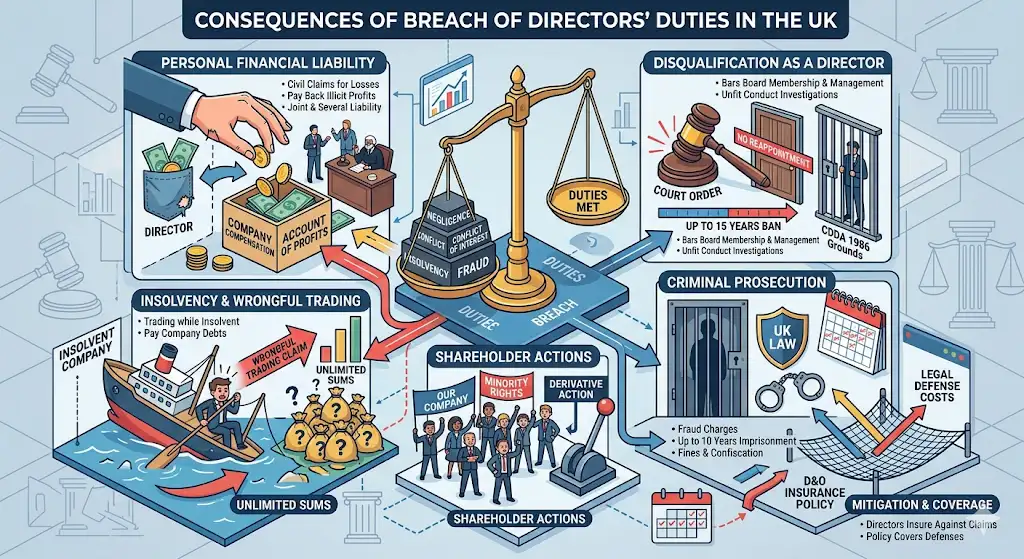
Breaches lead to personal liability for losses, disqualification up to 15 years, fines, or criminal prosecution under UK law.
Courts award compensation. Derivative actions recover funds.
Disqualification bars reappointment. Company Directors Disqualification Act 1986 lists grounds.
Insolvency triggers probes. Wrongful trading fines reach unlimited sums.
Criminal sanctions apply for fraud. Up to 10 years imprisonment possible.
Shareholders sue directly. Minority protections exist.
Directors insure against claims. D&O policies cover defenses.
How Do Director Appointments and Resignations Tie to These Duties?
Appointments activate duties immediately; resignations require formal notice and handover to avoid liability gaps.
Companies House registers appointments within 14 days. Form AP01 confirms.
Directors verify identity pre-appointment. Regulations demand proof.
Resignations use Form TM01. Duties persist until effective.
Handovers include records transfer. Successors inherit compliance burdens.
Breaches during transitions expose liability. Proper processes protect.
For seamless handling, explore the Director Appointment & Resignation Bundle. It streamlines registration and exit.
Read more on efficiency in How Professional Identity Verification Services Save Time for Busy UK Company Directors.
Ready to comply? Book Our Secure Online Identity Verification Service for Directors and PSCs Today.
From My Company provides compliant tools. Directors register, verify, and exit via verified processes. UK frameworks guide every step.
Frequently Asked Questions
What is included in the Director Appointment & Resignation Bundle from From My Company?
The Director Appointment & Resignation Bundle handles Companies House filings for Form AP01 appointments and Form TM01 resignations. It includes identity verification, document preparation, and registration within 14 days. UK regulations ensure seamless compliance for directors and PSCs.
How long does director appointment take with From My Company’s bundle?
Director appointments process in 24-48 hours via From My Company’s Director Appointment & Resignation Bundle, with Companies House confirmation in up to 14 days. Instant digital submission speeds verification and registration. This meets statutory deadlines under the Companies Act 2006.
Can From My Company help with director resignation procedures?
Yes, the Director Appointment & Resignation Bundle from From My Company files Form TM01 for resignations, including handover notices and record updates. Duties end upon effective date, with liability protection via proper documentation. It aligns with UK director compliance rules.
What documents are needed for the Director Appointment & Resignation Bundle?
Required documents include proof of ID, proof of address, and company details for From My Company’s bundle. Digital uploads enable quick validation using passport or driving licence checks. Semantic variations like PSC verification integrate for full compliance.
Is identity verification part of From My Company’s director services bundle?
From My Company’s Director Appointment & Resignation Bundle incorporates secure identity verification for directors. It uses government-approved methods like biometric scans and address validation. This prevents fraud and satisfies Companies House requirements.