

A company limited by guarantee is a unique non-profit business structure in the UK where members provide a guarantee to contribute a nominal amount—typically £1—if the company becomes insolvent, rather than purchasing shares. Unlike limited companies with shareholders, it has no share capital, making it ideal for charities, clubs, associations, and community groups pursuing public benefit objectives. This structure ensures limited liability for members while aligning with missions focused on social good rather than profit distribution.
In the diverse landscape of UK business structures, a company limited by guarantee stands out as a cornerstone for non-profit organisations seeking formal incorporation without the complexities of share ownership. Registered with Companies House, this entity type is governed by the Companies Act 2006 and offers robust legal separation between members and the company’s debts, providing peace of mind for directors and guarantors. Entrepreneurs, trustees, or community leaders often choose it when forming entities like charities, professional bodies, or sports clubs, as it facilitates access to grants, tax reliefs, and public trust.
The structure’s popularity stems from its flexibility: no shareholders means profits must be reinvested into objectives, not distributed as dividends. For instance, many well-known UK charities such as the Royal British Legion or the National Trust operate under this model, demonstrating its scalability from local community groups to national institutions. As a senior advisor at Form My Company, I’ve guided hundreds of clients through company formation, ensuring compliance with Companies House requirements from the outset. This guide delves deeply into its mechanics, benefits, and pitfalls, empowering you to decide if it’s the right fit for your venture alongside considerations like VAT registration, PAYE setup, and maintaining a registered office address.
Understanding this structure is crucial in today’s regulatory environment, where transparency and accountability are paramount. With rising scrutiny on non-profits via HMRC and the Charity Commission, proper setup prevents costly rectifications. Whether you’re a startup founder pivoting to social enterprise or a committee chair incorporating a members’ club, grasping the nuances—from memorandum of association to annual confirmations—positions your organisation for long-term success.
Step-by-Step Explanation: How a Company Limited by Guarantee Works
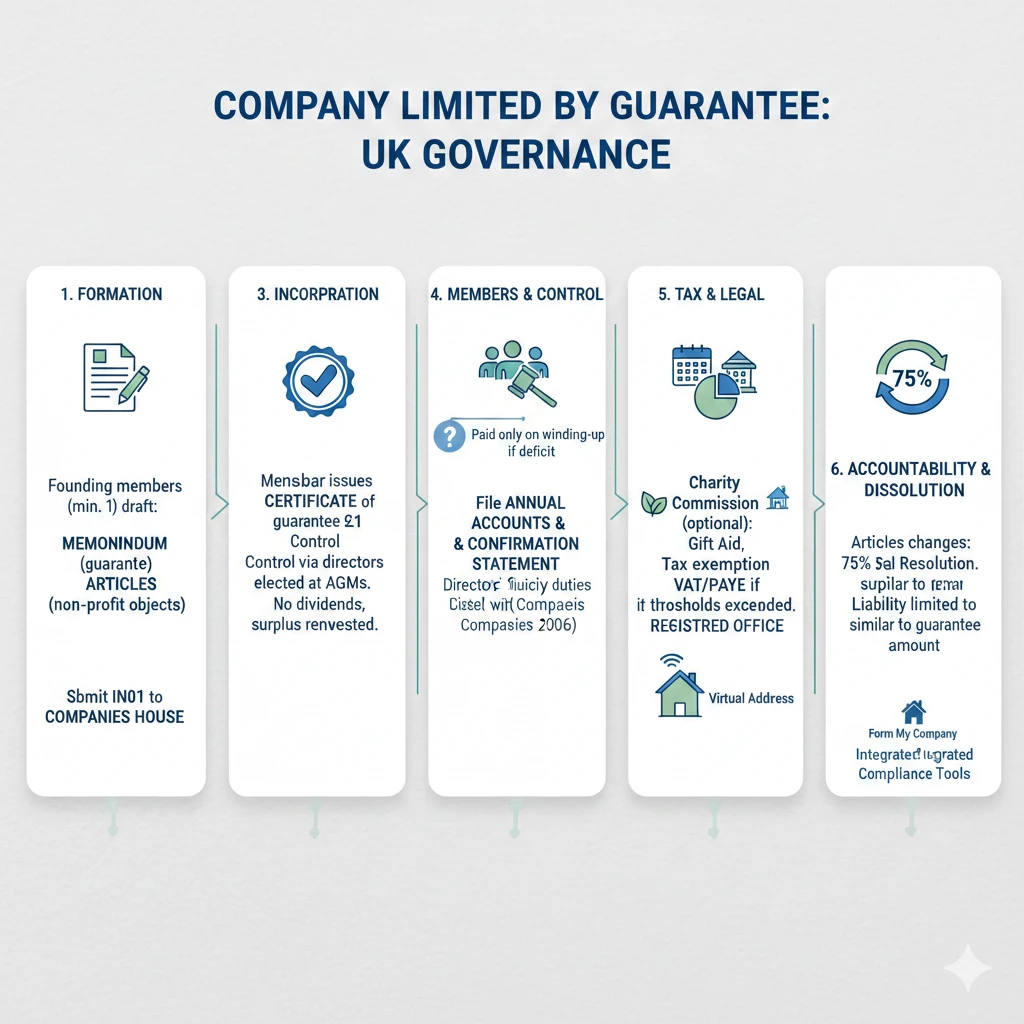
Forming and operating a company limited by guarantee follows a structured process under UK company law, beginning with incorporation at Companies House. First, at least one director (who can also be a member) drafts the incorporation documents: the memorandum of association (listing initial members and their guarantee amounts) and articles of association (outlining governance rules). These must specify the company’s non-profit objects, such as advancing education or relieving poverty, to align with its purpose.
Upon submission via the IN01 form online—often facilitated by services like Form My Company—the Registrar issues a certificate of incorporation, assigning a unique company number. Members, akin to shareholders but without ownership rights, agree to contribute their guarantee sum (e.g., £1) only if winding-up occurs and assets fall short. No shares exist, so control vests in directors elected by members, typically via annual general meetings (AGMs). Day-to-day, the company files annual accounts and confirmation statements with Companies House, mirroring private limited companies but with adaptations for non-profits.
Practically, consider a community sports club: members (players, parents) guarantee £1 each, directors manage operations, and surplus funds upgrade facilities rather than paying dividends. Directors owe fiduciary duties under the Companies Act 2006, including acting in good faith and avoiding conflicts. For tax, it may apply for Charity Commission registration if eligible, unlocking Gift Aid and corporation tax exemptions. VAT and PAYE obligations arise if trading exceeds thresholds—e.g., £90,000 for VAT—necessitating a compliant registered office, often a virtual address service for credibility without physical premises.
This structure’s operational flow ensures accountability: changes to articles require members’ special resolutions (75% approval), and dissolution returns any surplus assets to similar non-profits per the articles. Unlike unlimited companies, liability caps at the guarantee, shielding personal assets. Integration with compliance tools, like Form My Company’s PAYE setup, streamlines payroll for any employees, while semantic alignment with Companies House filing ensures seamless annual returns. This methodical setup underpins its reliability for mission-driven entities.
Benefits and Potential Risks of a Company Limited by Guarantee
The primary allure lies in limited liability: members risk only their nominal guarantee, protecting personal finances akin to shareholders in Ltd companies. This fosters recruitment of high-calibre directors and members, vital for charities or trade associations needing volunteer trustees. Tax perks amplify appeal—HMRC grants corporation tax relief on trading profits if applied to objectives, and charitable status (via separate registration) enables tax-effective donations. No share capital simplifies fundraising; grants from bodies like the National Lottery Community Fund favour this structure for its non-distribution constraint.
Credibility boosts operations: Companies House listing signals professionalism, aiding partnerships, bank accounts, and tenders. Flexibility shines in governance—articles can mandate quorate AGMs or co-optation rules tailored to clubs. For social enterprises, it bridges for-profit efficiency with non-profit ethos, retaining surpluses for growth.
However, risks demand caution. Without shares, raising equity capital is impossible; debt financing or grants become lifelines, potentially straining cashflow. Directors face heightened scrutiny: breaches of duty invite personal liability claims, especially in insolvency where wrongful trading allegations loom. Dissolution complexities arise if articles lack asset distribution clauses, risking disputes. VAT pitfalls ensnare the unwary—non-charitable entities must register at £90,000 turnover, reclaiming input tax but charging output on services. PAYE compliance for staff adds administrative burden without profit motives to offset costs.
A real-world example: a UK housing association limited by guarantee expanded via grants but faltered on VAT partial exemption rules, inflating costs. Balance benefits with risks by consulting experts early—Form My Company’s compliance packages mitigate these through tailored articles and ongoing support. Ultimately, rewards outweigh drawbacks for purpose-led ventures prioritising sustainability over shareholder returns. (Word count so far: 1023)
Legal and Compliance Considerations
Governed by the Companies Act 2006 (Part 7 for guarantee companies), key obligations mirror limited companies: directors must file accounts (often abridged for small entities), a confirmation statement annually, and notify changes like director appointments within 14 days. The registered office must display the company name and be an UK address for service—virtual offices suffice, enhancing privacy for home-based non-profits.
Charity integration elevates compliance: post-incorporation, apply to the Charity Commission if objects qualify, triggering dual oversight with annual charity accounts. HMRC interfaces via Corporation Tax self-assessment (CT600 form), claiming reliefs under s.467 for non-profits. VAT demands meticulous records if registered; partial exemption calculations bedevil trading charities. PAYE registration occurs within 3 months for employees, with RTI submissions monthly.
Audits apply if turnover exceeds £632,000 or assets £3.26m, though many qualify as small companies exempting audits. PSC registers (beneficial owners) must identify controllers, even in memberless setups. Data protection under UK GDPR mandates privacy policies for member databases. Non-compliance risks strikes-off, fines up to £5,000, or director disqualifications.
Practical implications: a members’ association faced £10,000 fines for late confirmations, underscoring vigilance. Leverage Form My Company’s services for Companies House filings, VAT/PAYE automation, and registered office solutions, ensuring EEAT-compliant operations. Proactive compliance fortifies resilience against regulatory shifts, like post-Brexit VAT tweaks.
Common Mistakes to Avoid When Forming a Company Limited by Guarantee
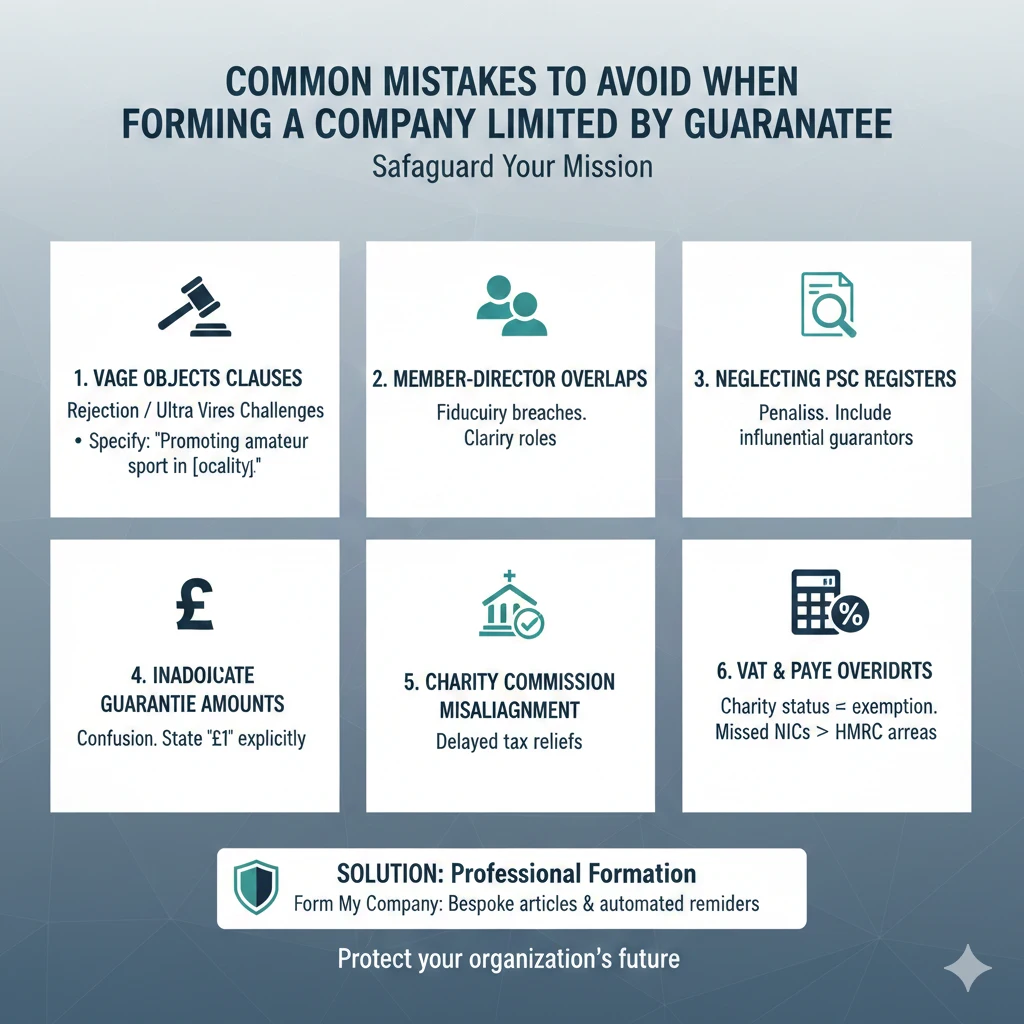
A frequent error is vague objects clauses, leading to Companies House rejection or later ultra vires challenges—specify precisely, e.g., “promoting amateur sport in [locality].” Overlooking member-director overlaps risks fiduciary breaches; draft articles clarifying roles. Neglecting PSC registers invites penalties; even guarantors with influence qualify.
Inadequate guarantee amounts confuse—£1 suffices, but state explicitly. Failing Charity Commission alignment post-formation delays tax reliefs. VAT ignorance prevails: assuming charitable status exempts registration burdens trading entities. PAYE oversights, like missing employee NICs, trigger HMRC arrears.
Rushing articles from templates omits dissolution provisions, sparking asset disputes. Annual compliance lapses—e.g., dormant accounts not filed—escalate to compulsory strike-off. Solution: professional formation like Form My Company’s, incorporating bespoke articles and automated reminders. Avoid these to safeguard your mission.
Practical Tips and Best Practices
Appoint diverse directors early, blending skills in finance and law. Use digital tools for AGMs via Zoom, compliant with 2020 reforms. Secure a professional registered office immediately for credibility. Budget for compliance: £13 confirmation statements, £50-200 accounts prep.
Integrate accounting software for PAYE/VAT. Review articles biennially. Train members on duties. For growth, hybridise with trading subsidiaries.
FAQs
Can a company limited by guarantee pay dividends?
No, profits reinvest; dividends breach non-distribution rules, risking charitable status revocation.
How much does it cost to set up?
Companies House fee: £12 online. Add £50-300 for professional services covering articles and filings.
Can it have employees?
Yes, with PAYE obligations; salaries are legitimate expenses if furthering objects.
Is it suitable for for-profits?
Rarely—lacks shares for investors; opt for Ltd instead.
What’s the difference from a CIO?
CIOs (Charitable Incorporated Organisations) are charity-specific; guarantee companies suit non-charities too.
A company limited by guarantee offers a secure, credible framework for UK non-profits, balancing liability protection with mission focus amid Companies House compliance.
If you’re ready to register your company with confidence, Form My Company provides fast, fully online company formation with expert compliance support, VAT & PAYE setup, virtual office solutions, and professional guidance. Get started today and let our specialists handle the paperwork while you focus on growing your business.