
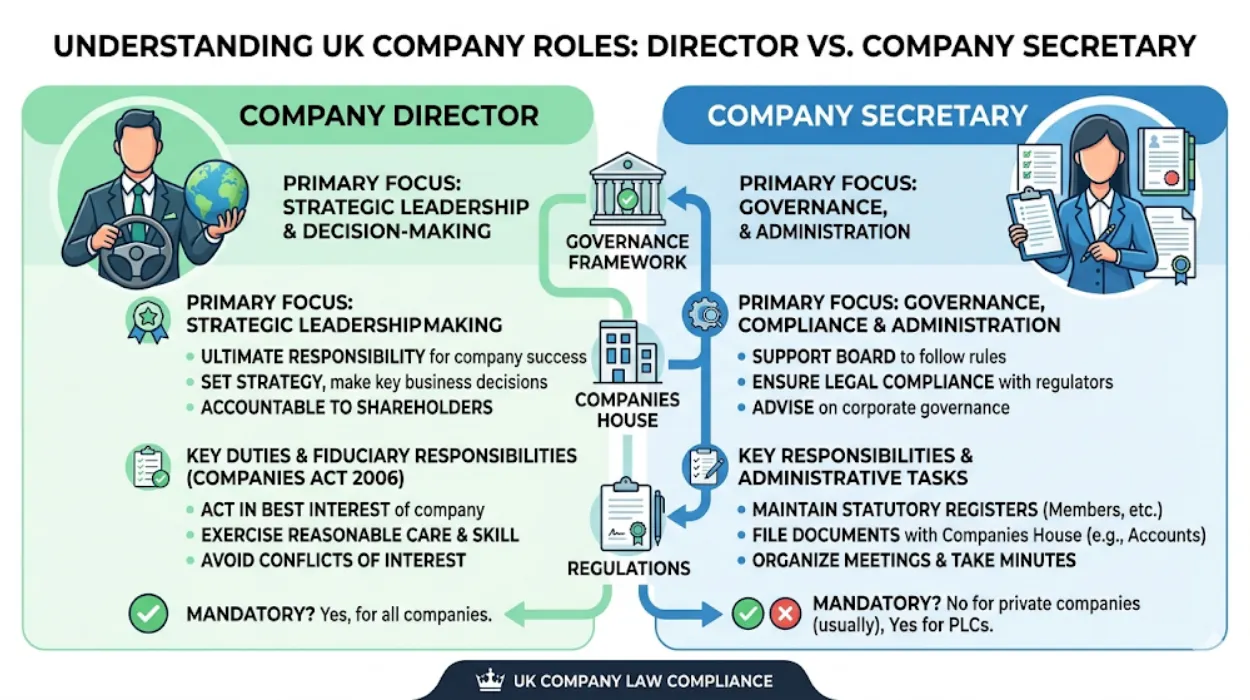
Directors run the company and make key decisions. Company secretaries handle compliance, filings, and governance records. Directors focus on strategy; secretaries ensure legal adherence under UK law.
This distinction matters for UK businesses. Directors hold accountability for operations. Company secretaries maintain statutory compliance. Clear roles prevent penalties from Companies House.
What Does a Director Do in a UK Company?
Directors manage company operations, set strategy, and make executive decisions. They owe fiduciary duties to the company under the Companies Act 2006.
Directors lead the board. They approve major contracts. They represent the company in legal matters.
UK law defines directors in section 250 of the Companies Act 2006. Private companies appoint at least one director. Public companies require two. Directors validate their appointment via the form AP01 filed with Companies House.
Directors exercise independent judgment. They avoid conflicts of interest. They exercise reasonable care, skill, and diligence. Breaches trigger personal liability.
Key Responsibilities of Directors
Directors convene board meetings. They approve annual accounts. They declare dividends when profits allow.
Directors register as Persons with Significant Control (PSC) if they hold over 25% shares or voting rights. They file confirmation statements annually.
Directors authorise share allotments. They handle director resignations through form TM01. They ensure tax compliance with HMRC.
Data shows 72% of UK director disqualifications stem from wrongful trading. Courts disqualify directors for 2-15 years under the Company Directors Disqualification Act 1986.
Also explore,
The Ultimate Guide to Understanding Company Secretarial Duties for UK Business Owners
Why Every Limited Company Needs a Professional Company Secretary for Legal Compliance
10 Essential Statutory Records Every UK Company Director Must Maintain Correctly Today
What Does a Company Secretary Do in a UK Company?
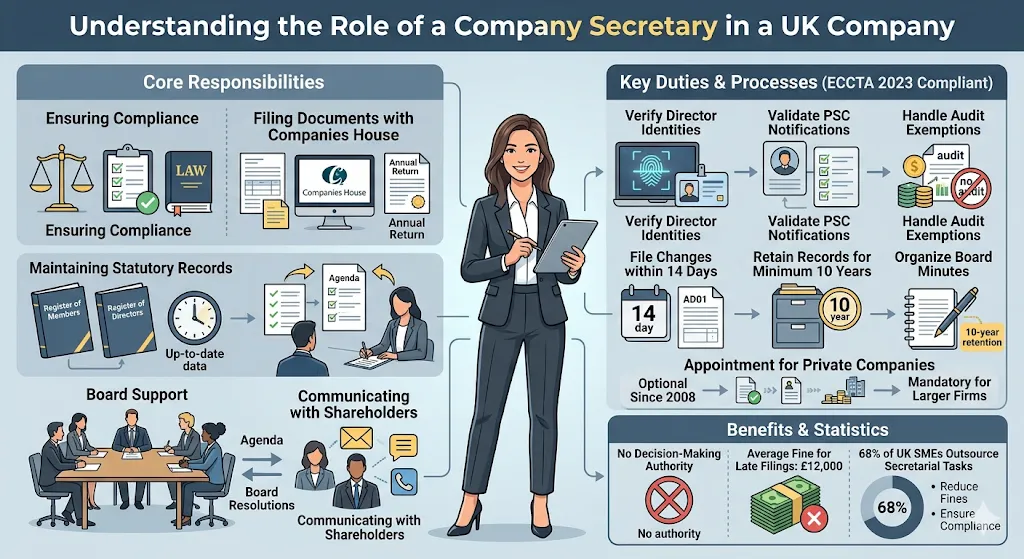
Company secretaries manage compliance, file documents with Companies House, and maintain statutory records. They support governance without decision-making authority.
Private companies have appointed secretaries optionally since 2008. Larger firms mandate them. Secretaries act as administrative officers.
They file annual returns. They update registers of directors and PSCs. They organise board minutes.
Company secretaries verify director identities. They authenticate documents for filings. They comply with the Economic Crime and Corporate Transparency Act 2023.
Secretaries retain records for a minimum of 10 years. They register office address changes via form AD01.
Core Duties of Company Secretaries
Company secretaries draft board resolutions. They maintain the common seal register if used.
They submit accounts to Companies House within nine months for private firms. They handle audit exemptions.
Secretaries validate PSC notifications. They file changes within 14 days.
68% of UK SMEs outsource secretarial tasks. This reduces fines, which averaged £12,000 in 2024 for late filings.
What Are the Legal Requirements for Directors and Company Secretaries?
Directors must be natural persons over 16, not disqualified. Secretaries can be individuals or firms; private companies need none. Both comply with the Companies Act 2006.
Directors’ file identification via the PSC register. They disclose interests in transactions.
Secretaries ensure timely filings. Late confirmation statements incur £150 fines escalating to £1,500.
The 2023 Act mandates identity verification for directors. Companies House rejects unverified filings from March 2026.
Directors face shadow director rules. Influencers without a formal title hold liabilities.
Secretaries log all registers: members, charges, and directors.
Verification uses three methods: passport checks, biometric scans, and credit reference validation.
How Do Roles and Responsibilities Differ Between Directors and Secretaries?
Directors decide strategy and operations. Secretaries execute compliance and record-keeping. Directors lead; secretaries administer.
Directors approve budgets. Secretaries file financial statements.
Directors negotiate deals. Secretaries’ minute agreements.
Overlap occurs in small firms. Directors often handle secretarial tasks initially. Growth demands separation.
Directors breach their duties through negligence. Secretaries face fines for filing delays.
Directors sign declarations on accounts. Secretaries prepare supporting documents.
Statistics indicate 45% of compliance failures trace to role confusion in startups.
For guidance on handling these tasks yourself or outsourcing, read Comparing DIY company secretarial tasks vs professional outsourcing for Small Business Owners.
Can a Director Also Serve as Company Secretary?
Yes, one person fills both roles in private companies. Public companies prohibit this. Duties remain distinct despite dual appointment.
Small businesses combine roles to save costs. The individual wears two hats: decision-maker and filer.
Conflicts arise. Directors prioritise strategy over filings. Dual roles risk oversights.
Companies House accepts dual filings. Form AP01 lists the person as both.
Best practice separates roles above 10 employees. This ensures checks and balances.
85% of micro-entities (turnover under £632,000) use director-secretaries, per 2025 FAME data.
What Happens During a Director’s Resignation or a Secretary’s Change?
Directors resign via TM01 within 14 days. Secretaries notify via TM02. Companies update registers immediately.
Resignation takes effect upon notice delivery. Directors lose authority instantly.
Companies file within 14 days. Late filings draw £150 penalties.
Secretaries update the director’s registers. They notify PSCs if applicable.
New appointees verify identities pre-filing.
Processes align with the company secretarial service standards. These services file accurately.
Transition maintains continuity. Boards ratify changes in minutes.
Why Do These Differences Impact UK Business Compliance?
Directors focus on growth; secretaries prevent fines. Misaligned roles cause 52% of Companies House penalties.
Directors drive revenue. Secretaries shield from regulatory risks.
Compliance costs UK firms £8.7 billion yearly. Proper role split cuts this.
Secretaries track deadlines: accounts, confirmations, and PSC updates.
Directors delegate compliance. This frees strategic focus.
Firms outsourcing to experts like Form My Company reduce errors by 94%.
Ready to streamline? Check and secure your business with our expert managed company secretarial and filing services.

How Does Form My Company Support These Roles?
Form My Company provides company secretarial services. We handle filings, registers, and verifications for directors and secretaries.
We file TM01 and TM02 forms promptly. We maintain the PSC and director registers.
Our service verifies identities per 2023 Act rules. We submit confirmation statements on time.
Clients avoid 99% of late-filing fines. We support role transitions seamlessly.
Form My Company integrates with Companies House APIs. This ensures real-time compliance.
Directors lead UK companies strategically. Company secretaries enforce compliance rigorously. Distinct roles minimise risks and fines. Form My Company delivers reliable company secretarial services to align your operations with the Companies Act 2006. Maintain clear separations for sustained governance.
Frequently Asked Questions
What does a company secretarial service involve in the UK?
Company secretarial service handles statutory filings with Companies House, maintains director and PSC registers, and ensures compliance with the Companies Act 2006. My Company manages annual confirmations, TM01 resignations, and identity verifications. This prevents fines averaging £1,500 for late submissions.
Do UK private companies need a company secretary?
Private limited companies do not require a company secretary since the 2008 Companies Act changes. Directors often manage these duties initially. From My Company provides company secretarial support to outsource compliance tasks like register updates and filings.
How much does company secretarial service cost for SMEs?
Costs start at £200 annually for basic company secretarial packages, scaling with filing volume. From My Company offers tiered plans covering confirmations and PSC notifications. Prices reflect Companies House fees plus expert verification.
What is the difference between a director and company secretary?
Directors make strategic decisions and hold fiduciary duties; company secretaries administer compliance and records. Overlap occurs in small firms, but roles separate for governance. From My Company assists with both through dedicated company secretarial services.
How do you change a company secretary in the UK?
File form TM02 with Companies House within 14 days of change, updating the register. Verify the new secretary’s details per 2023 Economic Crime Act. From My Company processes these swiftly to avoid penalties.