

Transitioning from a home office to serviced office space involves assessing your business growth, budget and operational needs, then selecting a flexible lease that scales with your company. This move supports UK company formation by providing a professional registered office while reducing isolation and enhancing team productivity. Done right, it marks a pivotal step from startup phase to established operation without long-term financial commitments.
Timing the Shift from Home to Serviced Offices
For many UK entrepreneurs, the home office serves as a practical launchpad after company formation, offering zero overheads while directors and shareholders focus on initial compliance like Companies House filings and VAT registrations. However, as revenue stabilises and teams expand, limitations emerge: lack of professional image for client meetings, zoning restrictions on home-based PAYE employment, and blurred work-life boundaries that hinder focus. Serviced offices address these by providing fully equipped, prestigious spaces on flexible terms monthly or rolling contracts with utilities, furniture, reception and meeting rooms included ideal for limited companies scaling beyond sole trader roots.
This transition signals maturity to stakeholders reviewing your registered office details online, facilitating business banking, supplier credit and investor pitches. With UK commercial property costs rising, serviced spaces in hubs like London, Manchester or Birmingham deliver enterprise-grade facilities at a fraction of traditional leases, often 30-50% less when factoring in fit-out savings. For businesses handling ongoing obligations such as confirmation statements or corporation tax returns, a dedicated environment streamlines governance, separating administrative tasks from domestic life and fostering the discipline needed for sustained growth.
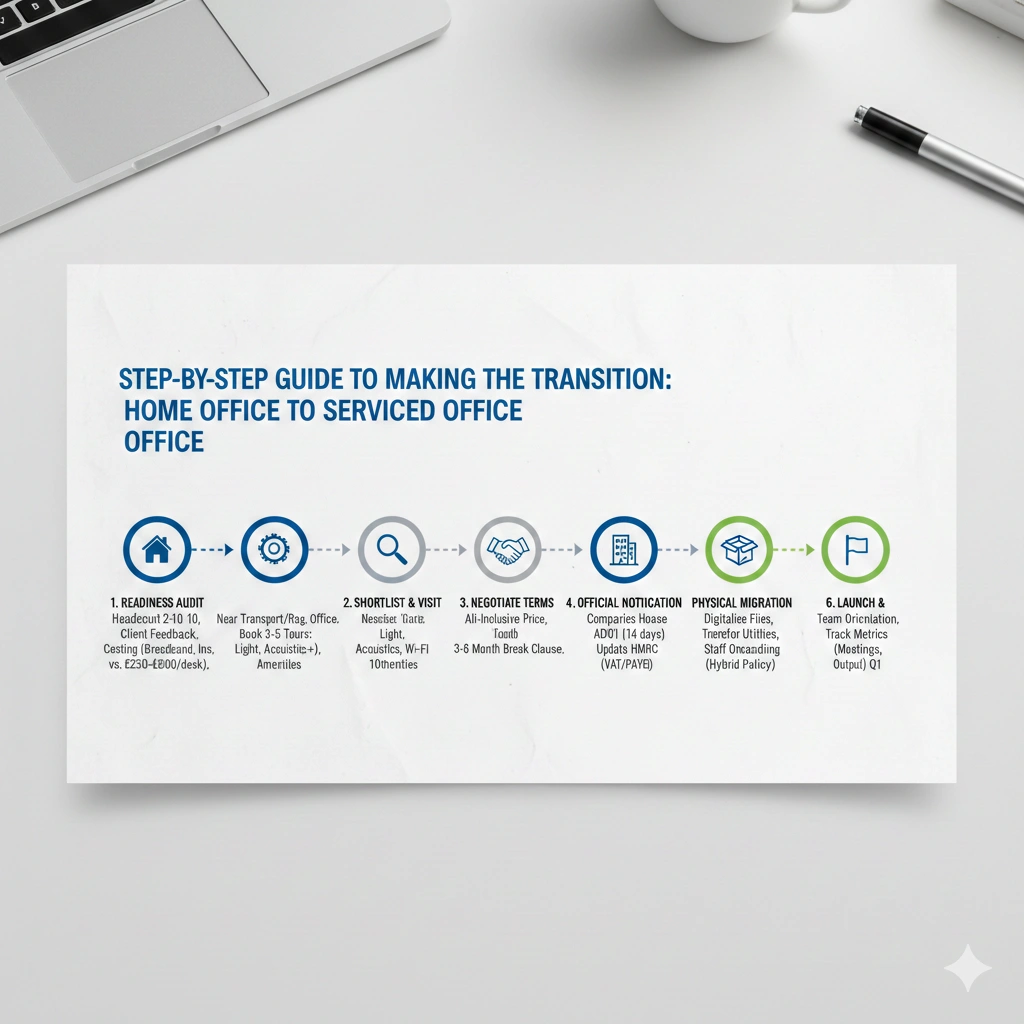
Step-by-Step Guide to Making the Transition
Begin with a readiness audit: review headcount (2-10 people signals the shift), call volumes requiring professional answering, and client feedback on your current setup. Calculate total home office costs including broadband upgrades, insurance riders for business use and lost productivity from distractions against serviced quotes starting at £250-£600 per desk monthly. Shortlist locations near transport links and your registered office jurisdiction to maintain compliance continuity.
Site visits follow: book tours of three to five providers, assessing natural light, acoustics, Wi-Fi speeds (aim for 100Mbps+), kitchen facilities and on-site amenities like gyms or networking events. Negotiate terms: insist on all-inclusive pricing covering business rates, service charges and cleaning, with break clauses at three or six months. Notify Companies House of your new address via form AD01 within 14 days of change, updating HMRC for VAT and PAYE correspondence simultaneously. Physically migrate by digitising files, transferring utilities and onboarding staff with clear hybrid policies. Launch with a team orientation to embed the new culture, tracking metrics like meeting bookings and output in the first quarter to validate the move.
Benefits and Potential Risks of Serviced Offices
Serviced offices unlock significant benefits for growing businesses, starting with scalability that matches your trajectory without capital lock-in. As your limited company hires for PAYE compliance or issues new shares to shareholders, you add desks seamlessly, avoiding the voids and renegotiations of conventional leases. Professional reception handles visitor greetings and mail, complementing virtual registered office setups and projecting polish to banks scrutinising your Companies House profile for account openings.
Collaboration thrives in shared lounges and events, combating home office isolation while networking yields partnerships data shows serviced tenants secure 25% more referrals. Cost predictability aids cashflow forecasting amid corporation tax deadlines, with inclusive bills eliminating surprise utilities. Risks include higher per-desk premiums in prime spots (20-40% above traditional), potential noise from communal areas disrupting focus, and short-term contract mark-ups if not negotiated. Dependency on provider maintenance can frustrate if response lags, and location lock-in hampers pivots. Overall, benefits outweigh for most, provided you model total economics upfront.
Legal and Compliance Considerations in the Move
Moving to serviced offices triggers specific legal steps to maintain compliance post-company formation. Update your registered office if changing via Companies House form AD01 (£8-£33 fee), ensuring the new address qualifies as a physical location capable of receiving statutory mail no PO boxes. For directors using service addresses, confirm provider consent for public listing to shield personal details while meeting PSC register rules.
Employment law activates fully: under PAYE, serviced spaces satisfy health and safety duties with professional risk assessments, unlike home setups potentially breaching zoning. GDPR strengthens shared printers demand secure disposal policies, and reception data handling requires DPA clauses in your lease. Business rates shift to the provider absorbing non-domestic costs, simplifying VAT recovery on services. Review lease terms for assignment rights if scaling prompts relocation, and align with shareholder agreements on premises decisions. HMRC accepts serviced addresses for tax residency, but document trading activity to affirm “mind and management” in the UK. Proactive filings preserve your compliance record.
Common Mistakes to Avoid During Transition
Rushing without financial modelling trips up many: overlooking inclusive vs excluded costs leads to 15-25% budget shocks, especially when adding meeting room credits or parking. Neglecting staff input risks low adoption teams resenting the commute without hybrid flexibility see productivity dip 10-20%. Failing to notify authorities promptly incurs late fees; one overlooked AD01 change triggered a £100 penalty and compliance flag.
Overlooking provider vetting exposes issues: subpar Wi-Fi cripples cloud-based accounting for VAT returns, while inflexible contracts trap you amid growth spurts. Privacy lapses occur when not securing dedicated lockers for shareholder documents. Underestimating cultural shift causes burnout sudden office mandates without phased onboarding erode morale. Location myopia ignores talent pools; a flashy central spot might inflate PAYE commuting claims. Finally, ignoring exit clauses leaves deposits forfeit on early moves. Methodical planning sidesteps these, ensuring smooth uplift.

Practical Tips and Best Practices for Success
Audit twice before committing: benchmark three providers on a matrix of price, facilities, reviews and renewal flexibility, targeting 85%+ Google ratings. Negotiate aggressively bundle mail handling with your virtual office for discounts, secure free trial months and cap annual uplifts at inflation. Implement hybrid models: reserve hot-desk days for focus work, full office for collaborations, cutting utilisation costs 30%.
Onboard systematically: migrate data night shifts, train on provider apps for booking and access, and host launch events to build excitement. Track ROI quarterly via KPIs client wins post-visits, staff NPS, output per desk adjusting leases accordingly. Leverage amenities: use networking for Companies House peers, gyms for retention amid PAYE rises. Budget 10% contingency for extras, review annually against home office benchmarks. Partner with compliance experts for seamless address updates. These practices cement serviced offices as growth accelerators.
Transitioning from home office to serviced space strategically elevates your operations, aligning physical presence with compliance maturity and growth ambitions. It equips directors and shareholders with professional infrastructure, smoothing VAT/PAYE scaling while mitigating home-based constraints.
If you’re ready to upgrade your workspace with seamless support, Form My Company provides fast, fully online company formation with expert compliance, VAT & PAYE handling, virtual offices and professional guidance. Get started today and let our specialists manage the details while you focus on scaling your business.
Frequently Asked Questions
When is the right time to leave a home office?
Typically when hiring exceeds two FTEs under PAYE, client meetings demand professionalism, or productivity plateaus from isolation—often 12-18 months post-formation.
How much do serviced offices cost versus traditional leases?
£300-£800 per desk monthly all-in, versus £200-£500 base rent plus £100-£300 extras for traditional; serviced wins on flexibility despite premium.
Do I need to update Companies House immediately?
Yes, within 14 days via AD01; failure risks strike-off warnings, but serviced providers often assist filings.
Can serviced offices serve as my registered office?
Most do, with consent; confirm lease permissions to receive HMRC/Companies House mail legally.
What if growth outpaces my contract?
Break clauses at 3-6 months allow expansion; negotiate expansion rights to priority space upfront.