

Individuals or entities with more than 25% of shares, voting rights, or significant influence over a UK company’s decisions must be listed in the PSC Register. This ensures transparency under Companies House rules, protecting stakeholders and the public from hidden ownership.
The PSC Register, or Persons with Significant Control Register, forms a cornerstone of UK corporate governance since its introduction under the Small Business, Enterprise and Employment Act 2015. It mandates companies to identify and record anyone exerting substantial control, preventing opaque ownership structures that could mask risks like money laundering or undue influence. For business owners navigating incorporation or ongoing compliance, understanding exactly who qualifies as a PSC proves essential failure to list them accurately can trigger fines up to £5,000 or even criminal prosecution.
This article breaks down PSC criteria, explores nuances for different company structures, and outlines practical steps for compliance, drawing on official guidance from Companies House.
What Defines a Person with Significant Control?
A PSC represents anyone meeting specific thresholds of ownership or control, designed to capture real decision-makers rather than nominal shareholders. Companies House defines five conditions triggering PSC status, each rooted in quantifiable metrics for clarity and enforceability.
First, ownership of more than 25% of shares in the company qualifies someone as a PSC. This includes ordinary shares or preference shares conferring economic rights. For instance, if an individual holds 30% of a private limited company’s issued shares, they must appear on the register, regardless of active involvement in daily operations.
Second, holding more than 25% of voting rights mirrors the share ownership test but focuses on influence over resolutions. Consider a founder retaining veto power through special voting shares; even without majority equity, this positions them as a PSC.
The third condition involves the right to appoint or remove the majority of directors, amplifying executive sway. A venture capitalist securing board control via investment terms would qualify here, ensuring investors with governance leverage are disclosed.
Fourth, exercising significant influence or control captures subtler dynamics, such as a trusted advisor shaping strategy without formal ownership. Companies House provides examples like family members directing decisions informally, emphasizing intent over paperwork.
Finally, any person holding rights indirectly through trusts, partnerships, or nominees must be listed if thresholds are met. Trustees managing shares on behalf of beneficiaries, for example, trigger scrutiny to reveal ultimate controllers.
These criteria apply universally to UK-incorporated companies, from startups to multinationals, fostering a public ledger of control that bolsters investor confidence and regulatory oversight.

Individuals Who Qualify as PSCs
Natural persons form the bulk of PSC listings, often founders, family members, or key investors. A tech startup founder owning 40% shares and appointing the CEO clearly meets multiple conditions, requiring prompt register entry upon incorporation.
Spouses or relatives exerting influence through joint ownership also qualify. Imagine a couple launching a consultancy where one holds shares but the other directs clients; both might register if influence thresholds apply, preventing underreporting in family businesses.
High-net-worth individuals investing via complex structures face similar obligations. A silent partner channeling funds through a trust still lists as a PSC if control exceeds 25%, with Companies House demanding details like date of birth and nationality for verification.
Employees rarely qualify unless holding equity or board powers, but executive directors with significant stakes must disclose. This transparency deters insider risks, as seen in cases where undisclosed PSCs led to enforcement actions.
Legal Entities as PSCs
Not all PSCs are individuals; registrable corporate entities include companies, LLPs, or overseas firms meeting control tests. A parent company owning 51% of a subsidiary qualifies, necessitating its details like registered office and jurisdiction in the PSC Register.
For overseas entities, additional steps apply post the Economic Crime and Corporate Transparency Act 2023 updates, requiring confirmation of their own PSC status. A US holding company influencing a UK arm through voting rights must register, linking global chains to UK transparency.
Partnerships or trusts holding interests demand careful mapping. If a law firm partnership controls 30% votes, the partnership entity lists, with trustees potentially adding as individuals if influence persists.
This entity-inclusive approach ensures layered ownership unravels, vital for sectors like real estate where anonymous vehicles once proliferated.
Exemptions and Non-Registrable PSCs
Certain parties escape listing despite meeting criteria, streamlining compliance for regulated entities. Licensed financial institutions under UK supervision, such as banks holding shares as custodians, qualify as exempt Companies House presumes their oversight suffices.
Similarly, government departments or public authorities wielding control through legislation need not register, avoiding redundancy in state-influenced firms.
Non-registrable cases arise when no qualifying PSC exists, like equally held shares below thresholds or diffuse control in employee-owned trusts. Here, companies confirm “no PSC” status annually, a declaration filed with confirmation statements.
Understanding exemptions prevents over-listing, which clutters registers and invites scrutiny. Always consult official guidance to classify correctly.
How to Identify and List PSCs in Your Company
Maintaining an accurate PSC Register starts with thorough due diligence during setup or changes. Directors bear personal liability for inaccuracies, so systematic checks prove indispensable.
Begin by reviewing shareholder registers and articles of association for ownership snapshots. Cross-reference with board minutes to flag influence holders.
- Query shareholders via notices under Section 790D of the Companies Act 2006, demanding PSC details within one month.
- Map indirect holdings using trust deeds or nominee agreements.
- Update for triggers like share transfers or new investments.
Once identified, compile details: full name, service address, residential address (kept private), nationality, date of birth, and nature of control. File with Companies House within 14 days of awareness, protecting against late penalties starting at £500.
For seamless handling, services like Form My Company’s PSC Register solution simplify identification and filing, ensuring compliance without administrative burden.
Common Challenges in PSC Compliance
Navigating PSC rules reveals pitfalls, especially for growing firms. Multi-jurisdictional ownership often confuses indirect control calculations, where overseas nominees obscure beneficiaries.
Dynamic structures, like convertible loans crystallizing into shares, demand vigilant updates—missing them risks strikes-off.
Enforcement has intensified; in 2024, Companies House issued over 10,000 penalties for PSC failures, underscoring urgency.
To deepen understanding, explore common PSC Register mistakes and how to avoid them for targeted strategies.
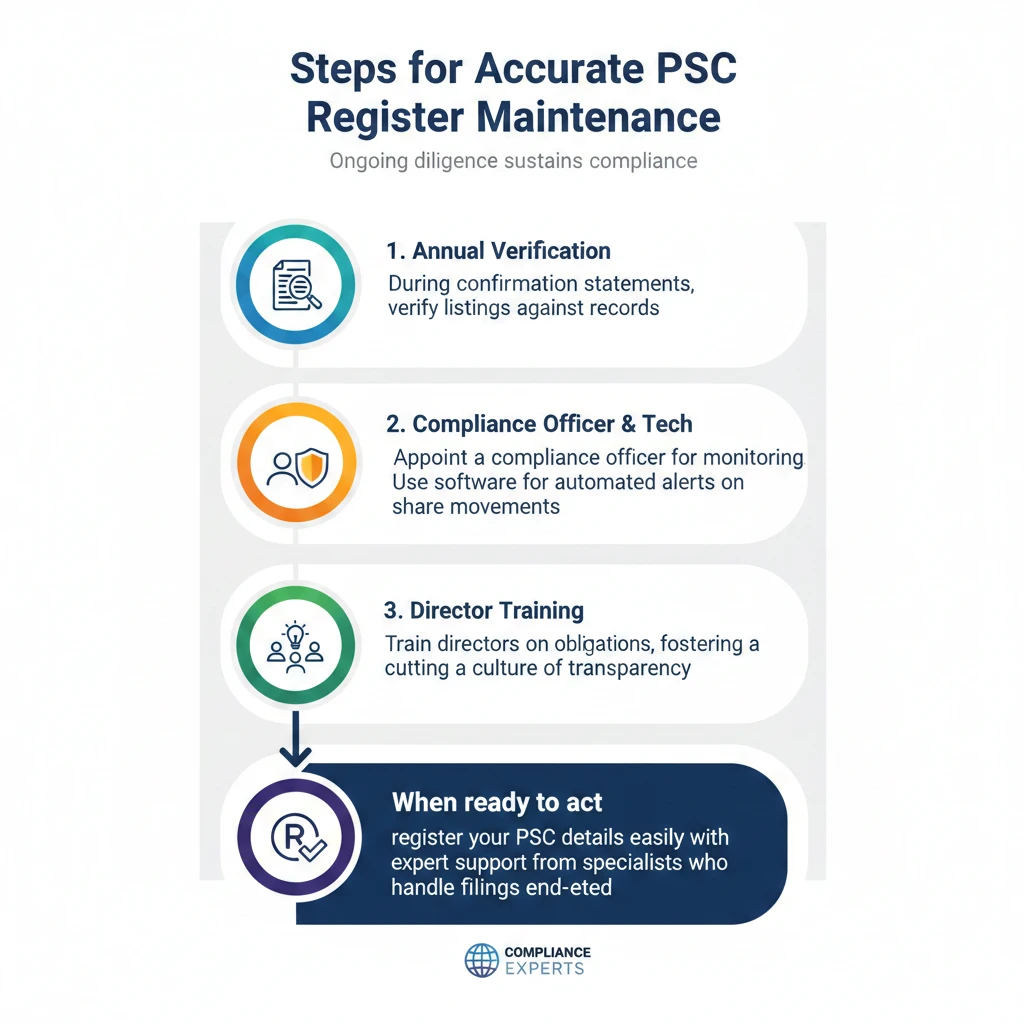
Steps for Accurate PSC Register Maintenance
Ongoing diligence sustains compliance. Annually, during confirmation statements, verify listings against records.
Appoint a compliance officer for monitoring changes, using software for automated alerts on share movements.
Train directors on obligations, fostering a culture of transparency.
When ready to act, register your PSC details easily with expert support from specialists who handle filings end-to-end.
Why PSC Transparency Matters for UK Businesses
Beyond mandates, PSC registers enhance credibility, aiding funding rounds by showcasing clean ownership. Investors favor transparent firms, reducing due diligence costs.
Regulators leverage data for anti-corruption efforts, while public access deters fraud benefiting ethical operators.
Partnering with Experts for PSC Compliance
Form My Company delivers professional PSC Register services, guiding businesses through identification, listing, and filings with precision. Their expertise minimizes risks, letting you focus on growth.
What is a PSC Register for a UK company?
The PSC Register, or Persons with Significant Control Register, is a mandatory public record for UK companies listing individuals or entities with over 25% shares, voting rights, or significant influence. It promotes transparency under Companies House rules, helping prevent hidden ownership. Form My Company’s PSC Register service assists in accurate identification and maintenance.
Who needs to be listed on a company’s PSC Register?
Anyone holding more than 25% of shares, voting rights, or the ability to appoint directors must be listed, including indirect holders like trustees. Legal entities such as parent companies also qualify if they meet control thresholds. From My Company’s PSC Register experts ensure all qualifying persons with significant control are properly documented.
How do I update the PSC Register for my company?
Updates must be filed with Companies House within 14 days of any change in control, using form PSC01 for additions or PSC07 for cessations. Annual confirmation statements verify ongoing accuracy. Form My Company’s PSC Register service streamlines these filings to avoid penalties up to £5,000.
What happens if you don’t maintain a PSC Register?
Failure to keep an accurate PSC Register can result in fines starting at £500, director disqualification, or company strike-off by Companies House. Late filings incur escalating penalties based on delay duration. From My Company’s PSC Register support helps businesses stay compliant and penalty-free.
Can legal entities be listed in the PSC Register?
Yes, registrable legal entities like overseas companies or LLPs qualify as PSCs if they hold more than 25% control, with their own PSC details required. This traces ownership chains effectively. Form My Company’s PSC Register service handles entity listings alongside individual ones for full compliance.