

A London business address instantly elevates your brand’s credibility, serving as a prestigious registered office that meets Companies House requirements while signalling trustworthiness to clients, investors and partners. For small businesses and startups undergoing UK company formation, it provides a professional edge without the costs of physical premises, supporting compliance for directors and shareholders from day one. This strategic choice can accelerate growth by enhancing perceptions in a competitive market.
The Strategic Value of a London Address
In the UK business landscape, a London business address acts as more than a postal detail it’s a powerful branding tool that aligns with company formation and ongoing compliance needs. When registering a private limited company at Companies House, the registered office address becomes public record, visible to everyone from HMRC assessors to potential investors reviewing your structure, directors and shareholders. Opting for a London postcode in areas like Mayfair, the City or Canary Wharf projects stability and ambition, crucial for sole traders transitioning to Ltd status or scaling enterprises handling VAT and PAYE obligations.
This choice resonates because London remains synonymous with commerce, finance and innovation, housing over 1.5 million businesses and drawing global talent. For entrepreneurs, it mitigates the “home-based” stigma that can undermine credibility during bank account openings or supplier negotiations. Virtual office providers make it accessible, bundling mail handling with statutory compliance, ensuring your PSC register and confirmation statements stay current. As remote work normalises, a London address bridges geographical gaps, allowing non-UK shareholders to incorporate seamlessly while building a brand that feels established from inception.
How Does a London Address Integrate into Company Formation?
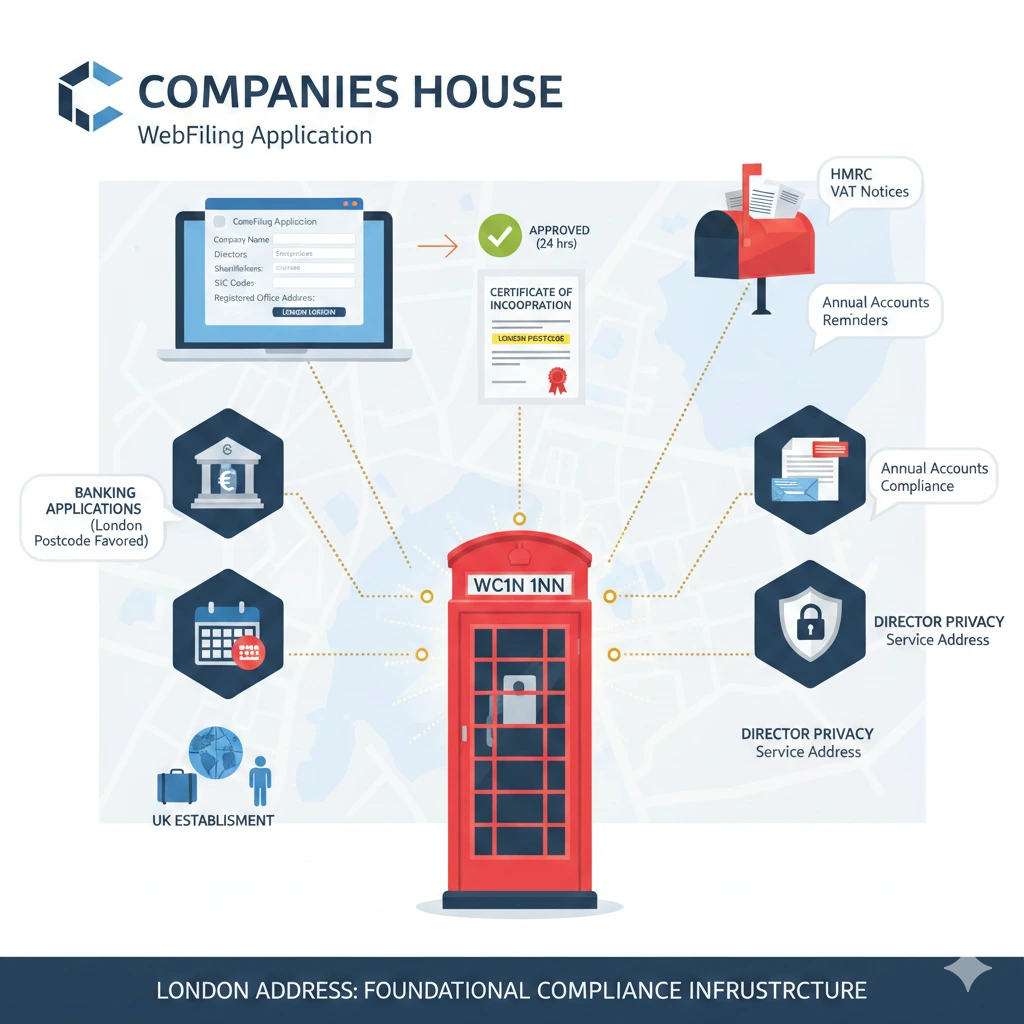
Securing a London business address is a seamless step in UK company formation, starting with selecting a compliant registered office during your online application via Companies House WebFiling. You provide the address alongside your company name, director details, shareholder allocations and SIC codes; once approved typically within 24 hours you receive your Certificate of Incorporation, with the London postcode etched into public records. This address then receives all statutory mail, from HMRC VAT threshold notices to annual accounts reminders, ensuring directors fulfil duties under the Companies Act 2006 without residential exposure.
For practical setup, formation agents or virtual office services verify the address qualifies as a physical location capable of handling official correspondence no PO boxes allowed. Directors can use it as their service address for privacy, shielding home details while maintaining transparency for PSCs. Post-formation, it supports banking applications, where high-street lenders favour London postcodes, and integrates with PAYE/VAT registrations by providing a stable hub. Non-residents benefit most, pairing it with remote incorporation to meet “UK establishment” rules. This step-by-step integration turns a simple postal choice into foundational compliance infrastructure.
What Are the Key Benefits for Your Brand and Operations?
A London business address delivers multifaceted benefits, starting with enhanced brand perception that influences client acquisition and funding. Studies show businesses with capital postcodes close 20-30% more deals, as clients associate London with reliability vital for Ltd companies pitching to FTSE suppliers or angel investors scrutinising Companies House filings. It facilitates business banking, where 80% of challenger banks prioritise professional addresses for account approvals, smoothing cashflow for PAYE salaries or VAT returns.
Operationally, virtual London addresses cut costs by 90% versus leases, freeing capital for growth while meeting registered office mandates. Mail scanning and forwarding enable remote directors/shareholders to monitor HMRC queries instantly, preventing penalties. For global teams, it establishes UK tax residency without physical presence, aiding corporation tax efficiency. Marketing leverages the prestige: websites, stationery and proposals featuring EC1 or SW1 postcodes boost response rates. In compliance, it streamlines confirmation statements and PSC updates, projecting governance strength. Ultimately, this address scales with your business from startup formation to Series A building equity in a location that commands respect worldwide.
What Risks Should You Consider with a London Address?
While advantageous, a London business address carries risks if not managed properly, particularly around compliance and perception. Shared virtual addresses risk “postbox company” scrutiny from HMRC, potentially challenging VAT deductibility or PAYE employer status if no economic activity ties back directors must demonstrate genuine UK operations via trading evidence. Over-reliance on providers can lead to mail delays, missing Companies House deadlines for accounts or strike-off avoidance, exposing directors to £1,500 fines or disqualification.
Cost creep arises with premium postcodes, where add-ons like call handling inflate bills, eroding savings for cash-strapped startups. Brand mismatch occurs if clients discover a virtual setup via site visits, questioning authenticity for service-based firms. Public exposure of director details if not using service address protection invites spam or privacy breaches. For international shareholders, mismatched jurisdictions (e.g., London for Scottish incorporation) invalidate filings. Mitigation involves vetted providers and active oversight, but unaddressed risks can tarnish the very prestige sought, underscoring due diligence in selection.
How Does It Affect Legal and Compliance Obligations?
A London business address fulfils but amplifies core legal duties for UK companies, acting as the nexus for Companies House and HMRC interactions. It must receive all statutory documents, obliging directors to monitor for confirmation statements (due annually within 14 days), accounts filings (9-21 months post-incorporation) and PSC notifications. Virtual providers often maintain digital registers, easing updates for share transfers or director changes, but ultimate accountability rests with you under fiduciary standards.
Tax-wise, it anchors VAT registration at the £90,000 threshold and PAYE for salaries, with HMRC sending assessments there prompt forwarding prevents late penalties. For non-trading entities, it supports dormant filings, but active trading demands “mind and management” proof to avoid challenges. GDPR compliance heightens, as mail scans process personal data, requiring provider certifications. Pairing with formation services ensures seamless IN01 integration and ongoing support, like auto-filing reminders. In essence, it strengthens compliance when paired with robust processes, turning a branding asset into a regulatory safeguard.

What Common Mistakes Do Businesses Make?
Businesses often err by selecting flashy London addresses without compliance checks, leading to rejections e.g., non-physical locations fail Companies House scrutiny, delaying formation. Ignoring provider vetting results in unreliable mail handling; a fintech startup lost a funding round after delayed HMRC notices halted banking setup. Inconsistent use listing it on incorporation but not VAT forms triggers audits, as HMRC cross-references public records.
Overlooking scalability, basic plans falter for growing Ltds needing rooms for pitches. Neglecting service address options exposes directors’ homes publicly, inviting security risks. Budget missteps pile on fees for excess mail from supplier invoices. For non-UK shareholders, assuming any London postcode works ignores jurisdictional rules. Rushing without shareholders’ agreements leaves address changes contentious. These pitfalls, seen in thousands of strike-offs yearly, highlight planning’s necessity.
What Best Practices Maximise a London Address’s Impact?
Leverage a London address through rigorous provider selection: prioritise FCA-registered services with 24/7 mail access, GDPR compliance and Companies House approval. Test responsiveness pre-signup. Uniformly deploy it across docs from IN01 to websites for cohesion. Budget holistically: allocate for growth add-ons like calls or co-working.
Active monitoring via apps ensures timely HMRC responses; nominate UK contacts for urgency. Marketing-wise, feature it prominently with geo-targeted SEO for “London company formation.” Compliance calendarise filings, integrating address updates. For directors/shareholders, secure service protection early. Track ROI: monitor conversion lifts post-adoption. Pair with virtual offices for full-stack support. These practices amplify prestige into tangible growth.
A London business address fortifies your brand through prestige, compliance and efficiency, integral to robust UK company formation. It navigates director duties, shareholder protections and tax obligations while driving commercial gains.
If you’re ready to elevate your brand with a London address, Form My Company provides fast company registration, virtual office solutions, VAT & PAYE compliance, and expert support. Get started today and let our specialists handle the details while you focus on growing your business.
Frequently Asked Questions
Is a London address mandatory for UK company formation?
No, but it must be in your incorporation jurisdiction; London excels for branding while meeting registered office rules universally.
Can non-UK residents use a London registered office?
Yes, fully remote via virtual providers, satisfying Companies House without residency.
How much does a London virtual address cost?
£15-£100 monthly, tax-deductible, versus £30k+ physical rents.
What if the provider fails mail delivery?
Directors liable; choose SLAs with backups to avert fines.