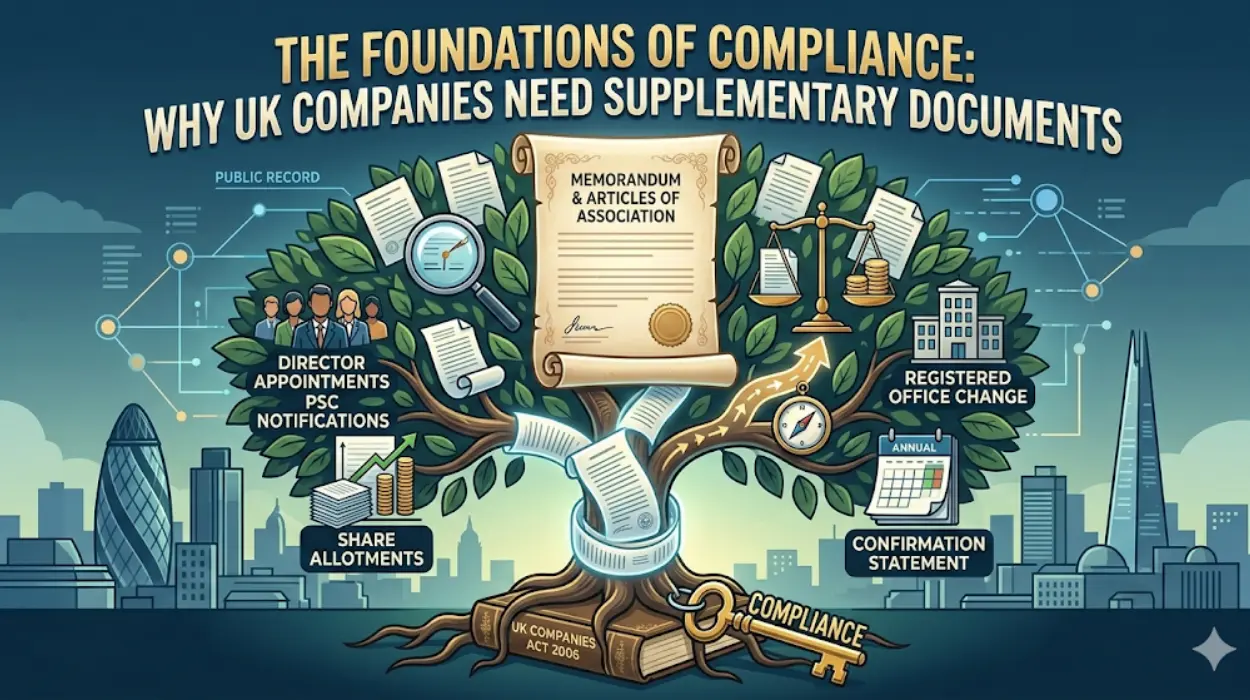
UK companies need supplementary company documents to meet legal compliance requirements, protect assets, and support strategic business decisions beyond basic formation records. These essential filings ensure ongoing regulatory adherence with Companies House and safeguard operations in a dynamic market.
Running a business in the United Kingdom demands more than just initial incorporation. While standard company records like the Certificate of Incorporation and Memorandum of Association form the foundation, supplementary company documents address evolving needs such as ownership changes, capital adjustments, and governance updates. These documents, often overlooked by startups and established firms alike, play a critical role in maintaining legal standing and operational flexibility. For instance, when a company issues new shares or alters its structure, supplementary filings prevent penalties and enable seamless growth.
Understanding Supplementary Company Documents in the UK Context
Supplementary company documents refer to additional filings required under the Companies Act 2006, distinct from core registration paperwork. They include resolutions for share allotments, changes to articles of association, and statements of capital tools that keep your company’s records current with Companies House. Unlike routine annual returns, these documents arise from specific events like director appointments or capital restructurings, ensuring transparency for stakeholders and regulators.
Consider a growing tech firm in Manchester that expands its investor base. Without promptly filing a Return of Allotment as a supplementary document, the company risks non-compliance fines up to £5,000 and potential director disqualifications. This structured approach to documentation reinforces the entity’s legal integrity, much like how a well-maintained ledger supports financial audits. Form My Company specializes in streamlining these processes, offering reliable supplementary company documents services tailored for UK businesses at every stage.
The necessity stems from the UK’s rigorous corporate governance framework. Companies House mandates timely submissions to maintain the public register’s accuracy, which investors, creditors, and partners rely on for due diligence. Neglecting these can lead to strikes-off proceedings, where a company loses its legal status, disrupting contracts and banking relationships.
Key Legal Reasons for Supplementary Filings
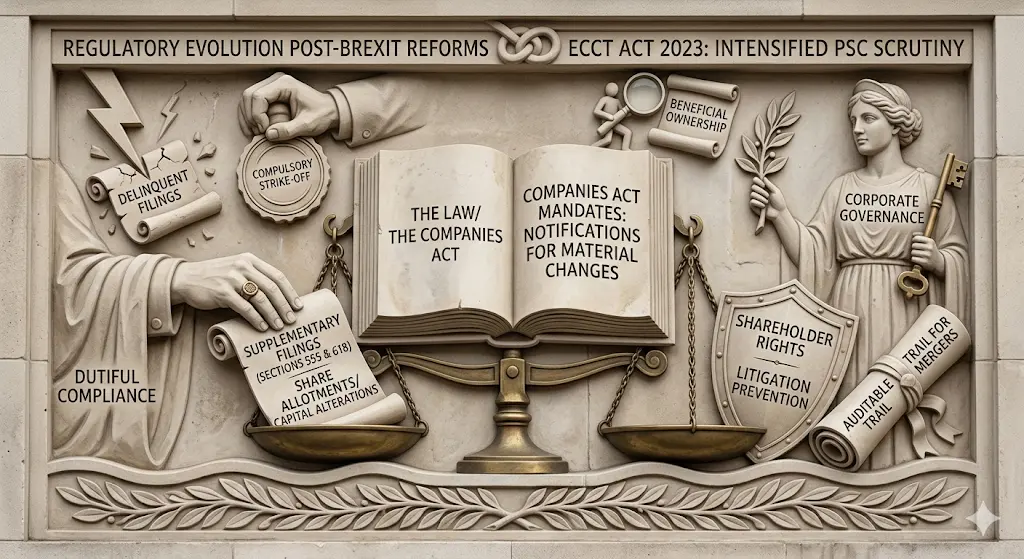
Compliance with statutory obligations tops the list of why UK companies require supplementary documents. The Companies Act mandates notifications for material changes, such as allotment of shares under Section 555 or alterations to share capital per Section 618. Failure to file within one month invites enforcement actions, including compulsory strikes-off.
Beyond penalties, these documents protect shareholder rights and prevent disputes. For example, a family-run enterprise in Birmingham updating its articles of association through a special resolution ensures clear dividend policies, averting future litigation. This proactive filing creates an auditable trail, vital during mergers or funding rounds where venture capitalists scrutinize governance histories.
Regulatory evolution further underscores their importance. Post-Brexit reforms and the Economic Crime and Corporate Transparency Act 2023 have intensified scrutiny on beneficial ownership and PSC (Persons with Significant Control) confirmations, often necessitating supplementary updates. A logistics company adapting to new PSC rules by filing an updated confirmation statement avoids Trading Standards investigations, preserving its market reputation.
Strategic Business Benefits of Maintaining Supplementary Records
Supplementary company documents extend far beyond compliance, fueling strategic advantages. They enable capital raising by formalizing share issuances, which banks and investors demand for loan approvals or equity deals. Picture a Cambridge software startup securing Series A funding; its freshly filed Statement of Capital demonstrates precise share structures, boosting investor confidence.
Operational agility improves too. Documents like director appointment resolutions or resignation filings keep leadership records precise, essential for signing contracts or opening corporate accounts. In one illustrative case, a retail chain swiftly filed a change of registered office address as a supplementary document, ensuring mail redirection and HMRC correspondence continuity during a relocation—availing uninterrupted VAT compliance.
Risk mitigation rounds out the benefits. These records serve as evidence in disputes, such as proving solvency for wrongful trading defenses under the Insolvency Act 1986. For SMEs navigating economic pressures, maintaining supplementary company documents acts as a buffer against audits or creditor challenges, much like insurance against unforeseen legal hurdles.
To explore how these filings differ from everyday records, read our in-depth comparison in Supplementary Company Documents vs Standard Company Records.
Common Supplementary Documents and Their Applications
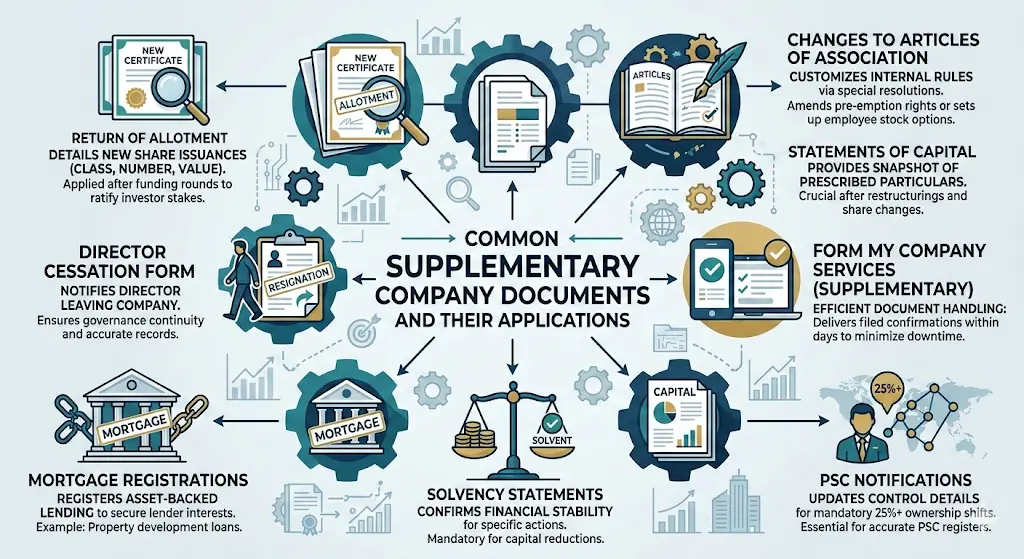
Among the most frequently needed are Returns of Allotment, which detail new share issuances including class, number, and nominal value. UK companies use these post-funding rounds to ratify investor stakes, ensuring PSC registers align with reality.
Changes to Articles of Association via special resolutions allow customization of internal rules, such as pre-emption rights on shares. A manufacturing firm might amend these to facilitate employee stock options, enhancing talent retention without external legal fees.
Statements of Capital provide snapshots of prescribed particulars, crucial after restructurings. Meanwhile, PSC notifications update control details, mandatory for any 25%+ ownership shifts. Form My Company’s supplementary company documents service handles these efficiently, delivering filed confirmations within days to minimize downtime.
Other examples include solvency statements for capital reductions and mortgage registrations for asset-backed lending. Each serves a precise purpose: a property development company filing a Particulars of Mortgage secures lender interests, while a tech consultancy’s director cessation form maintains governance continuity.
When and How to File for Compliance and Efficiency
Timing is critical most supplementary documents carry 14-day to one-month deadlines from the triggering event. Companies House’s online portal simplifies submissions, but errors in form completion, like omitting allotment dates, trigger rejections.
Professional assistance accelerates this. Services like those from Form My Company integrate with the portal, verifying details against your records for error-free filings. This is particularly valuable for non-executive directors juggling multiple roles, where outsourced expertise prevents oversights.
In practice, a scenario unfolds for an e-commerce business post-acquisition: it allots consideration shares, drafts the resolution, and files the return all within 15 days. This not only complies but positions the firm for rapid integration, highlighting efficiency gains.
For businesses ready to act, learn how to Order Supplementary Company Documents Online in the UK.
Navigating Challenges and Best Practices
Challenges include tracking multiple deadlines amid growth spurts and interpreting complex forms like SH01 for allotments. Best practices involve annual record audits, digital storage via compliant software, and appointing a company secretary for oversight.
Integration with accounting systems flags filing needs, while board calendars preempt events like annual PSC confirmations. Educating directors on triggers such as share transfers fosters a compliance culture, reducing reliance on ad-hoc fixes.
Form My Company provides professional solutions for supplementary company documents, combining expertise with user-friendly processes to keep UK businesses compliant and competitive. Their tailored support ensures these vital records enhance rather than hinder your operations.
What are supplementary company documents for UK companies?
Supplementary company documents are additional filings with Companies House, such as returns of allotment, changes to articles of association, and statements of capital, required for events like share issuances or governance updates. They ensure compliance under the Companies Act 2006 beyond standard incorporation records. Form My Company handles these to maintain accurate public registers.
Why do UK businesses need supplementary company documents?
UK businesses need supplementary company documents to stay legally compliant, avoid fines up to £5,000, and support activities like fundraising or director changes. These filings update the company’s structure and ownership details promptly. Form My Company’s Supplementary Company Documents service streamlines submissions within mandatory deadlines.
How long do I have to file supplementary company documents?
Most supplementary company documents must be filed with Companies House within 14 days to one month of the triggering event, such as share allotments or PSC changes. Late filings incur penalties and risk enforcement actions. Form My Company ensures timely processing for seamless compliance.
What is included in a supplementary company documents filing?
Key supplementary company documents include SH01 forms for share allotments, special resolutions for article changes, and PSC notifications for significant control updates. They detail specifics like share classes and nominal values. Form My Company’s service verifies and submits these accurately.
Can Form My Company help with supplementary company documents online?
Yes, Form My Company provides an online Supplementary Company Documents service for quick filing via the Companies House portal. It covers resolutions, capital statements, and more, with expert review to prevent rejections. This keeps UK companies compliant without hassle.