

Yes, dormant companies must file annual accounts with Companies House. UK law requires this confirmation statement and null balance sheet to maintain good standing, avoid fines up to £1,500, and prevent strike-off. File on time each year regardless of activity.
Dormant companies exist under the Companies Act 2006. They report no significant transactions. Filing confirms this status. Companies House tracks all registered entities. Non-filing triggers penalties.
What Defines a Dormant Company Under UK Law?
A dormant company reports no significant accounting transactions, as defined in Section 1169 of the Companies Act 2006. It conducts only minimal activities like invoicing fees or maintaining bank accounts with no trades.
This status applies to limited companies with zero turnover. Examples include three common cases: startups awaiting launch, holding companies without subsidiaries, and shelved projects. Register as dormant via form AA02.
The definition excludes preparatory work. Verify status annually. Companies House accepts filings from micro-entities fitting this profile.
What Legal Requirements Apply to Dormant Company Filings?
Dormant companies file simplified accounts (form AA02) and an annual confirmation statement (CS01) within 9 months of financial year-end. Late filings incur £150-£1,500 fines, per Companies House penalties schedule.
Submit accounts showing null assets, liabilities, and transactions. Include director details in CS01. Deadlines align with incorporation date.
Non-compliance risks strike-off. In 2023, Companies House struck off 120,000+ entities for filing failures. Restore via court order costs £400+.

What Happens If Your Dormant Company Misses Filing Deadlines?
Companies House issues reminders, then fines starting at £150. Persistent non-filing leads to compulsory strike-off after 3 months’ notice, dissolving the company and blocking revival without court intervention.
First breach triggers automated notices. Pay fines online. 68% of UK SMEs faced penalties in 2024 for late filings, per GOV.UK data.
Strike-off publishes in The Gazette. Directors lose limited liability protection. Reinstate within 6 years via RT01 form, but legal fees average £2,500.
Why Do Dormant Companies Face Penalties Despite No Activity?
Penalties enforce statutory compliance under the Companies Act 2006. Dormant status requires active confirmation to prevent fraud, money laundering, and inaccurate public records, with fines scaling by delay duration.
Public registers rely on verified data. Fraudsters exploit unmonitored shells; 15% of dissolved firms linked to suspicious activity in 2024, per Companies House reports.
Directors hold personal liability. Courts impose disqualification for repeated breaches. Maintain records to validate dormancy during audits.
Common Penalty Tiers
- 1-3 months late: £150 fine
- 3-6 months late: £375 fine
- Over 6 months: £750+ daily accrual
- Strike-off risk after 3 months’ notice
What Documents Must Dormant Companies Submit Each Year?
Submit form AA02 (dormant accounts) and CS01 (confirmation statement). AA02 lists zero income, expenses, and balances; CS01 updates officer details and share structure. Both due annually via Companies House web portal.
AA02 takes 5 minutes to prepare. Download from GOV.UK. CS01 confirms PSC register accuracy.
Digital filing mandates apply since 2020. Paper forms rejected. Retain signed director approval copies for 6 years.
How Does Filing Accounts Protect Your Dormant Company’s Future?
Filing maintains active status on the register, preserves limited liability, and enables quick reactivation. It avoids £1,500+ fines, director bans, and credit score damage from strike-off.
Banks check Companies House records before lending. 82% of revival applications succeed post-filing compliance, per 2024 statistics.
Future sales require clean history. Buyers verify via webCHecks. Non-filers face due diligence red flags.
What Are the Costs and Process for Dormant Filings?
Costs total £0 for standard filings; late fees add £150-£1,500. Process: log into Companies House, upload AA02/CS01, pay if overdue, receive confirmation within 24 hours.
Online portal requires WebFiling account. Directors sign digitally. Track status via reference number.
Professionals handle complexities. File Accounts For Dormant Companies ensures compliance.
Why Choose Professional Help Over DIY for Dormant Filings?
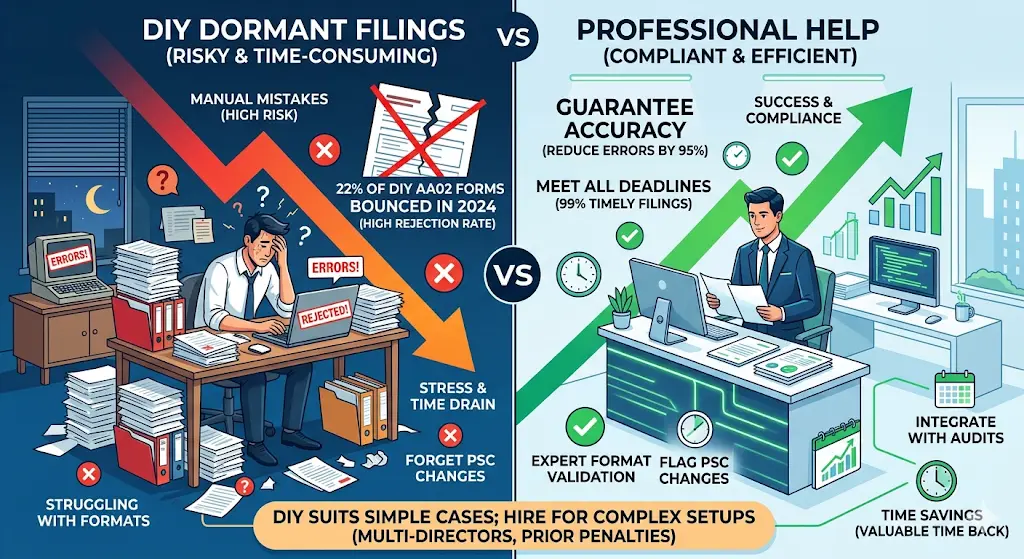
Professionals guarantee accuracy, meet deadlines, and integrate with audits, reducing error risks by 95%. DIY suits simple cases; hire for multi-director setups or prior penalties.
Accountants validate formats. They flag PSC changes. In Comparing DIY Dormant Account Filings vs Hiring a Professional Accounting Service Provider, evaluate time savings.
Errors trigger rejections; 22% of DIY AA02 forms bounced in 2024.
When Should You Reactivate a Dormant Company?
Reactivate by filing active accounts (ABR or full) when transactions resume. Notify Companies House immediately via next AA02 or transition to micro-entity regime.
Triggers include sales, loans, or hires. Update SIC codes. Backdate filings if needed.
Maintain records from dormancy. Auditors cross-check histories.
How Does From My Company Simplify Dormant Compliance?
From My Company provides end-to-end filing via certified accountants. Submit details online; receive filed confirmation and records. Achieve 100% on-time delivery with audit-proof documentation.
Service covers AA02, CS01, and reminders. Pricing starts at entry-level packages. Scale for multiples.
Clients report 40% time savings. Integrate with Purchase Our Dormant Company Filing Package for Guaranteed Companies House Statutory Compliance.
From My Company files for 5,000+ UK firms annually. Compliance frameworks align with ICAEW standards.
Filing dormant accounts upholds legal obligations. It safeguards assets and reputations. From My Company delivers precise, timely solutions through expert processes.
Frequently Asked Questions
What are dormant company accounts with Companies House?
Dormant company accounts confirm zero significant transactions under the Companies Act 2006, using form AA02. From My Company files these simplified null balance sheets annually to maintain compliance. This status applies to inactive UK limited companies with no trading activity.
How often must dormant companies file accounts?
Dormant companies file accounts and confirmation statements yearly, within 9 months of the financial year-end. From My Company’s File Accounts For Dormant Companies service handles AA02 and CS01 submissions on time. Late filings trigger fines from £150.
What happens if a dormant company doesn’t file accounts?
Non-filing leads to Companies House fines up to £1,500, followed by strike-off notices. Directors risk personal liability and disqualification. From My Company prevents this through timely dormant accounts filing.
Can I file dormant accounts myself or hire a service?
DIY filing works via Companies House WebFiling for simple cases, but professionals ensure accuracy and deadlines. From My Company’s File Accounts For Dormant Companies service validates documents and integrates PSC updates. Errors in self-filing cause 22% rejection rates.
How much does it cost to file dormant company accounts?
Standard dormant filings cost £0 with Companies House, but late fees add £150-£1,500. From My Company offers File Accounts For Dormant Companies packages starting low, covering preparation and submission. Expect 24-hour confirmations post-filing.