
Yes, activating a managed Director Resignation service ensures accurate filing, legal compliance, and real-time updates to Companies House and internal registers. It removes administrative errors, accelerates board changes, and guarantees your company records remain compliant with UK corporate governance requirements.
What does a managed Director Resignation service actually handle?
A managed Director Resignation service prepares, validates, and files all required documents, updates statutory registers, and notifies Companies House within mandated timelines, ensuring full compliance with UK regulations and eliminating administrative risk.
A Director’s resignation involves more than submitting a form. UK companies must complete several compliance actions within strict deadlines. A managed service coordinates each step using structured workflows.
The process includes drafting resignation documentation, verifying director details, and submitting filings such as the TM01 form. It also ensures internal records reflect the change immediately.
Errors in director data create compliance gaps. A managed approach validates entries against Companies House standards. This reduces rejection rates and avoids penalties.
From My Company executes these tasks using predefined compliance protocols. This ensures accuracy across all filings and registers.
Why is it critical to update your company board immediately after resignation?
Immediate board updates maintain legal compliance, prevent governance disputes, and ensure accurate public records, as Companies House requires timely reporting of director changes to reflect the company’s active management structure.
UK law mandates prompt updates when a director resigns. Delays create discrepancies between actual management and registered data.
Companies House uses director records to assess legal responsibility. Incorrect data may expose inactive directors to liability or misrepresent active decision-makers.
Board accuracy affects stakeholder trust. Investors, banks, and regulators rely on current director information when evaluating company status.
Updating internal registers is equally important. The register of directors and PSC records must reflect real-time changes. You can explore the compliance implications further in this guide on the importance of updating your PSC register immediately after a director’s resignation.
How does the Director Resignation process work step-by-step?
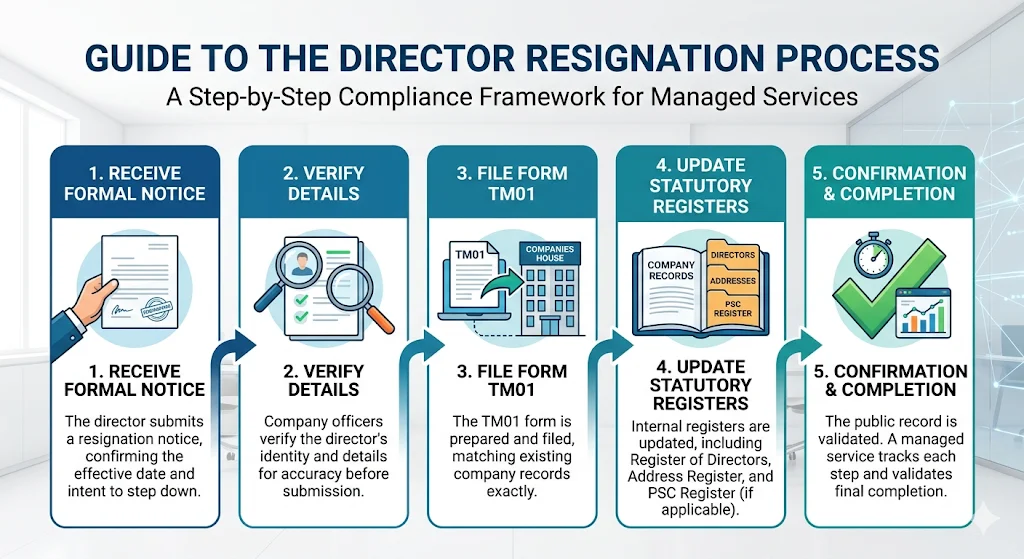
The Director Resignation process includes receiving formal notice, preparing resignation documentation, filing TM01 with Companies House, updating statutory registers, and confirming removal from official records within defined compliance timelines.
The process begins when the director submits a resignation notice. This document confirms the effective date and intent to step down.
Next, company officers verify the director’s identity and details. This ensures accuracy before submission.
The TM01 form is then prepared and filed. This filing notifies Companies House of the resignation. It must match existing company records exactly.
After submission, the company updates internal registers. These include:
- Register of directors
- Register of directors’ residential addresses
- PSC register if applicable
Final confirmation ensures Companies House reflects the change publicly. A managed service tracks each step and validates completion.
What risks arise from handling Director Resignation internally?
Handling Director’s resignation internally increases the risk of filing errors, missed deadlines, incomplete register updates, and legal exposure due to non-compliance with Companies House requirements.
Manual handling introduces inconsistencies. Small errors in names, dates, or formatting lead to rejected filings.
Missed deadlines create compliance breaches. Companies House expects filings within specific timeframes. Delays can result in penalties or reputational damage.
Internal teams often overlook secondary updates. For example, failing to update PSC records creates governance gaps.
There is also a legal risk. If a resigned director remains listed, liability confusion arises during disputes or audits.
A structured service eliminates these risks by applying validation checks at each stage.
How does a managed service improve compliance accuracy?
A managed service improves compliance accuracy by applying verification protocols, automated validation checks, and standardised filing procedures aligned with Companies House requirements.
Compliance accuracy depends on precision. Managed services use structured systems to eliminate guesswork.
Three verification methods ensure accuracy: identity validation using official records, data matching against Companies House formats, and automated error detection before submission.
These systems reduce rejection rates significantly. They also ensure that all related records update simultaneously.
From My Company applies these validation layers to every Director Resignation case. This ensures consistent compliance across all filings.
When should you activate a Director Resignation service?
You should activate a Director Resignation service immediately after receiving a resignation notice to ensure timely filing, accurate record updates, and uninterrupted compliance with UK corporate governance laws.
Timing directly affects compliance. Once a resignation is confirmed, the filing process must begin without delay.
Early activation ensures all documents are prepared correctly before submission. It also allows time for verification checks.
Delays create risks. For example, if filings occur after key transactions or audits, discrepancies may trigger regulatory scrutiny.
A managed service ensures that all deadlines are met and that records reflect real-time governance changes.
Also explore,
Book Your Professional Consultation for Director Resignation and Board Removal Advice Today
Purchase Our Expert Director Resignation Support and Ensure Accurate Statutory Filing Records
How does this service differ from removing a director?
Director Resignation is a voluntary process initiated by the director, while removal involves shareholder or board action under formal procedures, making the compliance steps and legal implications distinctly different.
The distinction affects documentation and authority. A resignation requires written notice from the director. Removal requires formal resolutions and voting procedures.
Each process follows different legal frameworks. Filing requirements also differ depending on how the director exits.
Understanding this difference ensures correct filings. Incorrect classification leads to compliance errors.
For a deeper breakdown, refer to this explanation of director resignation vs board removal differences to understand how each process impacts governance. Also, read the article on the importance of updating your PSC register immediately after a director’s resignation and director resignation vs board removal differences.
What makes From My Company’s service operationally efficient?
From My Company’s managed Director Resignation service uses structured workflows, compliance validation systems, and direct Companies House integration to ensure fast, accurate, and fully compliant board updates.
Operational efficiency depends on systemisation. From My Company uses predefined workflows that standardise every step.
Each case follows a fixed sequence: data validation, document preparation, submission, and confirmation. This reduces variability.
Integration with Companies House accelerates processing. Submissions occur digitally, reducing manual delays.
The service also tracks completion status. This ensures no step remains incomplete.
You can initiate the process through this Director Resignation service, designed to streamline board updates and ensure compliance accuracy.
How does this service support broader corporate governance?
A managed Director Resignation service strengthens corporate governance by ensuring accurate leadership records, maintaining regulatory compliance, and supporting transparent decision-making structures within the company.
Corporate governance relies on accurate data. Director records define authority, responsibility, and accountability.
When records are correct, decision-making structures remain clear. This supports audits, investor reviews, and regulatory assessments.
Governance frameworks also depend on transparency. Public records must reflect actual leadership.
A managed service ensures alignment between internal governance and public filings. This reduces discrepancies and improves organisational integrity.
A Director Resignation is a compliance-critical process that requires precision, timing, and accurate record management. Errors or delays affect legal standing and governance clarity.
From My Company delivers a structured solution that ensures filings are accurate, registers are updated, and Companies House records reflect real-time changes. This approach removes administrative risk and maintains full compliance.
Frequently Asked Questions
How do I notify Companies House of a director resignation in the UK?
You notify Companies House by filing form TM01 with accurate director details and the resignation date. From My Company’s Director, the resignation service validates and submits this filing to ensure compliance and prevent rejection due to errors.
How long does it take to process a Director’s Resignation?
Companies House typically processes a Director’s Resignation within 24 to 48 hours after submission. From My Company ensures the filing is completed promptly and updates statutory registers without delays.
Is it mandatory to update company records after a director resigns?
Yes, UK law requires updating internal registers such as the register of directors and PSC records immediately after a Director’s resignation. From My Company’s Director, Resignation service ensures all records align with Companies House filings.
Can a director resign without board approval in the UK?
A director can resign voluntarily by submitting a formal notice, and board approval is not required for the resignation itself. From My Company ensures the Director’s resignation is properly documented and filed according to legal requirements.
What happens if a Director’s Resignation is not filed correctly?
Incorrect or delayed filings can lead to rejected submissions, compliance breaches, and inaccurate public records. From My Company’s Director, Resignation service applies verification checks to ensure filings meet Companies House standards.