
Yes, you can fully register a UK limited company from Pakistan without visiting the UK, using online Companies House services and a UK registered office address. This process typically takes 24–48 hours for incorporation, enabling Pakistani entrepreneurs to access global markets seamlessly. Form My Company streamlines this with expert support tailored for international founders.
Registering a UK company from Pakistan has become a strategic move for entrepreneurs seeking to tap into one of the world’s most stable economies and business-friendly environments. With the UK’s Companies House allowing entirely digital incorporation, Pakistani business owners can establish a private limited company (Ltd) remotely, bypassing the need for physical presence. This approach is particularly appealing given Pakistan’s growing startup ecosystem and the UK’s advantages like lower corporate tax rates (19–25% post-2023 reforms), access to the English legal system, and credibility with international banks and clients.
The process leverages the Companies Act 2006, which mandates only a UK-registered office, at least one director (who can reside abroad), and standard filings like memorandum and articles of association. Semantic keywords such as “UK company formation from overseas” and “non-UK resident director” highlight the flexibility, but success hinges on compliance with anti-money laundering (AML) checks and accurate documentation. For Pakistani founders, challenges like time zone differences (GMT+5 vs UK GMT) and sourcing a compliant registered office can arise, yet services like Form My Company mitigate these by providing virtual addresses and handling submissions.
This guide draws on official Companies House guidelines and practical insights from thousands of successful international registrations. Whether you’re launching an e-commerce venture, tech startup, or trading entity, understanding the nuances ensures your UK company is operational quickly, compliant, and positioned for growth. We’ll cover every step, risks, and best practices to empower your decision-making.
Step-by-Step Guide to Registering a UK Company from Pakistan
Incorporating a UK private limited company from Pakistan follows a structured, online process via the Companies House WebFiling service or authorised agents. Begin by choosing your company structure—most opt for a private company limited by shares (LTD), ideal for small to medium enterprises with limited liability protecting personal assets.
Step 1: Prepare Essential Documents and Details. Gather your passport scans (as ID for directors/shareholders), proof of address (utility bill from Pakistan), and proposed company name. Use the Companies House name availability checker to ensure uniqueness—avoid offensive terms or similarities to existing firms. Decide on share capital (minimum £1, often 100 shares at £1 each) and appoint directors/shareholders; non-UK residents qualify, but list a UK service address for public records (personal home addresses remain private).
Step 2: Secure a UK Registered Office Address. Legally required under Section 87 of the Companies Act, this must be a physical UK postcode for official mail. Pakistani residents can’t use home addresses, so opt for virtual office services (e.g., Form My Company’s London or Manchester options at £50–£100/year). This address appears on Companies House records and your website’s imprint.
Step 3: File Incorporation Online. Create a Companies House account (free), then submit Form IN01 digitally. Include memorandum (shareholder agreement to form the company), articles (governance rules—use Model Articles for simplicity), and director details (SIC codes for business activity, e.g., 47910 for online retail). Pay £12 (WebFiling) or £50 (same-day software service). Approval yields a Certificate of Incorporation within 24 hours, assigning your company number.
Step 4: Post-Incorporation Setup. Open a UK business bank account (remotely via Barclays, HSBC, or fintechs like Wise Business—requires incorporation certificate). Register for Corporation Tax (unique taxpayer reference via HMRC online, within 3 months of trading). If employing staff or VAT-eligible (£90,000 threshold 2026), set up PAYE/VAT via HMRC portal.
From Pakistan, time it for UK business hours (9am–5pm GMT) to expedite queries. Total cost: £100–£500 including address and agent fees. Examples: A Lahore-based importer registers “PakUK Traders Ltd” in 48 hours, gaining EU market access.
This process ensures compliance while minimising bureaucracy, positioning your firm for VAT registration (if turnover exceeds threshold) and shareholder dividends.

Benefits and Potential Risks of UK Company Formation from Pakistan
Establishing a UK company offers Pakistani entrepreneurs substantial benefits, starting with enhanced credibility. A .ltd entity signals professionalism to global clients, easing partnerships and funding—UK startups raised £18.7 billion in 2025 per Beauhurst data. Tax efficiency shines: 19% corporation tax on profits (rising to 25% for £250k+ profits), plus R&D credits unavailable in Pakistan. No withholding tax on dividends to non-residents, and double taxation relief via UK-Pakistan treaty avoids double bites.
Market access expands via UK’s post-Brexit trade deals (140+ countries), ideal for exports. Banking perks include multi-currency accounts and Stripe/PayPal integration without local hurdles. Limited liability shields personal finances, crucial for high-risk ventures.
However, risks loom. Non-compliance with annual Confirmation Statements (£13 fee) or Accounts filing (to Companies House/HMRC) incurs £150–£1,500 fines. AML scrutiny delays bank accounts for overseas directors—prepare certified translations for Pakistani documents. Currency fluctuations (PKR vs GBP) impact setup costs, and without a UK presence, audits may flag “dormant” status if inactive.
Currency repatriation under Pakistan’s State Bank rules requires SBP approval for investments abroad, potentially complicating fund flows. Intellectual property protection is robust (UKIPO filings), but enforcement from Pakistan demands agents. Weigh these: benefits outweigh for scalable businesses, but consult advisors for personalised risk assessment.
Legal and Compliance Considerations for Non-Resident Directors
UK law under Companies Act 2006 permits 100% foreign ownership and non-resident directors/shareholders, with no minimum capital or residency mandates. Directors owe fiduciary duties (act in company’s best interest, avoid conflicts), enforceable globally via courts. PSC Register (Persons with Significant Control) must identify owners with >25% shares/votes—file within 14 days of incorporation.
Ongoing compliance includes: Annual Confirmation Statement (details unchanged?), Micro-Entity Accounts (turnover <£632k), and CT600 tax returns. VAT registration mandatory over £90k (voluntary below for reclaiming input tax). PAYE for UK employees (20%+ thresholds trigger). Late filings trigger strikes-off, dissolving the company.
For Pakistanis, FATCA/CRS reporting shares financial data with FBR, ensuring transparency. GDPR applies if handling EU data—appoint a UK representative (£2,400/year fine otherwise). Annual returns cost £100–£300 via accountants.
Form My Company ensures EEAT-compliant setups, handling SIC codes (e.g., 62012 for software) and dormant filings if pre-trading.
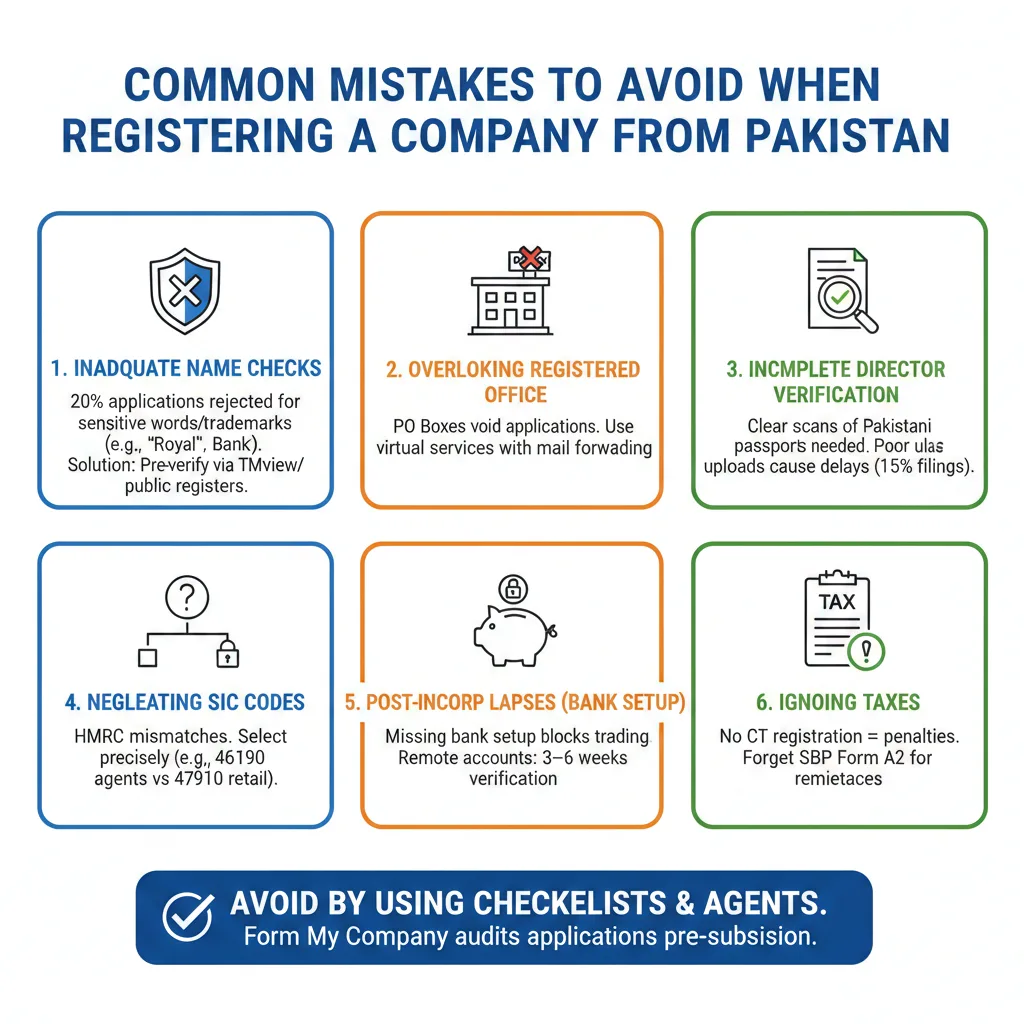
Common Mistakes to Avoid When Registering from Pakistan
A frequent pitfall is inadequate name checks—Companies House rejects 20% of applications for sensitive words (e.g., “Royal”, “Bank”) or trademarks. Solution: Pre-verify via TMview and public registers.
Overlooking registered office leads to rejection; using PO Boxes voids applications. Opt for compliant virtual services with mail forwarding.
Incomplete director verification: Pakistani passports need apostille? No, but scans must be clear; delays from poor uploads plague 15% of filings.
Neglecting SIC codes results in HMRC mismatches—select precisely (e.g., 46190 agents vs 47910 retail).
Post-incorp lapses like missing bank setup block trading; remote accounts demand 3–6 weeks verification.
Ignoring taxes: Trading without CT registration invites penalties. Pakistanis forget SBP Form A2 for remittances.
Avoid by using checklists and agents—Form My Company audits applications pre-submission.
Practical Tips and Best Practices
Select LTD for liability protection; use Table A articles. Budget £200–£1,000 first year (incorporation £12, address £99, accounting £300). Leverage free HMRC webinars for VAT/PAYE.
Integrate tools: Xero for accounts, Stripe for payments. Network via UK-Pakistan Business Council.
Scale with SEIS/EIS for investor tax relief. Maintain records digitally for audits.
Outsource compliance to build trust.
FAQs
Can a Pakistani resident be the sole director of a UK company?
Yes, Companies House allows non-UK resident sole directors. Provide ID and service address; no UK director required. Duties apply universally—act diligently.
How long does UK company registration take from Pakistan?
24–48 hours via WebFiling; same-day (£50) possible. Delays from name issues or docs.
Do I need a UK bank account immediately?
Recommended post-incorporation for trading. Remote options like Tide or Starling verify via certificate.
What are ongoing costs for a UK company?
£13 Confirmation, £100–£500 accounts, £50–£150 address, tax advisor £500+.
Is VAT registration compulsory from day one?
No, threshold £90k; voluntary for reclaims.
Registering a UK company from Pakistan unlocks global opportunities with minimal barriers, provided you navigate compliance meticulously.
If you’re ready to register your company with confidence, Form My Company provides fast, fully online company formation with expert compliance support, VAT & PAYE setup, virtual office addresses, and professional guidance. Get started today and let our specialists handle the paperwork while you focus on growing your business.