
A professional registered office address is essential for UK startups to meet Companies House requirements, protect director privacy, and build credibility with banks, investors, and clients. Using your home address risks public exposure and perceived unprofessionalism, while a prestigious business address signals legitimacy from day one. Opting for a compliant service ensures seamless company formation and ongoing compliance without operational headaches.
For new businesses undergoing company formation in the UK, selecting the right registered office address is a foundational decision that extends far beyond mere paperwork. Under the Companies Act 2006, every limited company must maintain a physical UK address where official documents from Companies House, HMRC, and other authorities can be served. This address appears on the public register, making it visible to anyone searching your company details, which underscores the need for a professional solution over residential alternatives.
In 2026’s competitive landscape, startups face heightened scrutiny during VAT and PAYE registrations, banking applications, and investor pitches. A professional registered office often provided via virtual office services offers not just compliance but strategic advantages like enhanced branding and administrative support. Directors and shareholders benefit from privacy protection and streamlined operations, allowing focus on growth rather than bureaucracy. This guide explores why startups cannot afford to overlook this critical element.
Step-by-Step: Why a Professional Address Matters
Establishing the necessity involves understanding legal mandates and practical implications through a structured evaluation.
1. Verify Legal Requirements for Company Registration
The first step is recognising that Companies House mandates a registered office in the UK (England/Wales, Scotland, or Northern Ireland matching your incorporation jurisdiction). It must be a physical location not a PO Box capable of receiving statutory mail. During company formation, your incorporation documents (IN01 form) list this address, which becomes public immediately upon approval, typically within 24 hours.
Home addresses suffice legally but expose personal details, including directors’ and shareholders’ residences, to public view. A professional service provides a compliant alternative, often with mail scanning and forwarding, ensuring you never miss critical notices like annual confirmation statements or tax demands.
2. Assess Credibility Impact on Stakeholders
Next, consider how the address influences perceptions. Banks require a verifiable business address for account opening, often rejecting home-based setups as “non-commercial.” A City of London or Manchester address impresses investors, facilitating funding rounds. For VAT registration, HMRC cross-checks against trading activity; a professional address bolsters applications.
3. Evaluate Ongoing Compliance Needs
Finally, factor in maintenance. Changes require Companies House filings (DS01 form, £8-£30 fee), while non-compliance risks fines (£150+) or strike-off. Professional providers handle updates seamlessly, integrating with PAYE setups and director service addresses.

Benefits and Potential Risks
A professional registered office delivers multifaceted value, though missteps carry consequences.
Key Benefits for Startups
Privacy protection is paramount: Directors list a service address publicly, shielding homes from spam, creditors, or stalkers vital for high-profile founders. Credibility surges; a prestigious postcode like EC2 enhances B2B trust, aiding contracts and partnerships. Administrative ease includes daily mail scans emailed securely, with forwarding options, saving time for lean teams.
Cost-effectiveness shines: £10-£50/month vs. commercial lease thousands. Scalability supports growth upgrade to virtual offices with meeting rooms. For international startups, it establishes UK presence for VAT thresholds (£90,000 turnover). Example: A SaaS firm registers via Form My Company, secures a Mayfair address, lands a £500k investment citing “professional footprint.”
Potential Risks of Subpar Choices
Using unregulated providers risks Companies House rejection if non-compliant. Home addresses deter banks (e.g., Barclays’ 2025 policy flags residential for SMEs). Over-reliance on free options exposes data breaches, undermining GDPR compliance for shareholders’ info.
Legal and Compliance Considerations
Navigating UK law demands precision to avoid pitfalls.
Companies House and HMRC Obligations
The registered office receives all statutory post: winding-up petitions, tax assessments, court documents. Section 87 of the Companies Act 2006 requires it effective immediately. Failure invites £5/day late penalties. For VAT/PAYE, HMRC verifies addresses during mandatory registrations post-formation; mismatches delay approvals.
Directors’ service addresses (public but separate) protect privacy under data protection laws. Professional services ensure AML/KYC compliance, as providers must verify identities per Money Laundering Regulations 2017.
Implications for Business Structures
Sole directors benefit most, but multi-shareholder setups gain from neutral addresses avoiding disputes over personal use. Limited by Guarantee or PLCs face stricter scrutiny; professional addresses affirm legitimacy.
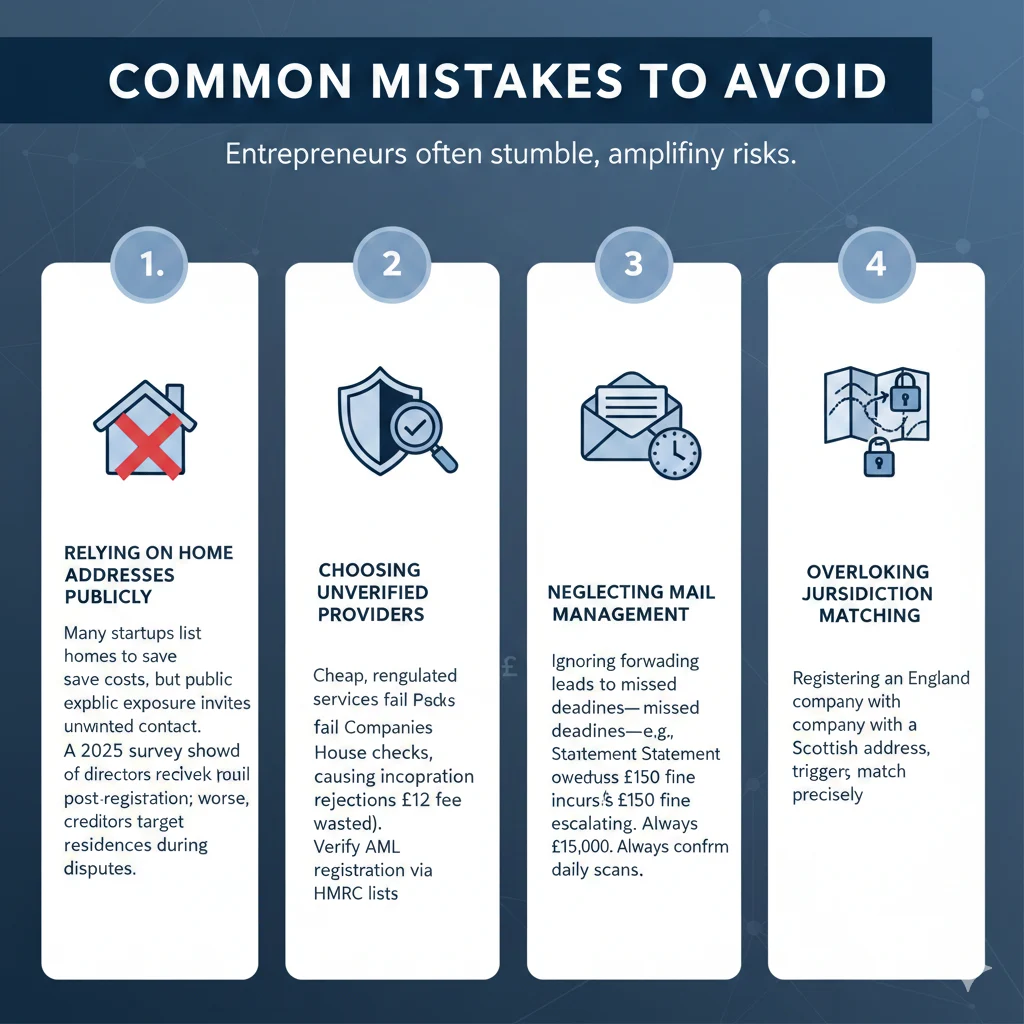
Common Mistakes to Avoid
Entrepreneurs often stumble, amplifying risks.
1. Relying on Home Addresses Publicly
Many startups list homes to save costs, but public exposure invites unwanted contact. A 2025 survey showed 40% of directors received junk mail post-registration; worse, creditors target residences during disputes.
2. Choosing Unverified Providers
Cheap, unregulated services fail Companies House checks, causing incorporation rejections (£12 fee wasted). Verify AML registration via HMRC lists.
3. Neglecting Mail Management
Ignoring forwarding leads to missed deadlines, e.g., Confirmation Statement overdue incurs £150 fine escalating to £1,500. Always confirm daily scans.
4. Overlooking Jurisdiction Matching
Registering an England company with a Scottish address triggers rejection; match precisely.
Practical Tips and Best Practices
Implement these for optimal results.
1. Select Prestigious Yet Affordable Locations
Prioritise London, Manchester, or Birmingham postcodes. Providers like Form My Company offer tiered plans: basic (£15/month) to premium (£99 with calls).
2. Bundle with Formation Services
Integrate during incorporation for one-stop compliance: registered office + director protection + VAT setup.
3. Set Up Automated Monitoring
Use provider dashboards for mail alerts; link to accounting software for HMRC sync.
4. Plan for Growth Transitions
Start professional, upgrade to serviced offices seamlessly without refiling.
A professional registered office address underpins successful UK company formation, safeguarding privacy, ensuring compliance, and elevating your startup’s profile. Avoid home addresses’ pitfalls; invest in a service aligning legal needs with business ambitions.
If you’re ready to register your company with confidence, Form My Company provides fast, fully online company formation with expert compliance support. From professional registered office addresses and virtual offices to VAT & PAYE registration, our specialists handle everything. Get started today and let our team manage the details while you focus on growing your business.
Frequently Asked Questions
1. Is a professional registered office mandatory for UK startups?
No, but Companies House accepts any physical UK address. However, professionals recommend it for privacy, credibility, and compliance efficiency during VAT/PAYE registrations.
2. How much does a registered office service cost?
£10-£100/month, depending on features like mail forwarding. Far cheaper than commercial rents (£500+/month), with full Companies House compliance.
3. Can it serve as my trading address too?
No, the registered office is legal only; use separately for operations. Virtual offices bridge both with optional meeting access.
4. What if I change addresses later?
File form AD01 with Companies House (£8 online). Providers assist, notifying HMRC automatically for PAYE/VAT continuity.
5. Does it help with bank accounts or investors?
Yes, banks like HSBC prioritise commercial addresses; investors view residential as risky, delaying funding.