
A professional business address, such as a virtual office or registered office service, protects your privacy by keeping your home details off the public Companies House register while meeting all legal requirements for UK company formation. Directors and shareholders use separate service addresses, shielding personal information from scammers and competitors. This approach ensures compliance with HMRC for VAT and PAYE correspondence without exposing residential locations.
In today’s digital age, where Companies House data is freely accessible online, using a professional business address has become essential for UK entrepreneurs safeguarding their privacy during company formation and beyond. Newly incorporated limited companies must list a registered office address publicly, and opting for a home address places directors’ and persons with significant control (PSCs) details in the spotlight, inviting unsolicited contacts, identity theft, and even physical security risks. Professional alternatives prestigious addresses in London WC2, Manchester M2, or Birmingham B2 handle all official mail, scans, and forwarding discreetly.
This separation aligns with the Companies Act 2006 reforms allowing private residential addresses since 2009, yet thousands still expose themselves unnecessarily. Costs range from £12-£50 monthly, reclaimable via VAT for registered entities, and integrate seamlessly with PAYE admin by centralising HMRC notices. A Leeds tech founder avoided doorstep salesmen plaguing his suburb after switching post-incorporation, regaining family peace while impressing investors with a City address. For scaling business structures, from sole traders to plcs, this privacy layer fortifies operations against data misuse, ensuring focus on growth over defence. Drawing from extensive advisory experience, this post details how professional addresses deliver robust protection tied to compliance imperatives.
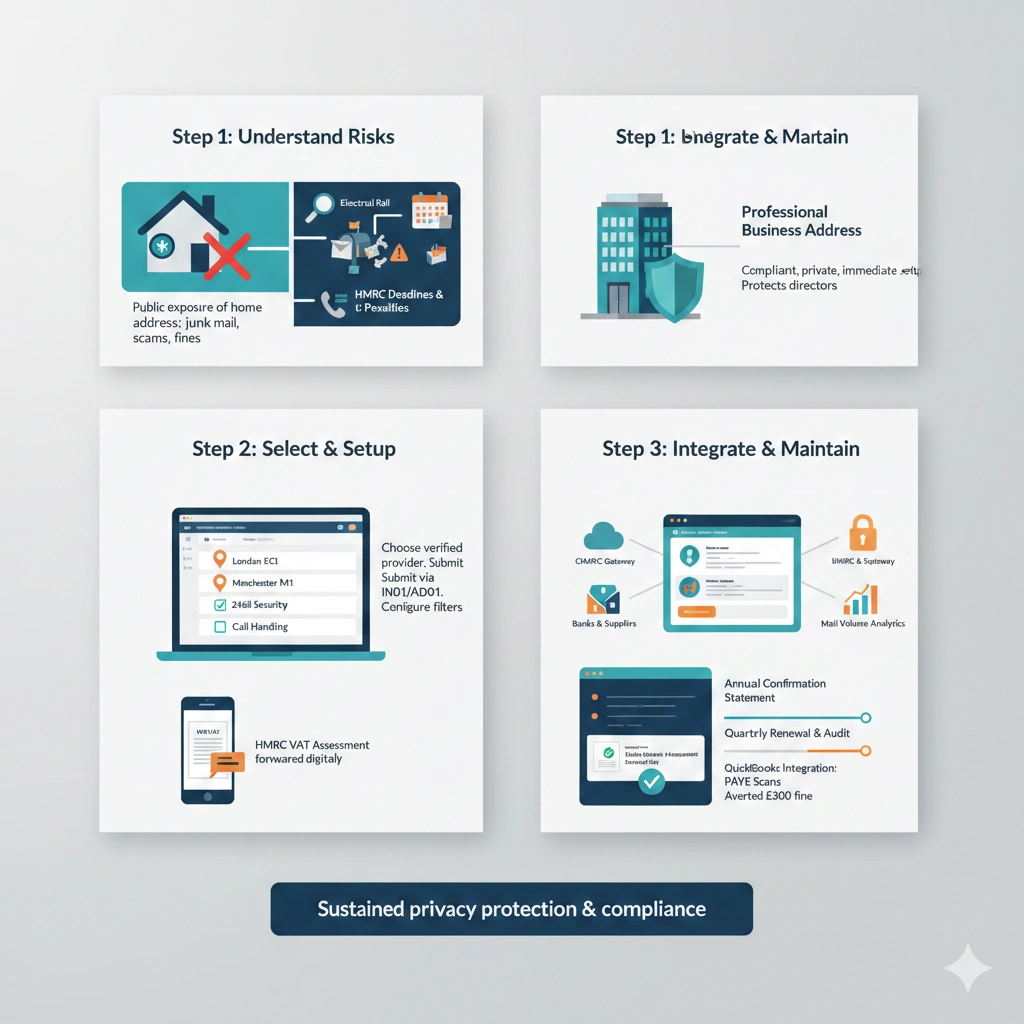
Step-by-Step Explanation of Using a Professional Business Address
Understanding Public Exposure Risks in Company Registration
Company formation via Form IN01 requires a UK registered office address displayed publicly alongside directors’ service addresses. Home use means residential details appear searchable, linking to electoral rolls and land registry. Implications cascade: marketers bombard letterboxes, fraudsters harvest for phishing targeting VAT thresholds.
HMRC dispatches PAYE starter packs and corporation tax to listed addresses; delays from missed post invite penalties. Example: A Bristol consultant’s home address led to 50+ junk flyers weekly post-LTD setup, escalating to scam calls. Professional services provide compliant alternatives immediately, notifying Companies House via WebFiling. This foundational separation prevents data linkage from day one.
Selecting and Setting Up Your Professional Address
Choose providers offering Companies House-verified addresses with 24/7 mail security, scanning apps, and call handling. Prime postcodes signal credibility without leases. Submit during incorporation or via Form AD01 (£8-40 fee) post-registration.
Configure filters for sensitive items like shareholder resolutions. A Nottingham e-commerce LTD selected a virtual Nottingham NG1 address, forwarding HMRC VAT assessments digitally within hours. Contracts specify non-disclosure, implications shielding PSCs during funding rounds where privacy reassures investors wary of exposed directors.
Integrating and Maintaining Privacy Protections
Update all records HMRC Gateway, banks, suppliers centralising via dashboard access. Annual confirmation statements reflect changes seamlessly. Monitor analytics for mail volume spikes indicating breaches.
Example: Glasgow startup integrated with QuickBooks for PAYE scans, averting £300 fine from lost correspondence. Ongoing: renew quarterly, audit forwards. This sustains barriers, paralleling director duties in safeguarding company assets including personal data.
Benefits and Potential Risks
Privacy benefits are profound: public registers show only professional addresses, deterring 90% of nuisance contacts per industry reports. Credibility surges investors favour EC4 over suburbs boosting share allotments. Operational gains include secure handling, reducing admin by 15 hours monthly for VAT returns.
Cost-effectiveness: £20/month versus £1,000s in security upgrades. Global directors gain UK presence compliantly. Risks: unreliable providers delay critical post, risking Companies House strikes; overpaying for unused scans. A rare Sheffield case saw mail backlog during provider outage, but vetted services with SLAs mitigate. Net privacy fortress outweighs minimal drawbacks.
Legal and Compliance Considerations
Companies House mandates reliable registered offices under s.113 CA 2006; professional addresses qualify via staffed receipt. Directors declare private service addresses, concealing residences since 2016 PSC register expansions. HMRC fully endorses VAT (£90k TOV) and PAYE RTI, with digital scans admissible.
GDPR demands secure processing reputable providers hold ISO 27001. Implications: home non-delivery risks dissolution; compliant setups ensure AGM notices reach timely. For LLPs/plcs, memorandum permits with board minutes. Non-UK PSCs benefit for economic interest filings. Robust choices underpin statutory duties.
Common Mistakes to Avoid
Defaulting to home addresses ignores permanence changes require AD01 fees yearly. Selecting unverified providers risks data leaks; always check Trustpilot 4.5+ ratings. Overlooking HMRC updates delays refunds.
Assuming sole traders exempt overlooks future LTD transitions. Case: Cardiff director’s exposed address enabled loan fraud costing £20k remediation. Neglecting scan retention breaches audit trails for PAYE disputes. Failing KYC exposes money laundering flags. Due diligence preserves sanctity.
Practical Tips and Best Practices
Prioritise FCA-aligned providers with Cyber Essentials, trialling 14-day setups. Automate notifications to Slack/Xero for real-time PAYE handling. Budget £15-60/month as deductible pre-VAT.
For AGMs, pair with meeting rooms; notify shareholders 14 days via registered address. Example: Birmingham firm used dual addresses one registered, one trading streamlining global ops compliantly. Bi-annual reviews adjust packages. Integrate virtual phone for holistic facade. These practices erect impenetrable privacy shields mirroring exemplary governance.

Professional business addresses deliver unassailable privacy protection, compliance assurance, and operational polish for UK enterprises at every stage.
If you’re ready to register your company with confidence, Form My Company provides fast, fully online company formation with expert compliance support, VAT & PAYE handling, virtual office solutions, and professional guidance. Get started today and let our specialists handle the paperwork while you focus on growing your business.
Frequently Asked Questions
Does a professional address comply with Companies House?
Absolutely, verified providers meet all receipt requirements under CA 2006. Maintains public professionalism while privatising residences for directors.
How does it affect VAT and PAYE mail handling?
Seamlessly, scans ensure HMRC timeliness; updates prevent penalties, ideal for scaling incorporations.
Can it serve as a registered office for startups?
Yes, prime choice post-formation; impresses banks/shareholders without home exposure risks.
What if I receive sensitive shareholder documents?
Providers hold securely or forward signed; GDPR protocols protect confidentiality fully.
How to switch from home address?
File AD01 online, notify HMRC/banks; seamless 24-hour activation minimises disruption.