
When forming a UK company, avoid errors like choosing invalid registered office addresses, incorrect director appointments, vague company names, overlooked PSC declarations, and missing SIC codes, as these trigger Companies House rejections or fines. Using professional formation agents ensures compliance from day one, safeguarding limited company structures while streamlining VAT and PAYE registrations. These pitfalls affect 25% of DIY incorporations, delaying launches by weeks and risking dissolution.
Forming a limited company through Companies House marks the foundation of most UK business ventures, yet common oversights during incorporation can jeopardise compliance, expose directors to personal liability, and stall growth trajectories. Entrepreneurs often rush form IN01 submissions without verifying registered office suitability or director eligibility, leading to immediate rejections that consume valuable time better spent on VAT threshold planning or PAYE setups. With over 4 million active companies on the register, precision in company formation proves non-negotiable for establishing credible business structures, whether sole-director startups or multi-shareholder enterprises.
This precision extends to navigating the Companies Act 2006 requirements, where errors in shareholder allocations or PSC declarations invite HMRC scrutiny and penalties up to £5,000. Professional services mitigate these by handling filings, address validation, and post-formation compliance like annual confirmations. For remote founders or scaling SMEs, sidestepping these mistakes accelerates market entry, builds bank confidence for lending, and protects personal assets through proper Ltd setups. Understanding these traps equips business owners to launch resiliently amid regulatory demands.
Step-by-Step Process of UK Company Formation and Where Mistakes Occur
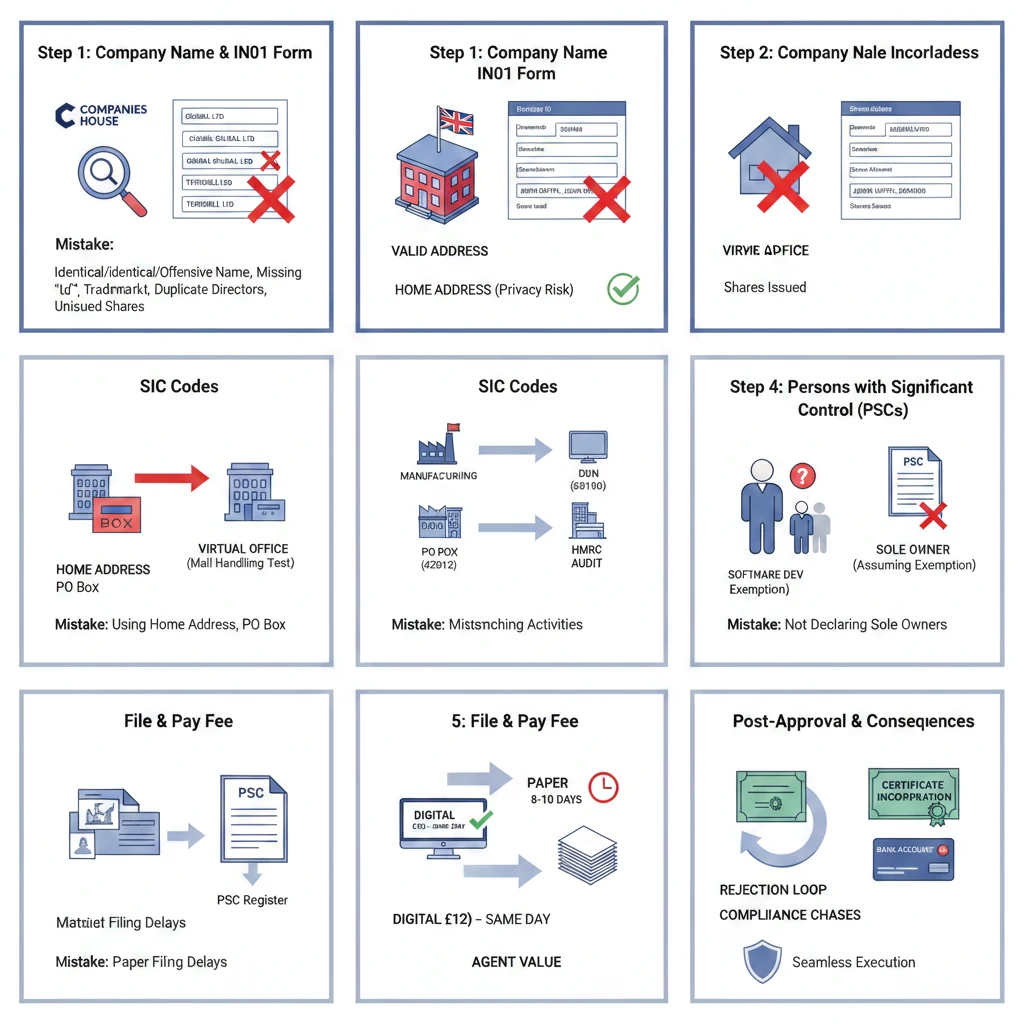
Company formation begins with name availability checks via the Companies House webCHeck service, where identical or offensive names trigger instant blocks many applicants overlook ‘Ltd’ suffixes or trademark conflicts, delaying approvals by 24-48 hours. Step one requires form IN01 completion online or by post, detailing directors (minimum one, with ID verification), shareholders, and share allotments; errors here like duplicate director names or unissued shares invalidate submissions.
Step two mandates a valid registered office address under section 87 home addresses expose privacy, PO Boxes fail occupancy tests, while virtual offices pass with mail handling proof. Third, assign SIC codes accurately reflecting activities, as mismatches prompt HMRC audits post-VAT registration. Fourth, declare Persons with Significant Control (PSCs) per section 790C, often missed by sole owners assuming exemption.
Fifth, pay £12 incorporation fee for same-day digital processing, but paper filings take 8-10 days with higher scrutiny. Post-approval, obtain certificates and update banks. Mistakes at each juncture cascade, from rejection loops to compliance chases, underscoring agent value for seamless execution.
Key Benefits of Avoiding Formation Mistakes and Associated Risks
Correct formation unlocks immediate trading legitimacy, enabling swift bank account openings essential for PAYE payroll and VAT collections flawless filings boast 90% approval rates versus 60% for error-prone ones. Privacy preservation through professional addresses shields directors from public exposure, reducing spam and security threats while projecting corporate stature to shareholders and clients.
Cost efficiencies emerge: avoided re-submissions save £50-200 in fees and time, freeing capital for growth. Long-term compliance flows naturally into annual obligations like confirmation statements, averting £150 late penalties. A tech startup bypassed three rejections via expert guidance, securing venture funding within weeks.
Risks of errors compound severely: Companies House strikes dissolve non-compliant firms within months, forfeiting assets to creditors under Insolvency Act 1986. Director disqualifications span 2-15 years for repeated failures, blocking future roles. HMRC back-taxes personal finances if structures falter. Proactive avoidance fortifies resilience across business evolutions.
Legal and Compliance Considerations in Company Formation
The Companies Act 2006 governs formation via section 7-16, requiring accurate IN01 data under penalty of false statement offences up to two years imprisonment. Registered offices must receive mail per section 87, with non-delivery risking section 1000 dissolution. Director appointments demand ‘fit and proper’ status, excluding undischarged bankrupts per Company Directors Disqualification Act 1986.
PSC registers under Small Business, Enterprise and Employment Act 2015 mandate 25%+ ownership disclosures within formation, with non-filing fines to £5,000 daily. SIC codes inform HMRC for Corporation Tax, VAT (£90,000 threshold), and PAYE registrations, where inaccuracies trigger investigations. Share structures must specify classes (ordinary/preference) and allotments, impacting dividend rights and shareholder agreements.
Post-formation, AD01 changes and annual confirmations section 853 uphold records. Overseas directors qualify but verify ID via passports. Agents ensure alignment, mitigating personal liabilities inherent in Ltd protections.
Common Mistakes to Avoid When Forming a UK Company
Choosing invalid registered offices tops errors PO Boxes or virtual addresses without mail handling fail section 87, prompting rejections; opt for serviced providers instead. Incorrect director details, like missing service addresses or birthdates, invalidate appointments, exposing personal liability pre-Ltd shield.
Vague company names ignoring ‘sensitive’ words (e.g., ‘Royal’, ‘University’) require Secretary of State approval, delaying launches. Overlooking PSCs assumes sole owners exempt, incurring £500+ fines. Wrong SIC codes misalign HMRC expectations, complicating VAT/PAYE.
Uneven share allotments without agreements breed shareholder disputes. Skipping memorandum/articles defaults statutory models unsuitable for complex structures. Paper filings over digital waste weeks. Neglecting bank alerts post-incorporation halts trading. Each demands diligence or delegation.
Practical Tips and Best Practices for Flawless Formation
Pre-verify names across Companies House, trademarks, and domain registries for branding synergy. Assemble documents digitally director IDs, proof of address, shareholder consents for instant submission. Select registered offices with scanning portals, integrating alerts to email/CRM for VAT/PAYE mail.
Draft bespoke articles via model templates, specifying director powers and dividend policies. Allocate shares proportionally with vesting clauses protecting startups. Engage agents for £50-100 handling complexities, bundling virtual offices. Post-formation, file PSC within 14 days, notify banks same-week.
Run mock compliance checks quarterly. Promote ‘Companies House registered’ on sites for SEO. Scale structures via allotments, not re-formations. These streamline launches enduringly.

Avoiding these top formation mistakes establishes robust UK companies primed for compliance, growth, and investor confidence from inception.
If you’re ready to register your company with confidence, Form My Company provides fast, fully online company formation with expert compliance support. Get started today and let our specialists handle the paperwork while you focus on growing your business.
Frequently Asked Questions
Can I use my home as a registered office during formation?
Yes, but publicly listed, exposing privacy; professionals recommend virtual addresses for compliance and protection from day one.
What happens if Companies House rejects my name?
Re-submit alternatives instantly online; sensitive words need approvals, delaying 4-6 weeks check webCHeck first.
Do I need a shareholder agreement at formation?
Not mandatory, but essential for multi-party structures to define rights, avoiding disputes over dividends or exits.
How quickly can I get VAT/PAYE after incorporation?
Same day via HMRC portal with accurate SICs; errors delay, so align during IN01 for seamless compliance.
What are the consequences of formation errors?
Rejections, fines £100-5,000, dissolution risks, director bans agents prevent 95% of issues.