
Supplementary company documents support UK compliance by ensuring that all statutory, regulatory, and reporting obligations are properly documented and accessible. They provide detailed evidence of a company’s legal and operational structure, facilitating transparency, accountability, and trust with regulatory bodies.
For UK businesses, maintaining accurate supplementary documents is much more than an administrative requirement it’s a compliance necessity that underpins corporate credibility. From shareholder agreements and director registers to minutes of meetings and special resolutions, each document plays a crucial role in meeting Companies House and HMRC standards. Understanding their importance and how to manage them effectively can protect your business from penalties and improve governance readiness.
The Compliance Landscape for UK Companies
The UK’s corporate compliance framework is designed to ensure that all companies operate transparently and in line with legislation such as the Companies Act 2006. Compliance demands clear documentation of ownership, management, and decision-making processes. Supplementary company documents fill in the details that your core incorporation papers cannot, supporting evidence of how the company runs on a day-to-day basis.
In simple terms, these documents form the backbone of corporate record-keeping. Without them, businesses risk incomplete filings, legal disputes, and reputational harm.
What Are Supplementary Company Documents?
Supplementary company documents are the secondary records that complement foundational paperwork (e.g., Certificate of Incorporation or Articles of Association). They capture ongoing changes and governance decisions that affect your company’s structure or operations.
Common examples include:
- Director and shareholder registers
- Share certificates and transfer forms
- Minutes of board and shareholder meetings
- Company resolutions and agreements
- Statutory registers and PSC (Persons with Significant Control) records
Each document type serves a distinct purpose but collectively they demonstrate corporate transparency and regulatory alignment. For instance, updating a share register after issuing new shares is a statutory duty. Similarly, maintaining meeting minutes shows compliance with governance protocols.
Why Supplementary Company Documents Matter for UK Compliance
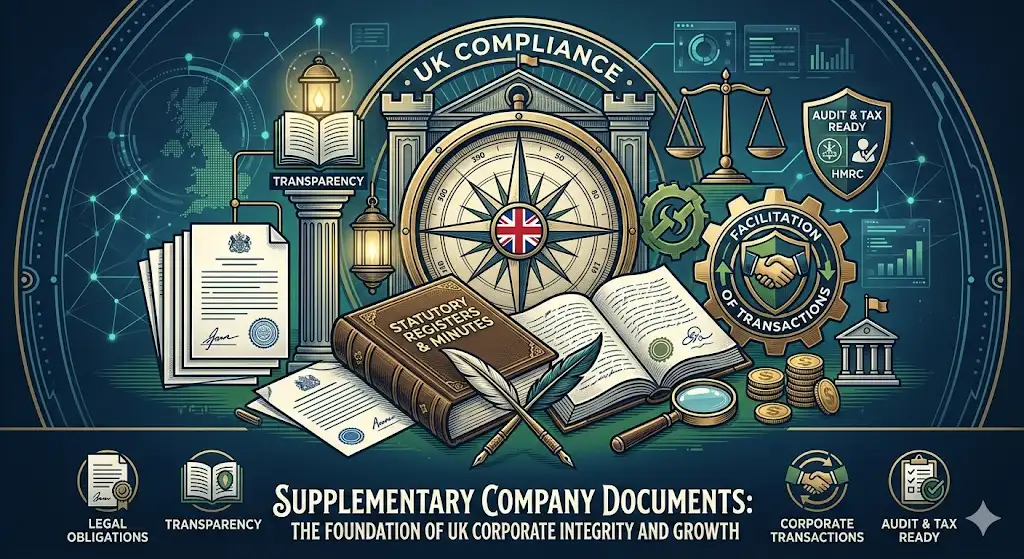
Maintaining supplementary company documents is essential for several reasons:
Legal and Statutory Obligations
UK companies are legally required to maintain certain records for inspection by regulators. For example, section 113 of the Companies Act 2006 mandates that an up-to-date register of members must always be accessible. Failing to comply can result in penalties or regulatory inquiry.
Transparency and Accountability
These records provide an auditable trail of corporate decisions. If the company is ever investigated, audited, or sold, well-organised documents demonstrate your commitment to proper governance and regulatory good practice.
Facilitation of Corporate Transactions
Transactions such as raising capital, restructuring, or mergers depend heavily on document clarity. Investors, banks, and due diligence teams review supplementary documents to verify ownership and confirm that all governance actions were validly taken.
Audit and Tax Readiness
Auditors and HMRC rely on company documentation to confirm financial integrity and reporting accuracy. Missing or incomplete supplementary records can delay audits or trigger compliance flags.
Key Documents and Their Compliance Functions
Each category of supplementary documentation serves specific compliance purposes:
Director and Shareholder Registers
Registers confirm who owns and controls the company. Maintaining them accurately ensures compliance with companies legislation, particularly around ownership transparency and PSC requirements.
Meeting Minutes
Minutes record board and shareholder decisions, confirming that directors act within their authority. They are particularly valuable during regulatory review or legal proceedings, providing continuity and accountability.
Share Issuance and Transfer Records
Such documents prevent disputes over ownership by clearly evidencing how shares have been issued or transferred. This transparency is critical during funding rounds or investor negotiations.
Company Resolutions
Written resolutions legally formalize major company decisions from appointing directors to approving new share classes. Keeping these resolutions up to date shows compliance with the Companies Act and Articles of Association.
Agreements and Contracts
Supplementary agreements (like director service contracts or shareholder agreements) clarify the ongoing rights and obligations of parties involved with the company. Properly managing them ensures contractual compliance and mitigates future disputes.
How Proper Documentation Supports Regulatory Alignment
Regulatory alignment isn’t achieved merely through filing annual returns or submitting accounts. It’s an ongoing process maintained through accurate recordkeeping.
Supplementary company documents provide continuous transparency allowing Companies House, regulators, and business partners to verify your company’s structure, governance, and operational integrity. They confirm, for instance, that director changes were legitimately approved, that issued shares were authorized, and that board meetings are held regularly in line with governance standards.
This documentation-driven compliance is essential for maintaining your company’s “good standing” and ensuring unbroken eligibility for various financial, contractual, or regulatory arrangements.
Common Risks When Documentation Is Neglected
Neglecting supplementary documents often leads to practical and legal problems:
- Outdated shareholder registers leading to disputes over control or dividends
- Missing meeting minutes undermining director accountability
- Absence of resolutions making corporate decisions unenforceable
- Gaps in statutory registers resulting in Companies House discrepancies
Such lapses not only attract fines but also reduce investor confidence. To see a deeper discussion of frequent filing and documentation errors, review our related article on informational, topic-focused guidance:
Common Mistakes with Supplementary Company Documents in UK.
Digital Management of Supplementary Documents
Modern compliance management increasingly depends on digital solutions. Electronic document systems and secure cloud storage tools simplify the process of organising, updating, and backing up company records.
Platforms used by professional filing services ensure that core and supplementary documents remain synchronized meaning updated registers automatically align with filing data submitted to Companies House. This reduces manual errors and ensures that regulatory deadlines are not missed.
However, digital handling must always comply with UK data protection law, ensuring sensitive information like director details is securely stored and shared only when rightfully required.

The Role of Supplementary Documents in Corporate Governance
Beyond legal obligations, supplementary documents reinforce sound corporate governance. They formalise decisions, clarify director and shareholder responsibilities, and maintain a historical record of how strategic choices were made.
For example, accurate board meeting minutes serve as evidence that governance decisions align with company policy and director duties under the Companies Act. Similarly, a complete register of members confirms ownership legitimacy. In regulated sectors such as finance, these records are examined routinely during compliance audits.
How to Maintain Supplementary Documents Effectively
To sustain full compliance and readiness for review, companies should adopt a structured documentation strategy:
- Schedule regular reviews of registers, minutes, and resolutions
- Record all changes immediately following board or shareholder actions
- Cross-verify that Companies House filings match internal records
- Securely archive past versions for the statutory retention period (typically six years)
Working with a professional document management partner like Form My Company ensures each step aligns with current UK regulations and best practices.
How Form My Company Simplifies Compliance
Form My Company provides experienced support for UK businesses seeking reliable Supplementary Company Documents management. Through precise record creation, audit preparation, and ongoing documentation services, the brand helps businesses maintain compliance integrity at every stage of their lifecycle.
By partnering with specialists who understand the intricacies of corporate filings, you reduce compliance risk and save valuable administrative time. This professional support also ensures consistency between company registers, corporate resolutions, and public filings a critical advantage when auditors, investors, or regulators review your company history.
To explore practical ways to protect and professionalise your company’s governance, learn about how to
secure supplementary company documents with expert support
through this commercial, decision-focused resource.
Final Thoughts
Effective compliance in the UK requires more than annual reports or public filings it depends on maintaining detailed, verifiable, and legally sound supplementary company documents. These records validate your company’s activities, strengthen governance practices, and protect operational continuity.
Whether your business is newly incorporated or established, maintaining compliant documentation is essential to staying on the right side of UK law. With Form My Company, you have a trusted partner to manage, update, and safeguard all supplementary records to ensure seamless regulatory alignment.
What are supplementary company documents in the UK?
Supplementary company documents are additional records that support a company’s legal and compliance responsibilities, such as shareholder registers, meeting minutes, and resolutions. From My Company helps businesses maintain these documents accurately to meet Companies House and UK regulatory standards.
Why are supplementary company documents important for compliance?
These documents demonstrate that a company is following the Companies Act 2006 and maintaining transparent records of decisions, ownership, and filings. With proper supplementary company documents, From My Company clients ensure accurate reporting and reduce the risk of compliance penalties.
How often should supplementary company documents be updated?
Supplementary company documents should be updated whenever key company details change—such as director appointments, share transfers, or resolutions. From My Company recommends reviewing and recording updates promptly to keep all filings consistent with Companies House records.
What happens if a business lacks proper supplementary company documents?
Missing or inaccurate supplementary company documents can lead to fines, disputes, and difficulties during audits or funding rounds. From My Company assists businesses in restoring or correcting documentation to ensure full compliance and corporate transparency.
Can supplementary company documents be stored digitally?
Yes, UK companies can securely maintain supplementary company documents in digital formats, provided data protection and access rules are followed. From My Company offers digital record management solutions to help businesses store and update documents efficiently and compliantly.