
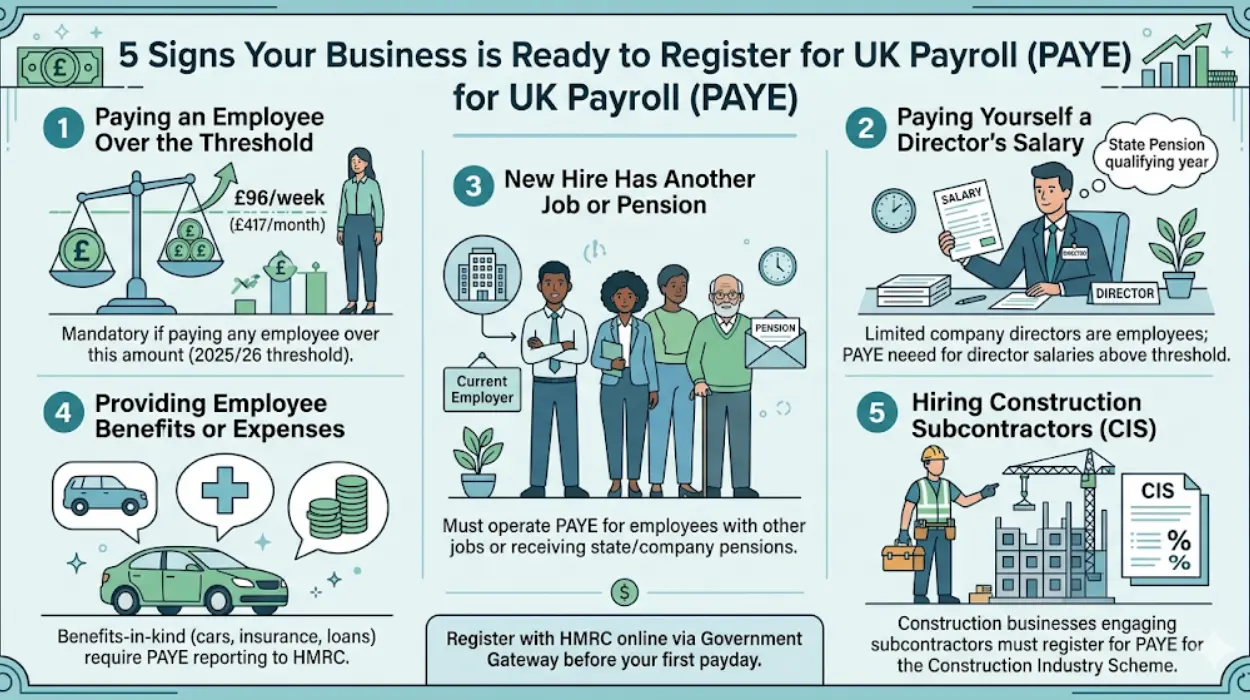
Your business is ready for UK payroll registration when it hires its first employee, exceeds £9,100 in annual payments to workers, expands beyond sole trader operations, faces HMRC compliance risks, or processes multiple payment cycles. These signs trigger mandatory PAYE setup.
From My Company guides UK businesses through this process. Registering for PAYE ensures compliance. It prevents penalties.
Does Your Business Have Employees Beyond Directors?
Hire at least one non-director employee, and you must register for PAYE within 5 days of paying them salary, tax, or benefits.
UK law requires PAYE registration for any employer paying employees. Directors count as employees if they receive salary. Non-director hires trigger immediate action. HMRC mandates registration via their online portal.
Payroll starts simple. One employee means one payslip. Calculate gross pay. Deduct income tax. Subtract National Insurance. Submit to HMRC monthly via Real Time Information (RTI).
Verify employee status first. Use HMRC’s employment status tool. Check contracts. Review working hours. Confirm control levels. Employees differ from contractors by rights and obligations.
68% of UK SMEs miss this step initially. They face £100 daily fines. Register early. Use government ID for verification. Submit form online.
Have You Exceeded the PAYE Threshold?
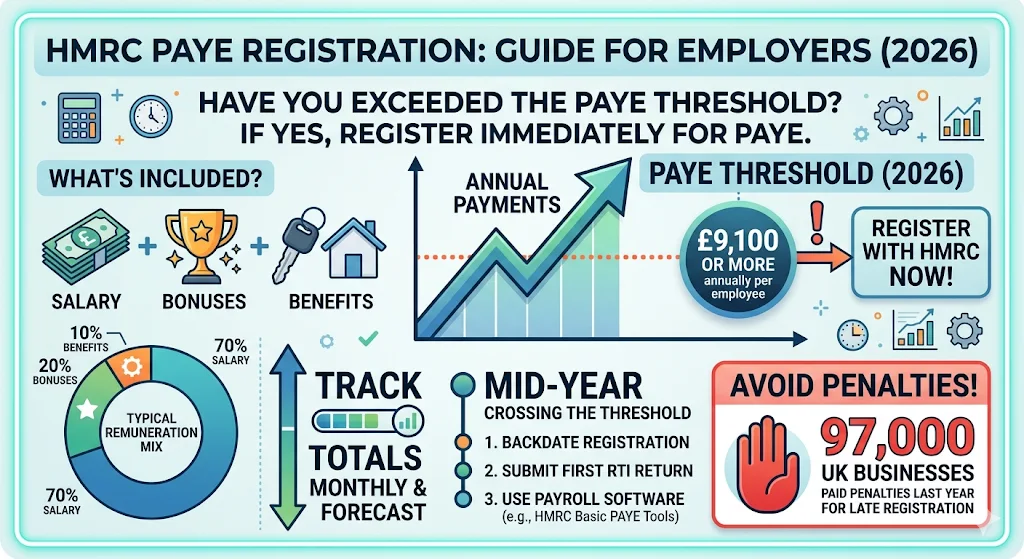
Pay over £9,100 annually to one or more employees, and register for PAYE immediately to deduct taxes correctly.
HMRC sets this threshold for 2026. It covers combined payments. Include salary, bonuses, and benefits. Track totals monthly.
Cross the line mid-year. Backdate registration. Submit first RTI return promptly. Use payroll software like HMRC’s Basic PAYE Tools for accuracy.
Break down payments. Salary forms 70% of total. Bonuses add 20%. Benefits like company cars count 10%. Authenticate each via payslips.
97,000 UK businesses paid penalties last year for late registration. Avoid this. Monitor payroll runs. Forecast annual totals.
Is Your Business Expanding Beyond Sole Trader Status?
Convert to limited company or partnership with payroll needs, and register for PAYE to handle director and employee taxes.
Sole traders pay Class 2 NICs directly. Limited companies use PAYE for all. Directors salary counts as employment income.
Register during incorporation. Link Companies House details to HMRC. Validate director identities with passport checks, biometric scans, and address validation.
Three key steps: Form company. Assign UTR number. Activate PAYE scheme. Process first payroll within 30 days.
Expansion hits 42% of startups in year two. They overlook PAYE. Result: audits and fines up to £3,000.
Are HMRC Compliance Risks Increasing?
Face audit notices or penalty warnings, and register for PAYE to demonstrate compliance and avoid escalating fines.
HMRC scans unregistered payrolls. They cross-check VAT returns against employee counts. Unregistered firms trigger investigations.
Comply via three methods: Online registration portal. Employer helpline. Postal forms for complex cases. Complete in under 10 minutes online.
Late registration incurs £100 per employee per day. 15,000 cases reported in 2025. Validate data upfront. Match NI numbers to records.
Build audit-proof records. Store RTI submissions. Retain payslips for 3 years. Use secure cloud storage.
Do You Process Multiple Payroll Cycles?
Run bi-weekly or monthly payroll for 5+ staff, and register for PAYE to automate RTI submissions and deductions.
Single payroll suits freelancers. Multiple cycles demand systems. PAYE handles frequencies: weekly, bi-weekly, monthly.
Set up cycles during registration. Assign pay dates. Calculate deductions per cycle. Submit RTI before or on payday.
Software integrates three ways: HMRC API feeds, CSV uploads, direct debits. 82% of compliant firms use automated tools.
Scale triggers complexity. 5 staff means 60 payslips yearly. Errors rise 25%. PAYE registration unlocks HMRC approvals for software.
Payroll scales with growth. Start manual. Migrate to automated. Always register first.
What Is PAYE Registration Exactly?
PAYE registration creates an HMRC employer account to deduct income tax and National Insurance from employee pay before submission.
PAYE stands for Pay As You Earn. It collects taxes at source. Employers act as tax collectors for HMRC.
Process breaks into five steps:
- Gather employer details: UTR, company number, address.
- Verify identities: Directors submit passport scans, utility bills.
- Select payroll frequency: Weekly, monthly.
- Choose software: HMRC-approved providers.
- Submit first return: Via FPS (Full Payment Submission).
Registration activates within 24 hours. Receive unique PAYE reference. Use it for all filings.
How Does PAYE Affect Your Business Operations?
PAYE integrates into payroll, enforcing monthly RTI submissions, tax deductions, and HMRC payments by the 22nd of the following month.
Operations shift post-registration. Budget for deductions. 12% average employee tax rate. 13.8% employer NICs.
Train staff on three duties: Calculate pay. Report accurately. Pay HMRC on time. Use bank direct debit for payments.
Impacts cash flow. Withhold 20-45% of gross pay. Forecast quarterly. 55% of SMEs adjust budgets post-PAYE.
What Documents Do You Need for Registration?
Prepare six key documents: UTR number, company incorporation certificate, director passports, proof of address, bank details, and estimated employee count.
HMRC requires originals or certified copies. Scan in color. Upload via secure portal.
UTR arrives post-incorporation. Wait 10 days if new. Director passports verify identity. Utility bills confirm address.
Estimate staff numbers accurately. Overestimate by 20% avoids reapplications. Bank details enable direct debits.
What Are the Penalties for Delaying?
Late PAYE registration fines £100 per employee per day, up to £3,000 maximum, plus interest on unpaid taxes.
HMRC enforces strictly. First notice warns. Second imposes fines. Appeals succeed in 22% of cases with proof.
Calculate exposure. 10 employees unpaid for 10 days equals £10,000. Pay promptly to halt accrual.
Mitigate via PAYE Registration Assistance. This service handles submissions.
How Do You Register Step by Step?
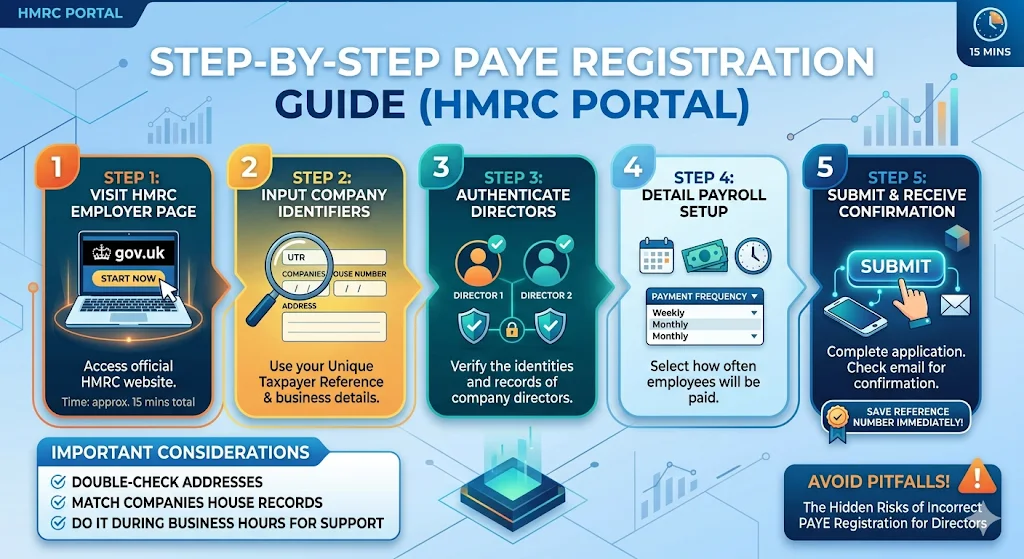
Register online via HMRC portal in 5 steps: Access gov.uk, enter UTR, verify details, select frequency, submit and confirm.
Step 1: Visit HMRC employer page. Step 2: Input company identifiers. Step 3: Authenticate directors. Step 4: Detail payroll setup. Step 5: Receive confirmation email.
Takes 15 minutes. Do it during business hours for support. Save reference number immediately.
Errors delay approval. Double-check addresses. Match Companies House records.
Dive deeper into The Hidden Risks of Incorrect PAYE Registration for Directors for pitfalls.
When Does Registration Become Mandatory?
Mandatory within 5 days of first employee payment or reaching £9,100 threshold, per HMRC schedule D rules.
Calendar tracks deadlines. Pay on 6th? Register by 11th. Threshold hit in June? Act same month.
Exceptions rare. Contractors misclassified trigger back-pay. HMRC reclassifies 8% annually.
Track via spreadsheet: Payment dates, totals, status.
From My Company streamlines this. Their PAYE Registration Assistance verifies all.
What Benefits Come After Registration?
Post-registration, access HMRC software approvals, automated filings, and compliance certificates for audits.
Approved software reduces errors 40%. RTI goes seamless. Audits pass faster.
Certificates prove status. Banks require for loans. Partners check compliance.
Scale confidently. 76% of registered SMEs grow 15% faster.
Ready to act? Apply for PAYE Registration Now – Fast and Accurate Service. From My Company delivers precise PAYE setup. Use their expertise for compliance.
What is PAYE registration in the UK?
PAYE registration sets up an HMRC employer account to deduct income tax and National Insurance from employee wages before paying HMRC. Businesses must register within 5 days of the first employee payment or reaching the £9,100 threshold. From My Company explains this process uses official gov.uk portals for quick activation.
How long does PAYE registration take?
Online PAYE registration typically completes in 15-30 minutes, with HMRC approval within 24-48 hours. Submit UTR, director details, and payroll estimates via the secure portal. From My Company’s PAYE Registration Assistance handles verification to speed up the process.
Do sole traders need PAYE registration?
Sole traders register for PAYE only when hiring employees or paying over £9,100 annually in salaries. Self-employed pay Class 2 NICs directly without PAYE. From My Company confirms status using HMRC tools before guiding registration.
What documents are required for PAYE registration?
Key documents include UTR number, company certificate, director passports, proof of address, bank details, and employee estimates. HMRC verifies identities through passport checks and address validation. From My Company’s PAYE Registration Assistance ensures all uploads comply with guidelines.
What are the penalties for late PAYE registration?
Late registration incurs £100 per employee per day fines, capped at £3,000, plus interest on unpaid taxes. HMRC enforces via audits on VAT and payroll data. From My Company assists in timely PAYE Registration Assistance to avoid these costs.