
A director resignation letter is a formal written notice used by a company director to communicate their decision to leave their position. A clear director resignation letter UK businesses can retain for their records should identify the company, state the director’s intention to resign and specify the intended effective date, subject to the company’s articles of association and any applicable contractual requirements.
Whether you are leaving a private limited company, stepping down after a change in ownership or preparing for a board transition, it is important to document the resignation correctly. The company must also notify Companies House of the director’s departure within the relevant statutory deadline. For most UK limited companies, this involves filing Form TM01 within 14 days of the date the director ceases to hold office. Companies House guidance explains the official notification process.
This guide explains what to include in a resignation letter, how to deliver it, how to establish the effective date and how to maintain appropriate company records. It also provides a copy-ready template you can adapt to your circumstances.
Director Resignation Letter: What Is It and Why Does It Matter?
A director resignation letter is a written communication confirming that an individual intends to leave their position as a company director. It creates a record of the decision, helps establish the intended resignation date and gives the company information needed to manage the change.
The letter should be clear, professional and consistent with the company’s articles of association and any relevant service agreement. It should not be confused with the separate notification that the company submits to Companies House.
A well-prepared letter helps the company maintain accurate internal records and reduces the likelihood of disagreement about when the director intended to resign. It also supports an orderly handover of responsibilities, company documents and ongoing decisions.
What Is the Difference Between Resigning and Filing with Companies House?
Resigning and updating Companies House records are related but distinct steps. The director communicates their resignation to the company in accordance with the applicable arrangements, while the company is responsible for notifying Companies House of the termination of the director’s appointment.
The relevant statutory filing is generally Form TM01, rather than Form RP02. Companies should check the current official guidance before submitting a notification.
What Should a Director Resignation Letter UK Include?
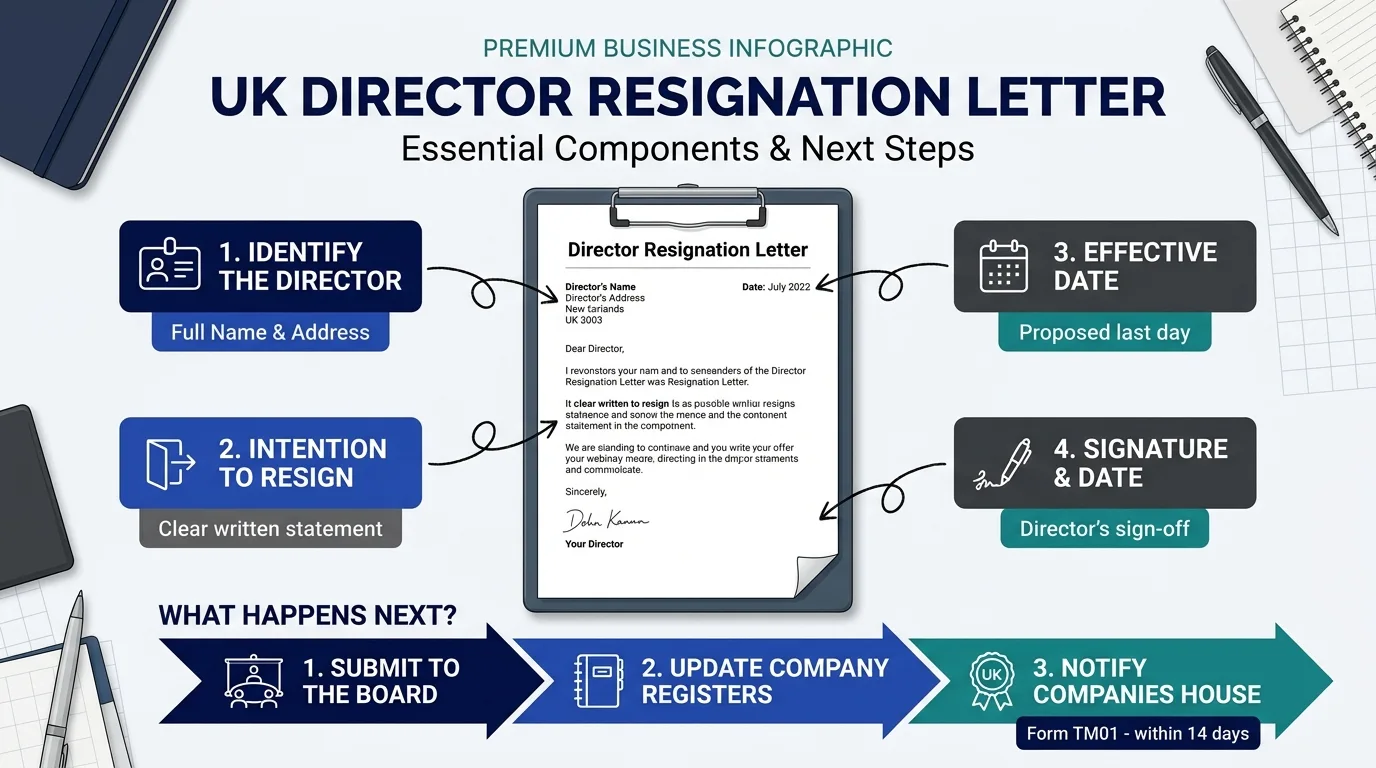
A director resignation letter should contain enough information for the company to identify the director, understand the intention to resign and record the proposed effective date.
Essential Information
Include the following details where relevant:
The director’s full name.
The company’s registered name and company number.
The date the letter is written.
A clear statement of resignation.
The intended effective date of resignation.
Any notice arrangements that apply under the articles or relevant agreement.
A brief handover statement, if appropriate.
The director’s signature or other suitable authentication.
A concise letter is generally sufficient. Avoid unnecessary explanations, allegations or confidential information that does not need to form part of the resignation record.
How Should the Effective Date Be Written?
State the intended date clearly, using an unambiguous format such as 29 October 2026. Avoid expressions such as soon, at the earliest opportunity or after the next meeting.
Before setting the date, review the company’s articles of association and any applicable contractual provisions. These may affect the notice required or the process for leaving office. Do not assume that every director must give one or three months’ notice, or that the board must accept every resignation in the same way.
Copy-and-Paste Director Resignation Letter Template
Use the following template as a starting point. Replace the placeholders with accurate details and check the relevant company documents before sending it.
Subject: Resignation as Company Director
[Director’s Full Name]
[Director’s Address, if appropriate]
[Date]
To the Board of Directors
[Company Name]
Company Number: [Company Number]
Dear Board Members,
I am writing to formally notify you of my resignation from my position as a director of [Company Name], company number [Company Number].
My resignation is intended to take effect on [Effective Date], subject to the applicable provisions of the company’s articles of association and any relevant contractual requirements.
I will cooperate with reasonable arrangements for the handover of my responsibilities and any company records or information in my possession, subject to my continuing legal obligations.
Please arrange for the company’s records to be updated and for the necessary notification to be submitted to Companies House within the applicable statutory deadline.
Please acknowledge receipt of this letter for the company’s records.
Yours sincerely,
[Director’s Full Name]
[Signature, where appropriate]
How to Adapt the Template
Use the template as a practical starting point rather than a universal legal form. If the resignation involves a dispute, an insolvency concern, a contractual notice issue or several directorships, obtain appropriate legal advice before sending the letter.
If you are resigning from more than one company, prepare a separate notice for each relevant company and confirm the correct effective date for each appointment.
How to Format and Deliver a Director Resignation Letter
A professional resignation letter should be easy to read and straightforward to retain in the company’s records. A one-page document is usually sufficient for a routine resignation.
Recommended Letter Format
Arrange the information in this order:
Director’s name and relevant contact details.
Date of the letter.
Company’s registered name and address.
A clear subject line.
A direct statement of resignation.
The intended effective date and any relevant notice details.
A brief handover statement, where appropriate.
Closing, name and signature.
Use consistent company details and check the company number against the official Companies House record.
Who Should Receive the Letter?
Send the letter to the person or body identified by the company’s articles of association or applicable procedures. This may be the board, the company secretary or another designated recipient.
If the company does not have a company secretary, the director should follow the company’s applicable arrangements for delivering the notice. Keep a copy of the final letter and reasonable evidence of delivery, such as an email record or postal receipt.
Email may be suitable where permitted by the relevant arrangements. Check whether the company’s documents require a particular delivery method, notice period or form of authentication.
When Should a Director Resignation Take Effect?
The effective date should reflect the applicable company rules and the director’s intended departure. It may be a future date or another date permitted under the relevant arrangements.
Review the articles of association, any service agreement and other relevant documents before sending the notice. If a notice period applies, ensure that the proposed date is consistent with it or obtain advice about any alternative arrangement.
A resignation letter should not state that the board’s acceptance is always required. Whether any approval or other procedural step is necessary depends on the circumstances and the governing documents.
Immediate Resignation
A director may wish to resign with immediate effect. Before doing so, check the company’s articles and any relevant contractual obligations to understand how the resignation should be communicated and when it can take effect.
If there is a dispute about the effective date, the company should retain the correspondence and relevant records. Legal advice may be appropriate if the date affects contractual obligations, company governance or an ongoing dispute.
How to Notify Companies House of a Director’s Resignation
A director resignation letter does not itself update the company’s public record. The company must notify Companies House through the appropriate process.
For most UK limited companies, the company uses Form TM01 to notify Companies House that a director’s appointment has ended. The notification must generally be submitted within 14 days of the date the director ceases to hold office.
Steps for the Company
Confirm the resignation and the date on which the director ceases to hold office.
Check the company’s current Companies House record and the director’s details.
Access the appropriate Companies House filing service.
Submit the required termination notification using the correct information.
Retain the submission confirmation and supporting internal records.
Check the public record to ensure that the change has been recorded correctly.
Use the official Form TM01 guidance for current instructions and filing options.
What If the Filing Deadline Is Missed?
If a company misses the deadline, it should review the circumstances and submit the required notification without unnecessary delay. Check the official guidance and contact Companies House where clarification is needed.
Do not assume that every late notification attracts a fixed fine or that the director automatically remains legally in office solely because the public record has not yet been updated. The legal position depends on the circumstances and the applicable requirements.
For a detailed explanation of the notification process, read our guide on how to notify Companies House about a director’s resignation within legal deadlines.
What Legal Obligations Continue After Resignation?
Resigning as a director does not automatically remove responsibility for actions or decisions made while holding office. Former directors may remain subject to relevant legal claims, contractual obligations, confidentiality duties or investigations, depending on the circumstances.
The precise position depends on the nature of the obligation and the facts involved. A resignation letter should not claim that all duties and potential liabilities end immediately on the effective date.
Handover and Outstanding Responsibilities
Before leaving, consider whether a practical handover is needed for ongoing contracts, financial decisions, employee matters, regulatory correspondence and company records. Arrange the transfer of company property and access credentials through appropriate channels.
The departing director should preserve relevant records and avoid retaining or disclosing confidential company information improperly.
For more information, see our guide to legal obligations after resigning as a company director.
What Records Should the Company Keep After a Director Resigns?
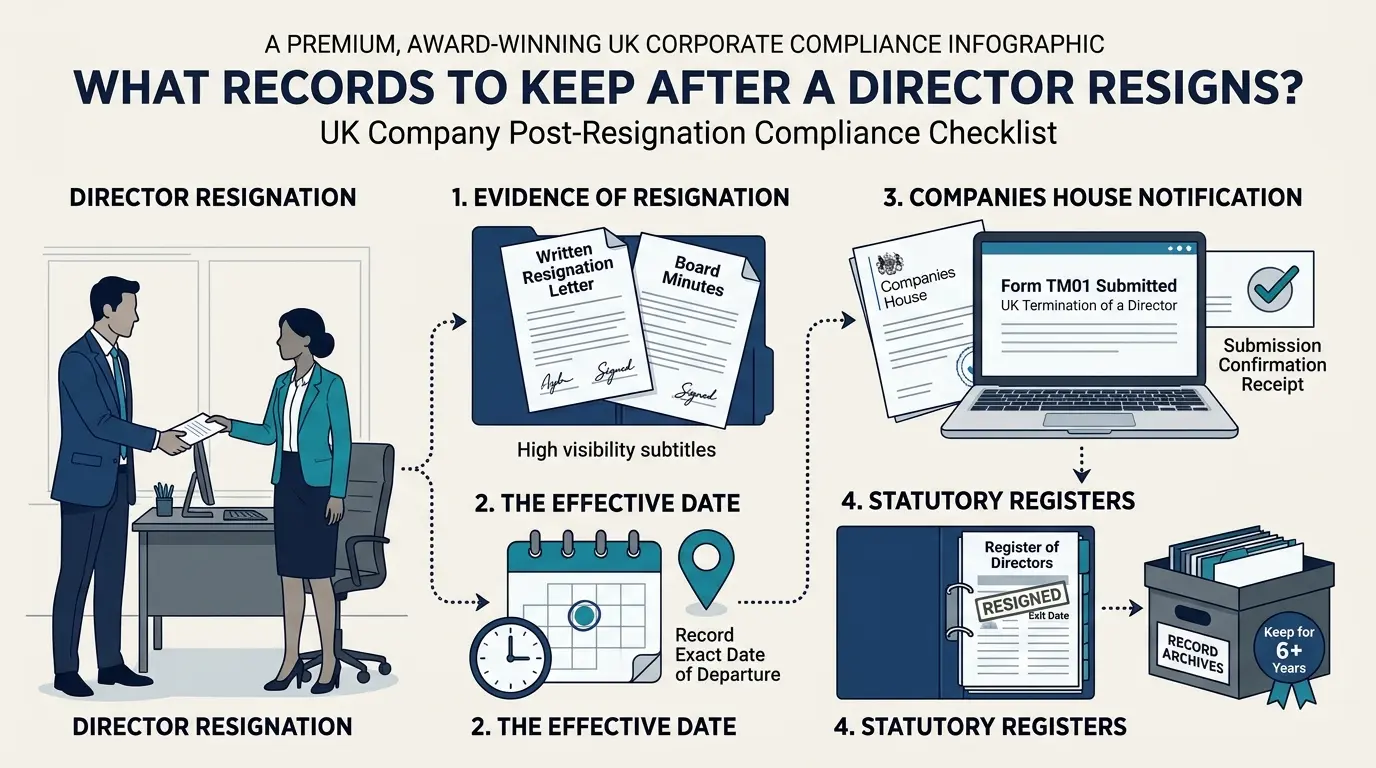
The company should maintain appropriate records showing the resignation, the effective date and the related notification to Companies House.
Relevant records may include:
The resignation letter and evidence of receipt.
Board minutes or other records relevant to the resignation.
The confirmation of the Companies House filing.
Updated statutory records and relevant governance documents.
Handover records where needed for ongoing business matters.
Store the information securely and apply appropriate access controls. Follow the company’s retention policies and applicable legal requirements rather than assuming that every document must be retained for the same fixed period.
Common Mistakes to Avoid in a Director Resignation Letter
Leaving the Resignation Date Unclear
A vague or inconsistent date can create confusion about the director’s departure. State the intended effective date clearly and make sure the company understands it.
Using the Wrong Companies House Form
Form TM01 is generally used to notify Companies House of the termination of a director’s appointment in a UK company. Form RP02 should not be presented as the standard director resignation filing.
Ignoring the Company’s Articles
The articles may contain relevant provisions about resignation, notice and governance. Review them before sending the letter rather than assuming the same procedure applies to every company.
Assuming the Letter Updates the Public Record
The letter creates a written record but does not replace the company’s Companies House notification. Ensure the responsible person completes the appropriate filing.
Making Unsupported Claims About Liability
A resignation does not automatically remove potential liability for previous conduct or resolve outstanding contractual obligations. Keep the letter factual and obtain legal advice where necessary.
Professional Help with Director Resignation
Preparing a resignation letter is often straightforward, but complications can arise when the company has unclear governance arrangements, a disagreement about the effective date or several changes to its directors.
Professional support can help businesses prepare documentation, follow the relevant filing process and maintain consistent company records.
For a comparison of the available approaches, read our guide to the benefits of outsourcing director resignation filings for statutory compliance.
If you are ready to proceed, you can also order your director resignation filing package online or review the Director Resignation service from Form My Company.
Frequently Asked Questions
What should a director resignation letter UK include?
A director resignation letter UK should include the director’s name, the company’s registered name and number, a clear resignation statement, the intended effective date and any relevant notice details. Retain a copy and follow the company’s applicable procedures.
Is a director resignation letter legally required?
A written notice is a practical way to document the resignation, but the exact requirements depend on the company’s governing documents and circumstances. Check the articles of association and applicable legal requirements rather than assuming a single format is compulsory in every case.
Which form is used to notify Companies House of a director’s resignation?
Form TM01 is generally used to notify Companies House of the termination of a director’s appointment in a UK company. The company should follow the current official filing instructions.
How long does a company have to notify Companies House?
A company generally must notify Companies House within 14 days of a director ceasing to hold office. Check the applicable requirements and submit accurate information promptly.
Can a director resign with immediate effect?
The position depends on the company’s articles, any relevant contractual terms and the circumstances. Check the applicable provisions before setting an immediate effective date, especially if a dispute or notice requirement exists.
Does a company need to accept a director’s resignation?
There is no universal rule that every resignation must be accepted by a board vote. The applicable process depends on the company’s governing documents and circumstances. Check those documents if the company disputes the notice or effective date.
Does resignation remove a director’s previous liabilities?
No. Resignation does not automatically eliminate responsibility for actions taken while the person was a director or resolve every outstanding contractual obligation. The relevant position depends on the facts and the type of claim.
Can I use a template for a director resignation letter?
Yes. A template can help organise the essential information, but it should be adapted to the company’s details, applicable notice requirements and intended effective date. Seek legal advice for complex or disputed resignations.
Arrange Your Director Resignation with Form My Company
A clear director resignation letter helps document a director’s departure, while accurate company records and the correct Companies House notification support an orderly transition.
Form My Company provides a dedicated Director Resignation service for businesses that need assistance with director changes and related filing arrangements. Review the service to understand the available support and take the next step towards maintaining accurate company records.