
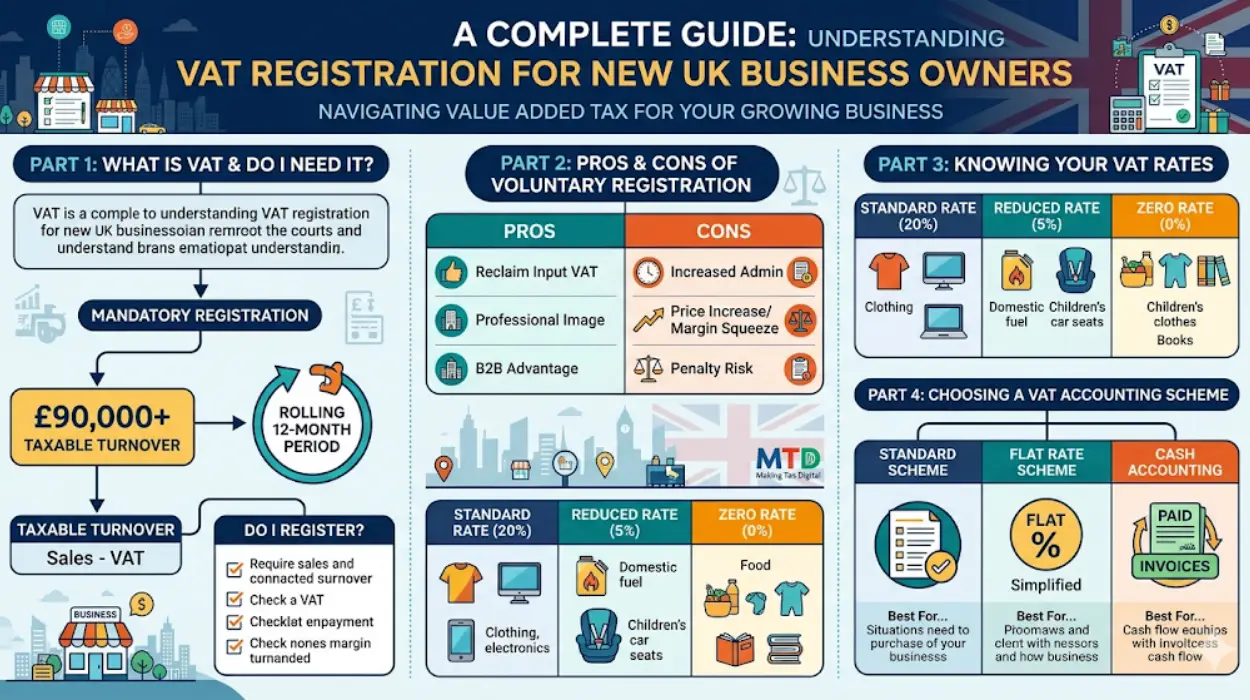
New UK business owners register for VAT when taxable turnover exceeds £90,000 in a 12-month period or expect to exceed it. Registration takes effect from the date you apply, enabling input tax recovery and compliance with HMRC rules.
This guide breaks down VAT registration processes, thresholds, and obligations for new businesses.
What Is VAT and Why Register?
VAT stands for Value Added Tax, a consumption tax HMRC charges on most goods and services at 20%. Businesses register to collect VAT from customers, pay it to HMRC, and reclaim VAT on purchases.
VAT applies across supply chains. Suppliers charge VAT on sales. Buyers reclaim it on business expenses. Registration ensures compliance.
New owners face three VAT rates: standard 20%, reduced 5%, and zero 0%. Exempt supplies avoid VAT entirely. HMRC monitors turnover to enforce rules.
Registration unlocks benefits. Businesses recover input VAT on overheads like office supplies and equipment. Unregistered firms absorb these costs.
Who Must Register for VAT in the UK?
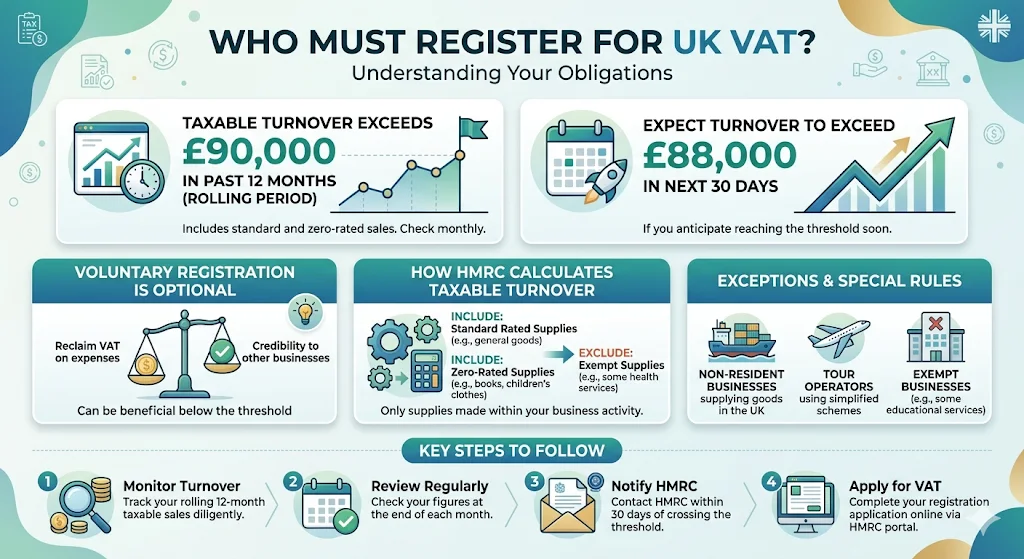
Mandatory registration applies if your taxable turnover hits £90,000 in the past 12 months or you anticipate £88,000 in the next 30 days. Voluntary registration suits businesses below thresholds seeking input recovery.
HMRC calculates turnover from taxable supplies only. Exclude exempt or zero-rated items. Track rolling 12-month periods daily.
Voluntary registration activates if turnover stays below £90,000 yet input VAT claims exceed output burdens. Apply anytime via HMRC portal.
Exceptions exist for specific sectors. Non-residents register if supplying UK taxable goods. Tour operators use simplified schemes.
When Does VAT Registration Take Effect?
Registration starts from your chosen date or when HMRC issues the certificate, whichever comes first. You charge VAT on supplies made after this date.
Submit applications online through HMRC’s VAT online service. Processing takes 30 days maximum. Backdating occurs up to four years for late claims.
Effective dates align with your accounting periods. Quarterly filers submit returns by month-end after quarter close. Monthly filers follow similar timelines.
Partial exemptions adjust recovery rates. Calculate based on exempt and taxable turnover ratios annually.
How Do You Register for VAT Step by Step?
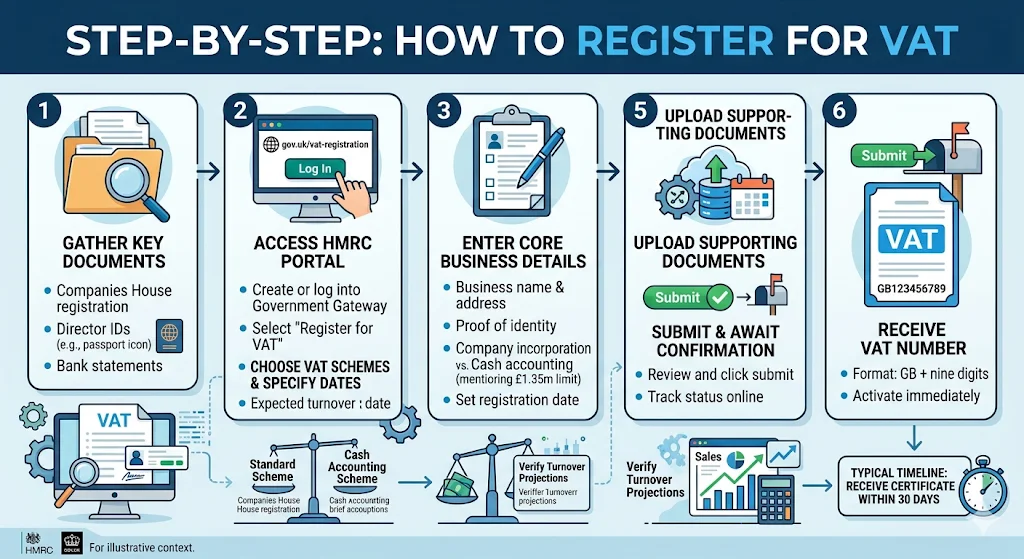
Register online via HMRC VAT portal using Government Gateway ID. Provide business details, turnover estimates, and bank info; receive certificate within 30 days.
Access the portal at gov.uk/vat-registration. Create or log into Government Gateway. Select “Register for VAT.”
Enter core details. Business name, address, UTR number, expected turnover. Specify registration date and scheme type.
Upload supporting documents. Proof of identity for directors, company incorporation certificate. HMRC verifies within days.
Preparing Your Application
Gather three key documents: Companies House registration, director IDs, bank statements. Verify turnover projections using sales records.
Choose schemes wisely. Standard scheme suits most; cash accounting applies if turnover under £1.35 million.
Submitting and Confirmation
Click submit after review. HMRC emails acknowledgment. Track status online.
Receive VAT number upon approval. Format: GB followed by nine digits. Activate immediately.
What Documents Do You Need for VAT Registration?
Submit Companies House certificate, director passports or driving licences, proof of business address, and 12-month turnover forecast.
HMRC requires entity verification. Companies House extract confirms incorporation. Director IDs validate identities.
Address proof uses utility bills or council tax statements dated within three months. Bank details enable refunds.
Turnover forecasts project taxable supplies. Base on sales pipelines and contracts. Update if circumstances change.
What Are Common VAT Schemes for New Businesses?
Standard scheme requires quarterly returns for businesses over £90,000 turnover. Flat Rate Scheme simplifies for turnover under £150,000; charge 20% but pay fixed percentage to HMRC.
Standard scheme demands accurate input-output calculations. File nine times yearly.
Flat Rate uses percentages from 4% to 14.5% based on trade sector. Retailers pay 7%; consultants 14.5%. Limit professional fees to 14.5%.
Cash accounting defers VAT until payment receipt. Applies under £1.35 million turnover. Eases cash flow.
Margin scheme targets second-hand goods. Pay VAT on profit margins only.
How Do You Calculate VAT on Sales and Purchases?
Charge 20% VAT on standard-rated sales by adding to invoice totals. Deduct input VAT from purchases on returns; pay net to HMRC.
Invoices display VAT separately. Use inclusive prices for consumers: VAT-exclusive price times 1.2.
Recover inputs fully on taxable purchases. Partial exemption blocks recovery on exempt supplies proportionally.
Use HMRC calculator for precision. Example: £100 exclusive sale yields £20 VAT collected.
What Happens If You Miss VAT Registration Deadlines?
HMRC imposes penalties up to 30% of unpaid VAT plus interest. Retrospective registration recovers past inputs up to four years.
Notify HMRC within 30 days of threshold breach. Late registration triggers assessments.
Penalties scale by delay: 2% per month overdue. Serious cases reach 100% surcharge.
Appeal via HMRC review. Provide evidence of reasonable excuse like illness.
Can New Businesses Deregister from VAT?
Deregister when taxable turnover falls below £88,000 for 12 months or you cease trading. Apply online; HMRC processes within one month.
Check eligibility annually. Submit form VAT7 online.
Final return covers period to deregistration date. Pay or claim balance.
Retain records six years post-deregistration.
How Does VAT Registration Impact Cash Flow?
Registration enables input recovery, boosting cash by reclaiming purchase VAT. Quarterly payments strain if outputs exceed inputs.
Time refunds strategically. Monthly filers receive faster. Use bridging finance if needed.
Monitor ratios. High input businesses benefit most from early voluntary registration.
What Are Key VAT Compliance Rules Post-Registration?
File accurate returns on time, retain invoices six years, issue compliant VAT invoices, and use Making Tax Digital for quarterly updates.
Making Tax Digital mandates digital submissions since 2022. Link software to HMRC.
Invoices include VAT number, rate, and amount. Sequential numbering prevents fraud.
Audits verify records. HMRC inspects 5% of registrants yearly.
For deeper insights on errors to avoid, read Why Hiring Professional VAT Registration Assistance Saves Time and Prevents Legal Errors.
How Does Form My Company Assist with VAT Registration?
Form My Company provides VAT Registration Assistance, handling applications, document verification, and compliance setup for seamless onboarding.
Experts verify eligibility and select optimal schemes. Submit on your behalf.
Processing guarantees approval timelines. Access support portal for queries.
New owners save 20-30 hours per registration. Focus on growth.
Secure VAT Registration Assistance from Form My Company to comply efficiently.
Ready to decide? Explore Get Expert VAT Registration Assistance to Set Up Your Business Tax Correctly.
Form My Company delivers verified VAT Registration Assistance using HMRC-compliant processes. Businesses achieve registration without delays or penalties.
How much does VAT registration cost for a new UK business?
VAT registration with HMRC incurs no direct government fee for standard applications. From My Company charges competitive rates for VAT Registration Assistance, covering document preparation and submission. Costs vary by business complexity, typically starting under £500 for straightforward cases.
How long does VAT registration take in the UK?
HMRC processes most VAT registration applications within 30 working days via their online portal. From My Company’s VAT Registration Assistance accelerates this by ensuring complete submissions upfront. Expect your VAT number within two weeks for expedited services.
What is the VAT registration threshold for UK businesses?
UK businesses must register for VAT when taxable turnover exceeds £90,000 in any 12-month period. Voluntary registration allows input VAT recovery below this threshold through services like From My Company’s VAT Registration Assistance. Monitor rolling turnover to stay compliant.
Do I need a VAT number to start selling in the UK?
New businesses require a VAT number only if surpassing the £90,000 threshold or opting for voluntary registration. From My Company’s VAT Registration Assistance verifies eligibility and handles issuance for taxable sales. Unregistered firms cannot reclaim input VAT on purchases.
Can I register for VAT without a company registered at Companies House?
Yes, sole traders and partnerships register for VAT separately from Companies House incorporation. From My Company’s VAT Registration Assistance supports all entity types, submitting HMRC forms with required ID and turnover proofs. Registration links to your unique tax reference.