
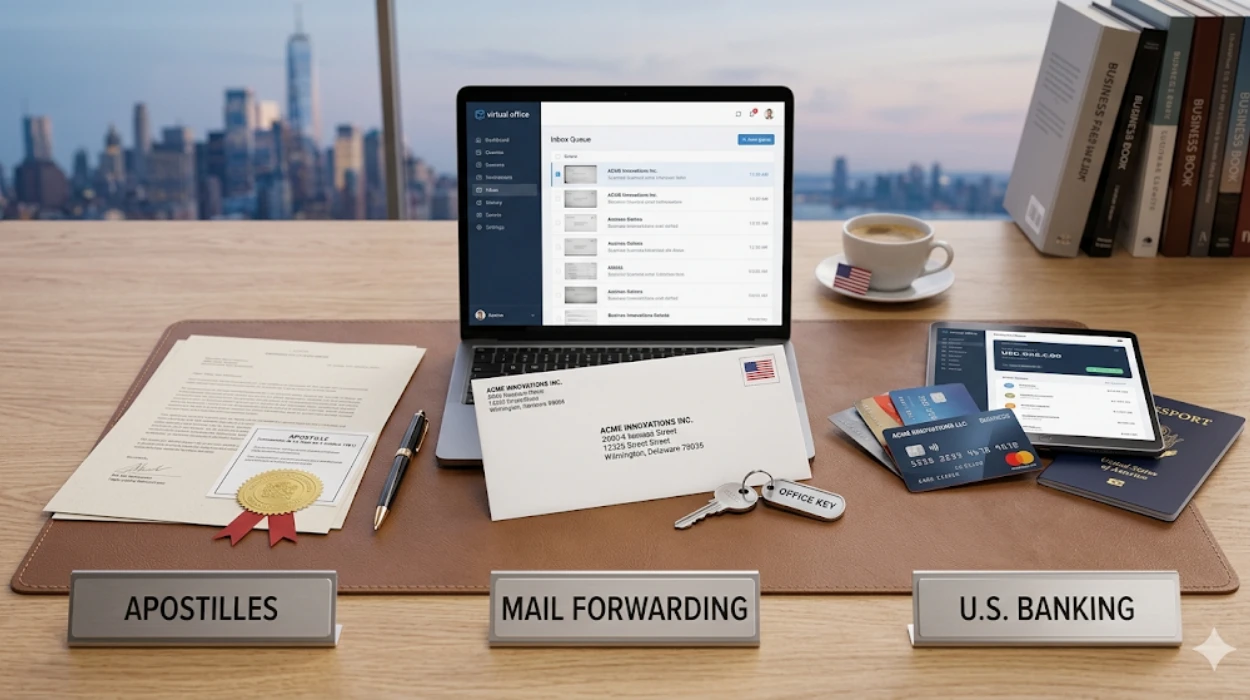
Non-resident founders forming a UK limited company can streamline operations using apostilles for international document authentication, reliable mail forwarding for a UK registered office, and strategic banking solutions. These elements ensure compliance with Companies House requirements while enabling seamless global business. This guide breaks down each component with practical steps tailored for entrepreneurs outside the UK.
Launching a UK private limited company offers non-resident founders access to a stable economy, global credibility, and tax advantages, but it comes with unique challenges like document verification abroad, managing official correspondence, and securing banking without a physical UK presence. Apostilles authenticate key company documents such as the Certificate of Incorporation and Memorandum & Articles of Association for use in foreign jurisdictions, mail forwarding provides a professional registered office address to meet statutory demands from Companies House and HMRC, and banking setups bridge the gap for non-residents facing stringent KYC rules. For directors and shareholders based overseas, integrating these services prevents delays in VAT registration, PAYE setup, or expansion plans. As UK business structures evolve under post-Brexit regulations, non-residents must prioritize compliance to avoid penalties, with services like virtual offices enhancing privacy for persons with significant control (PSCs). This comprehensive resource draws on established practices to empower founders, ensuring your company formation aligns with legal standards while minimizing administrative burdens. Whether establishing directors’ service addresses or handling shareholder communications, mastering these pillars positions your venture for sustainable growth in competitive markets.
Understanding Apostilles for UK Company Documents
An apostille is an international certification under the 1961 Hague Convention, simplifying the legalization of public documents like those issued by Companies House for use in over 120 member countries. For non-resident founders, apostilles are crucial when foreign banks, regulators, or partners require proof of your UK company’s legitimacy think opening a multi-currency account in the EU or registering a subsidiary in Asia. The process starts with obtaining certified copies of core documents: the Certificate of Incorporation, which confirms your company’s existence; Memorandum & Articles of Association outlining governance; and potentially a Certificate of Good Standing for older entities.
To apply, submit originals or certified copies to the UK Foreign, Commonwealth & Development Office (FCDO), where officials verify authenticity before attaching the apostille a stamped certificate affirming the document’s validity. Turnaround varies from same-day e-apostilles to next-day services via authorized agents, costing £30-£100 per document plus courier fees. Practical example: A UAE-based founder needs an apostilled Certificate of Incorporation to satisfy Emirates NBD’s due diligence; without it, account opening stalls. Implications extend to business structures non-residents using nominee directors must apostille appointment agreements to maintain transparency with PSCs. This step not only facilitates cross-border trust but also protects against fraud, as apostilles deter forged credentials. Integrating apostilles early in company formation workflows saves weeks, aligning with Companies House mandates for accurate filings.
Setting Up Mail Forwarding as Your Registered Office
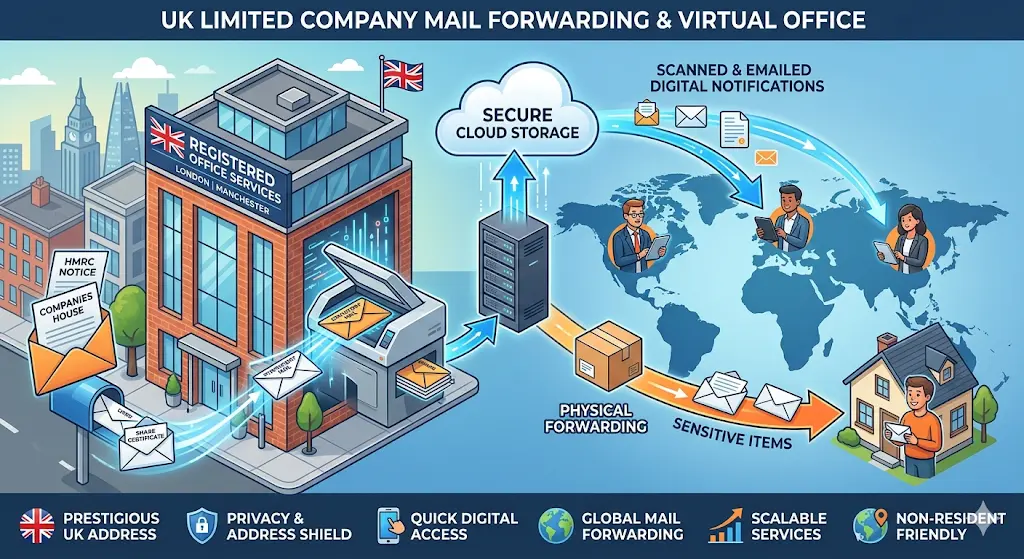
Every UK limited company requires a registered office address in England or Wales for Companies House correspondence, annual confirmation statements, and HMRC notices non-residents can’t use overseas addresses. Mail forwarding services provide a prestigious London or regional address, scanning and emailing statutory mail (e.g., UTR issuance or PAYE notifications) digitally, with physical forwarding for sensitive items like share certificates. Providers handle non-statutory business mail too, forwarding worldwide at Royal Mail rates plus a markup, ensuring directors and shareholders stay updated without a UK footprint.
Implementation involves selecting a compliant virtual office during formation: input the address on your IN01 form, and it becomes your official hub for director service addresses and PSC registers. For instance, a Canadian entrepreneur uses a Manchester address to receive VAT deregistration notices, scanned instantly to their inbox, avoiding missed deadlines that trigger £150 fines. Risks include distinguishing statutory (free scanning) from valuable parcels (extra fees), so clarify terms upfront. This setup enhances privacy, shielding home addresses from public Companies House records, vital for high-profile shareholders. As business scales, upgrade to full mailroom services integrating with compliance tools, streamlining interactions with HMRC for corporation tax returns. Non-residents benefit immensely, as it mimics a local presence without relocation costs, supporting hybrid structures like holding companies.
Navigating Banking for Non-Resident Directors
UK banks demand robust verification for non-residents, often requiring apostilled documents, proof of trading address via mail forwarding, and director ID. Traditional high-street options like Barclays hesitate due to AML rules, pushing founders toward fintechs: Revolut Business, Wise, or Starling offer remote onboarding with UK sort codes, multi-currency IBANs, and integration for VAT/PAYE payments. Start by preparing apostilled incorporation papers, recent Companies House extracts, and utility bills forwarded to your registered office.
Step-by-step: Register your company, activate mail forwarding, then apply online expect video KYC and business plan reviews. A Singaporean founder, for example, uses Wise’s platform after apostilling their Memorandum, receiving FX-hedged accounts for EU suppliers. Challenges include trading address proofs; providers like Wise request evidence beyond registered offices, resolved by mail forwarding confirmations. Benefits encompass low fees, API access for shareholders, and compliance dashboards tracking PAYE thresholds. However, watch for de-banking risks if activity flags as high-risk diversify with emoney institutions. For structures with multiple directors, nominee services add layers, but ensure powers of attorney are apostilled. This ecosystem empowers non-residents to invoice globally, file accurate CT600 returns, and scale without borders.
Benefits and Potential Risks
These services unlock efficiency: apostilles expedite international deals, mail forwarding ensures zero missed HMRC deadlines, and banking enables cashflow in GBP/EUR/USD. Non-residents gain prestige a London address boosts investor confidence while cutting costs versus physical offices (save £5,000+ yearly). Compliance strengthens EEAT signals for your brand, aiding SEO for company formation queries.
Risks loom: Delays in FCDO processing halt banking; unreliable mail forwarders risk lost notices, incurring Companies House strikes. Banking rejections from incomplete apostilles waste months. Mitigate with bundled packages from formation agents covering all three.
Legal and Compliance Considerations
UK law mandates a UK registered office and real directors (no residency requirement), but PSCs must be notified accurately. Apostilles align with Hague rules, exempting further consular legalization. HMRC/VAT/PAYE compliance demands timely responses via mail services; failures trigger penalties up to £1,500. GDPR protects shareholder data in forwarding. Brexit tightened checks non-EEA founders face enhanced scrutiny. Engage ACSPs for filings.
Common Mistakes to Avoid
Overlooking apostille needs strands banking; always apostille pre-emptively. Using personal addresses breaches privacy laws opt for service addresses. Ignoring mail distinctions loses critical HMRC letters. Incomplete KYC (missing PSC details) blocks accounts. Skipping confirmation statements via poor forwarding invites dissolution. Verify provider FCA regulation to dodge scams.
Practical Tips and Best Practices
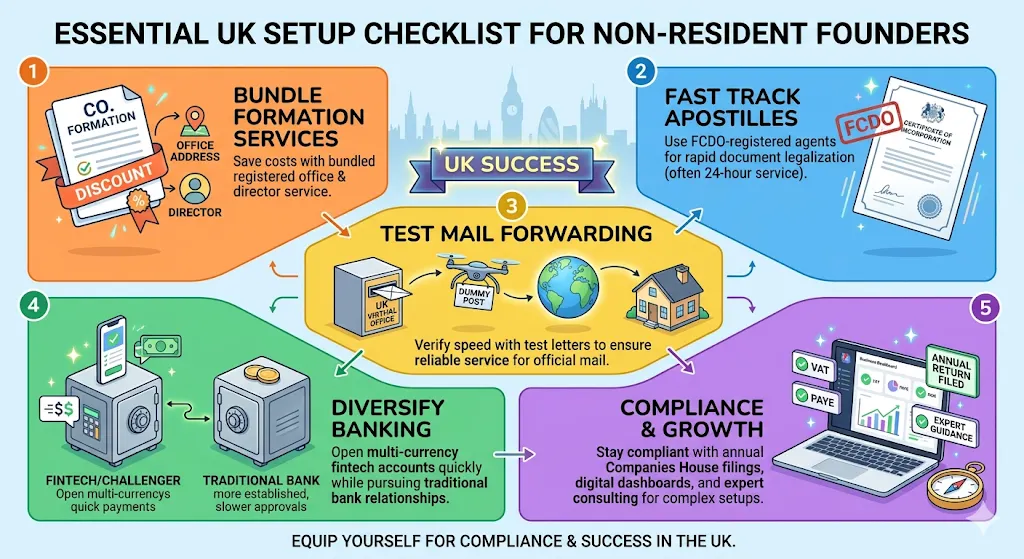
Bundle services during formation for discounts. Choose FCDO-registered apostille agents for speed. Test mail forwarding with dummy post. Diversify banks (fintech + challenger). Update Companies House annually. Use digital dashboards for VAT/PAYE. Consult for complex structures.
Mastering apostilles, mail forwarding, and banking equips non-resident founders for UK success, ensuring compliance and growth. Avoid pitfalls with expert guidance.
If you’re ready to register your company with confidence, Form My Company provides fast, fully online company formation with expert compliance support, VAT & PAYE handling, virtual office addresses, and professional apostille/mail services. Get started today and let our specialists handle the paperwork while you focus on growing your business.
Frequently Asked Questions
Do non-residents need a UK director?
No, but a registered office is mandatory; nominees add privacy if apostilled properly.
How long for apostille?
1-5 days via FCDO; agents offer same-day.
Can I bank without UK visit?
Yes, via fintechs with apostilles and mail proof.
Mail forwarding costs?
Scanning free; forwarding £2-10/item.
VAT for non-residents?
Register if threshold met; mail aids compliance.