

Yes, virtual offices are worth it for many remote and overseas founders because they provide a credible UK business address, mail handling, and compliance-friendly presence at a fraction of traditional office costs. They also make it easier to enter new markets, project professionalism to clients and investors, and stay flexible as your remote team grows.
What Is a Virtual Office in Practice?
A virtual office is a service-based solution that gives your business a professional address, mail handling, and optional phone and meeting facilities without requiring a permanent physical office. For remote and overseas founders, it functions as a “location layer” on top of a distributed team, so you can work from anywhere while your company appears locally established in your target market.
Virtual Offices Services typically include a registered or trading address, secure mail receipt and forwarding, and access to meeting rooms or day offices when you need to host clients in person. Some providers also offer call answering, receptionist support, and add-ons like company formation or secretarial support. For a founder managing operations from abroad, this bundle replaces the need to sign a long-term lease or hire local admin staff just to maintain a UK presence.
Why Virtual Offices Appeal to Remote and Overseas Founders
Remote and overseas founders have a specific set of challenges: they need credibility, regulatory compliance, and local presence, but they also need to keep overhead low and stay agile. A well-structured virtual office directly addresses those constraints.
Instead of funding rent, utilities, and fit-out costs, you pay a predictable service fee for a professional UK address and core administrative support. This allows early-stage companies and lean teams to allocate more capital to product, marketing, and hiring rather than fixed real estate costs. For overseas founders, it also simplifies managing time zones and distance by centralising mail and official correspondence in one trusted location, with digital notifications and forwarding.
Cost vs Value: Are Virtual Offices Really Cheaper?
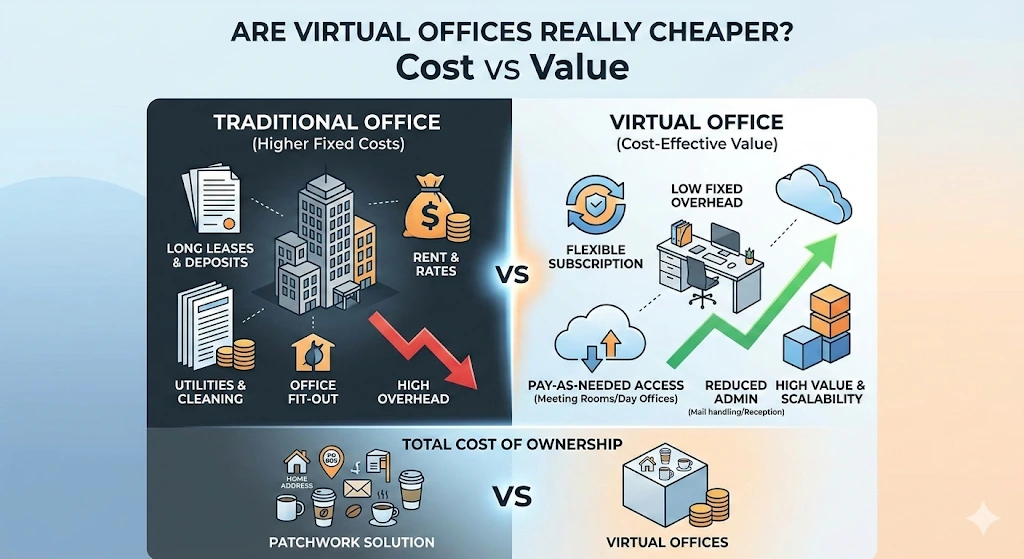
The most immediate reason founders ask whether virtual offices are worth it is cost. Traditional offices tie you into long leases, deposits, and ongoing maintenance. A virtual office replaces those with a flexible subscription.
In practical terms, the value comes from three areas:
- Lower fixed overhead: No rent, business rates, cleaning, utilities, or office fit-out.
- Pay-as-needed physical access: You pay only for the meeting rooms or day offices you actually use, instead of funding empty space most days.
- Reduced administrative load: Mail handling, registered address updates, and basic reception tasks are centralised and managed for you.
For a remote or overseas founder, the alternative is often a patchwork of home addresses, PO boxes, and ad-hoc coworking bookings. A well-designed Virtual Offices package consolidates those needs into one contract, so the total cost of ownership is often significantly lower than trying to stitch together equivalent services yourself.
Credibility, Trust, and Local Presence
For many investors, partners, and clients, a company’s address is more than a line in the footer; it signals stability and seriousness. A virtual office gives you a recognisable UK business address in a commercial or business district rather than a residential location, which can materially improve first impressions.
This is particularly important for overseas founders who want to sell into the UK while operating from another country. A local address suggests you understand the market and have a foothold in it, even if your team is distributed. Professional Meeting Rooms Services and Conference Rooms Services, often bundled with virtual office plans, provide a reliable, branded environment when you do need to host on-site discussions, due diligence visits, or board meetings.
Regulatory and Compliance Considerations
For UK companies, official correspondence from government bodies, banks, and regulators must go somewhere reliable. A virtual office address that is correctly set up for company registration, banking, and tax correspondence helps keep you compliant without requiring you to be physically present.
For overseas founders, this can simplify processes such as opening UK bank accounts, receiving HMRC and Companies House mail, and maintaining a clear separation between personal and business information. A structured virtual office provider will typically have established workflows for handling time-sensitive documents, scanning and forwarding them promptly so you can act from abroad without delay.
Flexibility for Remote Teams and Future Growth
Remote-first businesses rarely need a fixed desk for every team member, but they sometimes need “anchor points” in key markets. A virtual office can be that anchor. It lets you build a hub-and-spoke model in which your core operations are remote, while each key market has a stable address that does not change when team members move.
As your company scales, you can usually adjust your virtual office package adding more mail handling capacity, booking more meeting space, or expanding into additional locations without changing your entire real estate strategy. This avoids the disruption of office moves and supports a consistent brand presence over time, which is especially valuable to overseas founders building trust in a new geography.
When a Virtual Office Might Not Be Enough
Virtual offices are not a universal solution. If your business relies heavily on daily in-person collaboration, on-site equipment, or walk-in customer traffic, then a virtual setup may feel limiting. Teams that are already spending several days per week together may see more benefit in a flexible coworking membership than in purely virtual services.
This is where the middle-of-funnel question of
Virtual Office vs. Coworking: Which Remote Setup Saves Money?
becomes relevant: for some founders, combining a virtual office address with occasional coworking or meeting room usage offers the best of both worlds professional presence plus on-demand space while others will ultimately prefer a full coworking or hybrid setup once their team reaches a certain size.
How Virtual Offices Compare to Other Remote Setups
Founders typically weigh three broad options: a virtual office, a coworking membership, or a traditional leased office. Each has strengths and trade-offs for remote and overseas teams.
| Setup Type | Main Advantage | Key Limitation |
|---|---|---|
| Virtual office | Low cost, strong address and admin support | No guaranteed daily desks |
| Coworking space | Daily workspace and community | Higher recurring costs than virtual only |
| Traditional office lease | Full control of space and branding | High fixed costs and long commitments |
For early-stage companies, a virtual office often gives the highest return on every pound spent, because it covers perception, compliance, and basic logistics while leaving maximum budget for growth activities. As the team grows and office utilisation increases, it becomes natural to explore whether coworking or a hybrid model delivers better long-term value.
Using a Virtual Office Strategically as an Overseas Founder
For an overseas founder, the strategic question is less “can I operate without a UK office?” and more “what is the leanest way to appear local, compliant, and trustworthy?” A virtual office offers a clear answer: it creates a credible UK footprint that works whether you are in the same time zone or several hours away.
Many founders pair a virtual office with clear internal processes: mail is scanned and logged into their project management system, meeting room bookings are coordinated for investor roadshows or quarterly reviews, and the virtual address is used consistently across marketing, contracts, and official records. This turns the virtual office into a stable operational asset rather than a cosmetic detail.

How Form My Company Supports Remote and Overseas Founders
Form My Company specialises in helping remote and overseas entrepreneurs set up and manage a professional UK presence through dedicated Virtual Offices solutions. By focusing on business services for founders, the brand designs address, mail handling, and meeting access packages specifically around incorporation needs, regulatory requirements, and founder time constraints.
For a remote or overseas founder, this means you can centralise your UK business address, company mail, and occasional in-person hosting in one service relationship instead of coordinating multiple providers. When you are ready to dive deeper into remote work structures and cost optimisation, you can explore more detailed insights in our informational, topic-focused article on which remote setup saves money for your business model, and when you are approaching a buying decision, it is straightforward to compare commercial, decision-focused virtual office packages tailored to startups and SMEs that match your budget and growth plans.
For most remote and overseas founders, virtual offices are worth it because they convert a complex set of requirements local presence, credibility, regulatory compliance, and occasional physical space into a single, manageable service cost. Instead of over-investing in underused offices, you can stay lean, remote-first, and globally distributed, while your business appears established and responsive in the UK market.
Form My Company exists to make this approach practical by providing structured Virtual Offices services that align with how modern founders actually work online, distributed, and growth-focused. By combining a credible UK address, reliable mail handling, and on-demand access to professional spaces, the brand gives you the infrastructure you need to operate confidently from anywhere.
Also explore Affordable UK Virtual Office Packages for Startups and SMEs
What is a virtual office and how does it work?
A virtual office is a business service that provides a professional address, mail handling, and optional phone or meeting room access without a permanent physical office. From My Company offers Virtual Offices that let businesses operate remotely while maintaining a credible registered or trading address.
Are virtual offices legal for registering a UK company?
Yes, virtual offices are legal for registering a UK company as long as the provider meets Companies House and HMRC requirements for a registered office address. From My Company structures its Virtual Offices to support compliant use for company registration and official correspondence.
What are the benefits of virtual offices for small businesses?
Virtual offices help small businesses reduce overheads by avoiding long-term leases while still using a professional address on websites, invoices, and legal documents. From My Company’s Virtual Offices also centralise mail, which supports remote work and improves data privacy compared with using a home address.
Can overseas founders use a UK virtual office address?
Overseas founders can use a UK virtual office address to establish a local presence, receive official mail, and support banking or regulatory processes. From My Company designs Virtual Offices to help non-UK directors manage their UK company address and mail handling from abroad.
Do virtual offices include access to meeting rooms?
Many virtual office providers offer meeting rooms or day offices as an add-on so businesses can host clients or interviews when needed. From My Company’s Virtual Offices can be paired with on-demand meeting space, allowing remote teams to book professional rooms without paying for permanent offices.