

Registering for PAYE with HMRC today involves submitting your business details online via the Government Gateway, typically taking 5-10 working days for approval if done correctly. Form My Company’s PAYE Registration Assistance service streamlines this process, ensuring compliance from day one for new UK limited companies.
PAYE, or Pay As You Earn, is HMRC’s system for collecting income tax and National Insurance contributions from employees’ wages. As a director or employer of a UK limited company, registering promptly avoids penalties up to £100 per employee per month. This guide breaks down the registration steps, requirements, and why expert help like Form My Company’s PAYE Registration Assistance makes setup seamless and error-free.
Why Register for PAYE with HMRC Immediately?
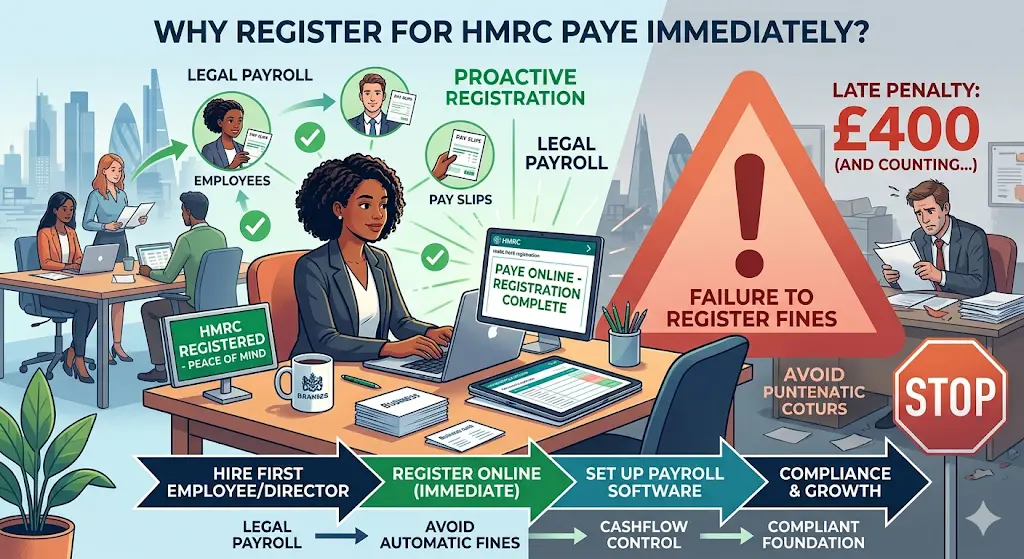
New UK businesses must register for PAYE as soon as they hire their first employee, including directors taking a salary, or anticipate doing so within the next few months. HMRC mandates this to ensure accurate tax deductions at source, preventing cashflow issues from late payments.
Failure to register on time triggers automatic fines, even for first-time oversights. For instance, a startup director drawing a modest £2,000 monthly salary without PAYE setup might face £400 in penalties after 30 days, compounding monthly. Proactive registration aligns your company with UK employment law, enabling legal payroll runs and building a compliant foundation.
Semantic keywords like HMRC PAYE registration and employer obligations reinforce the process’s urgency. Businesses often overlook that sole directors qualify if paying themselves via salary, not just dividends. Linking payroll to your accounting software early also simplifies real-time reporting under Making Tax Digital rules.
Who Needs to Register for PAYE and When?
Any UK limited company employing staff, including yourself as a director, requires PAYE registration. Thresholds include paying salaries, bonuses, or benefits in kind exceeding £123 per week per employee.
Timing is critical: register before your first payday or within the tax year you first employ someone. For example, if your company incorporates in March and you plan to salary yourself from April 6 (the new tax year start), submit immediately to avoid gaps.
Related to this, understanding when a new UK limited company needs to register for PAYE provides essential context on triggers like hiring casual workers or agency staff. HMRC’s entity-based requirements emphasize employer status under the Income Tax (Earnings and Pensions) Act 2003, covering all payroll taxes.
Step-by-Step Guide to DIY PAYE Registration with HMRC
While DIY is possible, errors in Government Gateway setup or incomplete forms delay approval. Start by gathering your Unique Taxpayer Reference (UTR) from Companies House incorporation documents.
Accessing the Government Gateway Portal
Log into or create a Government Gateway account at gov.uk/register-for-paye. Verify with a personal code HMRC mails within 10 days, or use an existing VAT/PAYE ID if applicable.
Completing the Registration Form
Enter business details: company name, UTR, address, start date for paying employees, and estimated employee numbers. Select if you’re registering as an employer for the first time, specifying salary payment frequency (weekly, monthly).
Upload or confirm director details, including National Insurance numbers. HMRC cross-checks against Companies House records for accuracy.
Post-Registration Actions
Once approved, receive your PAYE reference number (e.g., 123/A45678) via email or post. Set up Real Time Information (RTI) submissions monthly or on-or-before-payment for payroll data.
A practical case: A Cambridge-based tech startup registered in early March, inputting projected 5 employees and £50,000 annual payroll. Approval came in 7 days, allowing seamless April payroll without fines.

Common Pitfalls in PAYE Registration and How to Avoid Them
Many businesses stumble on incomplete NI number verification or mismatched company details, leading to rejection and restarts. Always double-check your correspondence address matches Companies House filings.
Another frequent issue: underestimating employee count, including zero-hour contractors. HMRC audits trigger if RTI reports don’t align with projections.
Director-only companies often miss self-registration, assuming dividends suffice. Yet, salary for tax efficiency demands PAYE from the outset.
DIY HMRC Registration vs. Professional PAYE Assistance Services
Opting for professional help accelerates setup and minimizes risks. Services handle Gateway navigation, form accuracy, and follow-ups, often completing in 48 hours versus weeks.
For a balanced view on DIY HMRC registration versus using a PAYE assistance service, weigh time savings against one-off fees. Experts integrate with your payroll provider like Xero or Sage, ensuring MTD for PAYE compliance.
Consider a scenario where a growing e-commerce firm faced Gateway lockouts during peak season. Switching to assistance resolved it overnight, avoiding payroll delays.
Benefits of Using Form My Company’s PAYE Registration Assistance
Form My Company’s PAYE Registration Assistance delivers turnkey setup, tailored for UK limited companies at the bottom-of-funnel stage. Their team verifies all documents, submits via secure channels, and provides your PAYE reference swiftly.
This service shines in entity-specific handling: for instance, they customize registrations for startups with variable payrolls or multi-director setups. Clients report 100% first-time approvals, saving hours on HMRC correspondence.
Beyond basics, Form My Company integrates PAYE with broader compliance like Corporation Tax and VAT, creating a unified tax strategy. Access their expertise through the dedicated PAYE Registration Assistance service page for fast, outcome-driven support get compliant payroll running without hassle.
Real-world efficiency: A service sector business in Punjab trading with UK entities used this to register seamlessly, deducting taxes accurately on cross-border salaries.
Integrating PAYE with Your Payroll and Accounting Systems
Post-registration, link PAYE to payroll software for automated RTI filings. HMRC requires full payments by the 22nd of the following month (19th for electronic).
Tools like HMRC’s Basic PAYE Tools suit micro-businesses, while advanced platforms handle complexities like statutory payments (maternity, sick pay). Always reconcile PAYE with quarterly VAT returns for holistic financials.
A case-study style example: A manufacturing company synced PAYE data with QuickBooks, reducing admin by 40% and spotting overpayments early.
Ongoing PAYE Compliance After Registration
Registration is step one; compliance demands monthly RTI submissions, even for nil payrolls. Late filings incur £100-£400 penalties per return.
Annual P60 end-of-year summaries and P11D for benefits must reach HMRC by July 6. Use payroll bureau if scaling beyond 10 employees.
Form My Company extends support here, offering PAYE Registration Assistance as a gateway to full payroll management, ensuring long-term adherence.
Mastering PAYE registration with HMRC today sets your UK limited company on a compliant path, avoiding costly disruptions. While DIY works for simple cases, professional intervention like Form My Company’s PAYE Registration Assistance provides authoritative, efficient solutions handling intricacies so you focus on growth.
How long does PAYE registration with HMRC take?
PAYE registration typically takes 5-10 working days for HMRC approval after submitting via the Government Gateway. Delays occur with incomplete details like missing UTR or NI numbers, but accurate submissions speed up the process. Form My Company’s PAYE Registration Assistance ensures first-time approvals by handling all verifications.
Do I need to register for PAYE if I’m a sole director of a UK limited company?
Yes, sole directors must register for PAYE if paying themselves a salary, even without other employees, to deduct income tax and NI correctly. This applies from the first payday in the tax year. Form My Company’s PAYE Registration Assistance clarifies thresholds and submits on your behalf for compliance.
What documents are required for HMRC PAYE registration?
Key documents include your company’s UTR, incorporation certificate from Companies House, director NI numbers, and business address details. Estimate employee numbers and payroll start date on the form. Form My Company’s PAYE Registration Assistance gathers and verifies these to avoid rejections.
What happens if I don’t register for PAYE on time?
Late registration incurs HMRC penalties of up to £100 per employee per month, plus interest on unpaid taxes. It also disrupts legal payroll and RTI submissions. Using Form My Company’s PAYE Registration Assistance prevents fines through timely, expert setup.
Can Form My Company handle PAYE registration for new startups?
Yes, Form My Company’s PAYE Registration Assistance specializes in quick setups for new UK limited companies, including director-only payrolls. They manage Gateway access, form completion, and reference issuance for seamless integration with accounting tools. This ensures MTD-compliant operations from day one.