
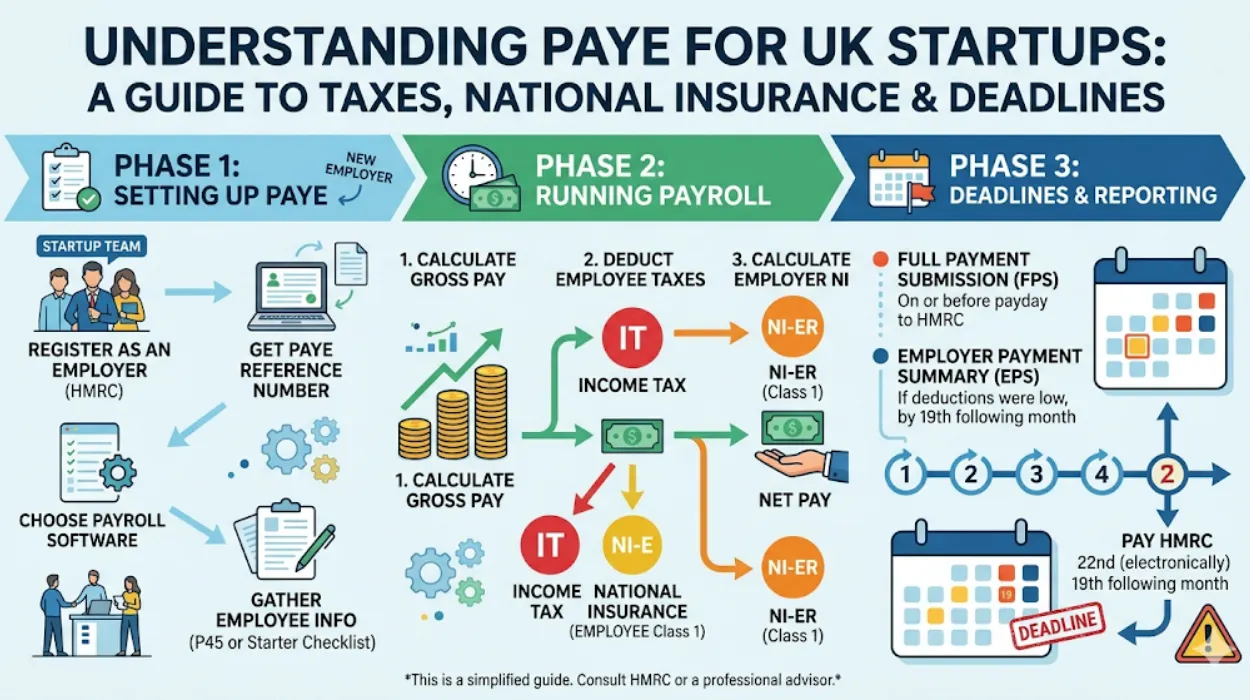
PAYE, or Pay As You Earn, is HMRC’s system for collecting income tax and National Insurance (NI) contributions from employees’ wages in real-time. For UK startups, it means registering as an employer, calculating deductions accurately, and meeting strict payroll deadlines to avoid penalties.
This payroll mechanism ensures compliance from day one, helping new businesses manage cash flow while fulfilling legal obligations. As your team grows, understanding PAYE becomes essential to scale without disruptions.
What Is PAYE and Why Do UK Startups Need It?
PAYE stands at the core of UK employment taxation, acting as the bridge between employers and HMRC for withholding taxes directly from salaries. Launched in 1944, it simplifies tax collection by integrating it into monthly payroll runs, preventing employees from facing large tax bills at year-end.
For startups, PAYE kicks in the moment you hire your first employee or director drawing a salary. Even sole traders expanding into limited companies must register if paying salaries above the personal allowance threshold of £12,570 annually (as of the 2025/26 tax year). Failure to do so can trigger fines up to £100 per employee per month, plus interest on late payments.
Consider a tech startup in Cambridge launching with five developers. The founder realizes midway through the first quarter that salaries paid without PAYE setup have created a compliance gap. By grasping PAYE basics early, such businesses avoid HMRC investigations that could derail funding rounds or investor confidence.
Semantic keywords like employer PAYE obligations reinforce its role in broader payroll compliance. From My Company specializes in streamlining this for new ventures, ensuring seamless integration with accounting software like Xero or QuickBooks.
Step-by-Step: How PAYE Operates for Startups
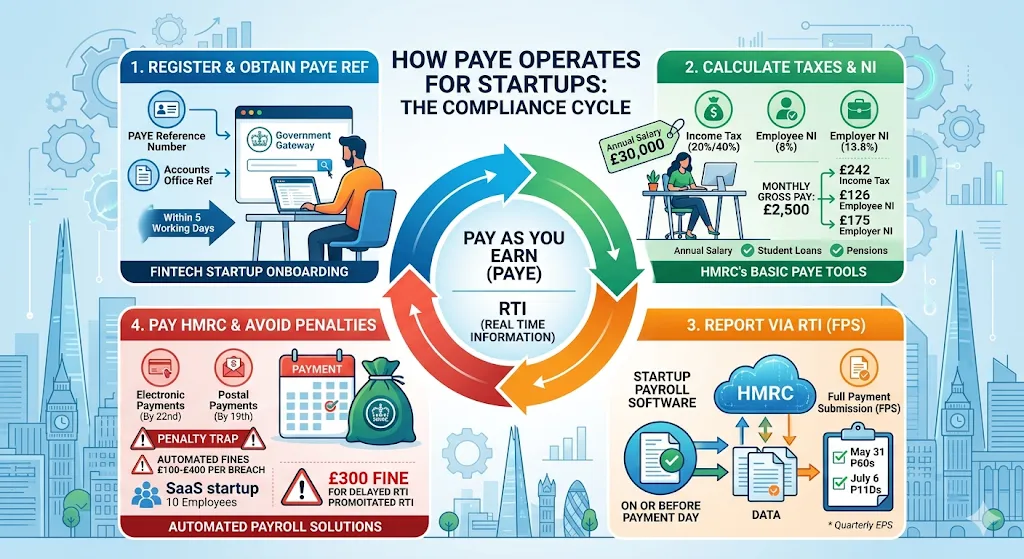
PAYE functions through a cyclical process: calculate, deduct, report, and pay. Startups begin by obtaining a PAYE reference number via HMRC’s online portal, typically within five working days of application.
Registering Your Startup for PAYE
Registration is mandatory within three months of becoming an employer. Use HMRC’s Government Gateway to submit details like your company UTR, expected employee numbers, and start date. For a fintech startup onboarding remote workers, this step unlocks Real Time Information (RTI) submissions—digital payroll reports sent before or on payment day.
Once approved, your PAYE scheme receives a unique identifier, essential for all future filings. Delays here compound as payroll deadlines loom.
Calculating Taxes and NI Under PAYE
Each pay period, run payroll to deduct income tax and NI. Basic rate tax starts at 20% on earnings between £12,571 and £50,270, with higher rates scaling up. Employee NI sits at 8% on earnings above £12,570, while employers pay 13.8% on amounts over £9,100 per year.
Imagine a marketing startup paying a graphic designer £30,000 annually. Monthly gross pay of £2,500 yields roughly £242 in income tax and £126 in employee NI deductions, plus £175 employer NI. Tools like HMRC’s Basic PAYE Tools automate this, factoring in student loans or pension contributions.
Startups must also handle student loan repayments (Plan 1, 2, or 5) and statutory payments like maternity pay, all coded via PAYE tax codes (e.g., 1257L for standard allowance).
RTI Reporting and Payment Deadlines
RTI is PAYE’s digital heartbeat submit Full Payment Submission (FPS) for every pay run, even if zero-paid. Deadlines align with payment dates: on or before the 19th (or 22nd for electronic) of the following month.
For startups, quarterly EPS (Employer Payment Summary) filings occur by the 19th after quarter-end if no payments due. Annual P60s and P11D forms follow by May 31 and July 6, respectively. Missing these incurs £100-£400 automated penalties per breach, escalating for persistent non-compliance.
A SaaS startup scaling to 10 employees learns this the hard way: a delayed RTI leads to £300 in fines, prompting a review of automated payroll solutions.
Taxes and NI Breakdown for Startup Founders and Teams
PAYE taxes hinge on progressive bands, ensuring fairness while funding public services. Startups benefit from the Employment Allowance up to £5,000 relief on employer NI for eligible firms, excluding single-director companies over £100,000 turnover.
Income Tax Nuances in PAYE
Tax codes personalize deductions; emergencies like 0T signal HMRC adjustments. Startups with international hires navigate non-resident codes, withholding 20% basic rate unless treaty relief applies.
For a biotech startup, a founder’s £80,000 salary incurs 40% higher rate tax on £29,730, deducted seamlessly via PAYE to maintain steady take-home pay.
National Insurance Contributions Explained
Class 1 NI splits employee (primary) and employer (secondary) classes. Thresholds adjust yearly monitor HMRC bulletins. Apprentices under 21 or veterans enjoy zero employer NI, aiding talent acquisition.
Employer NI impacts cash flow; a 10-person e-commerce startup faces £20,000+ annual liability. Offsetting via R&D tax credits or SEIS/EIS schemes eases the burden.
Common PAYE Pitfalls and How Startups Avoid Them
New businesses often stumble on misclassifying contractors versus employees, triggering IR35 rules. PAYE applies strictly to employees, with CEST tool aiding status checks.
Another trap: ignoring auto-enrolment pensions, where minimum 3% employer contributions route through PAYE. A creative agency overlooks this, facing £10,000 back-payments.
Deadlines amplify risks use calendar reminders or payroll apps. For intricate setups, PAYE Registration Assistance from From My Company delivers expert handling, minimizing errors and ensuring HMRC approval.
Scaling startups ponder why professional PAYE setup is better than doing it yourself, as in-house attempts often overlook nuances like multiple payrolls.
Integrating PAYE with Startup Growth Strategies
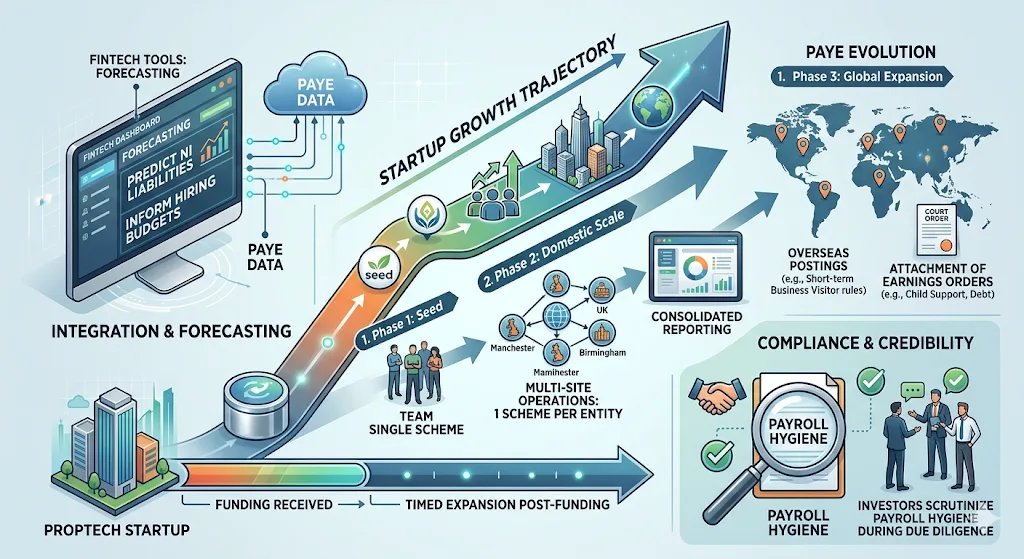
As headcount rises, PAYE evolves. Multi-site operations require one scheme per entity, with consolidated reporting. Global expansion introduces attachment of earnings orders or overseas postings.
Integrate PAYE with fintech tools for forecasting predict NI liabilities to inform hiring budgets. A proptech startup uses this to time expansions post-funding.
Compliance builds credibility; investors scrutinize payroll hygiene during due diligence.
From My Company: Your Partner in PAYE Compliance
Navigating PAYE doesn’t have to overwhelm. From My Company offers tailored PAYE Registration Assistance, from initial setup to ongoing advisory, empowering UK startups to focus on innovation.
Ready for expert support? Complete your HMRC payroll setup with our PAYE specialists for turnkey compliance.
In summary, mastering PAYE secures your startup’s foundation handling taxes, NI, and deadlines with precision.
Frequently Asked Questions
What is PAYE registration for UK businesses?
PAYE registration is the process of notifying HMRC that your business has become an employer, enabling you to operate a payroll scheme for deducting income tax and National Insurance from employee wages. It must be completed within three months of hiring your first employee or paying salaries. From My Company’s PAYE Registration Assistance handles this setup efficiently to ensure compliance from day one.
How long does PAYE registration take with HMRC?
HMRC typically processes PAYE registration applications within five working days via their online Government Gateway portal, provided all details like company UTR and employee numbers are accurate. Delays can occur with incomplete submissions, but professional services like From My Company’s PAYE Registration Assistance minimize this by preparing error-free applications.
Do startups need PAYE registration if they have no employees?
Startups generally don’t need PAYE registration without employees, but it’s required if paying salaries to directors or hiring staff, even part-time. Sole traders or contractors may defer until expansion, though early setup avoids penalties. From My Company’s PAYE Registration Assistance clarifies your specific obligations based on business structure.
What documents are needed for PAYE registration?
Key documents include your company’s Unique Taxpayer Reference (UTR), VAT number if applicable, expected start date, and employee count estimates. HMRC also requires director details and payroll software info. From My Company’s PAYE Registration Assistance compiles and submits these for seamless approval.
What happens if you miss PAYE registration deadlines?
Missing the three-month deadline after becoming an employer can result in HMRC penalties of up to £100 per employee per month, plus interest on unpaid taxes and NI. Proactive registration prevents disruptions to payroll and cash flow. From My Company’s PAYE Registration Assistance ensures timely filing to avoid fines.