

Appointing or resigning a director in your company doesn’t have to be complicated. With the right understanding of legal requirements and proper filing procedures, you can complete the process smoothly and remain compliant with Companies House regulations. Let’s walk through exactly how to handle director appointments and resignations efficiently while avoiding the most common pitfalls.
Understanding the Role of a Company Director
A company director is legally responsible for running a limited company and ensuring it meets its financial and statutory obligations. In the UK, directors must ensure the company maintains accurate accounting records, files annual returns, pays corporation tax, and complies with the Companies Act 2006. Whether you have one director or several, every decision and change must be properly recorded and reported to Companies House.
Appointing or removing a director impacts not just day-to-day operations but also how your company is perceived by clients, banks, and HMRC. For example, a director’s resignation may affect access to the company’s business bank account or its registered address if the resigning director managed correspondence. Therefore, the process must be managed formally, clearly documented, and quickly updated in statutory records to preserve your company’s compliance reputation.
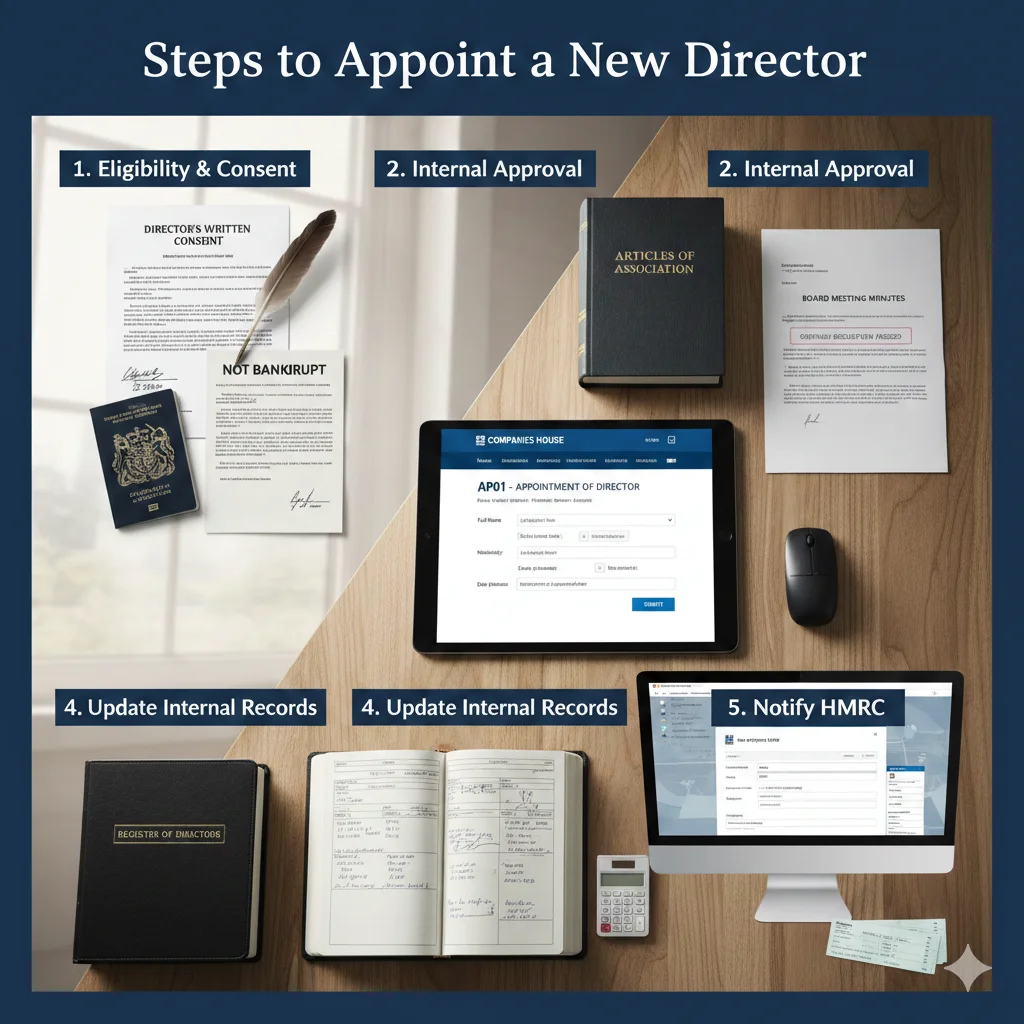
Steps to Appoint a New Director
Appointing a new director is straightforward when done correctly. The key is ensuring the person meets all legal requirements and that the appointment is properly recorded both internally and with Companies House.
Check eligibility and consent:
The new director must be at least 16 years old and not disqualified or bankrupt. Companies should always obtain written consent from the director before proceeding. This written consent, often in the form of a letter or a director’s declaration, confirms acceptance of the appointment and responsibilities.
Internal approval:
Review your company’s articles of association, as they may specify how directors are appointed. In many private limited companies (Ltds), shareholders can appoint directors via an ordinary resolution. Record the decision in the board minutes for future reference.
Completion of form AP01:
The appointment must be reported to Companies House using form AP01 (for individual directors) or form AP02 (for corporate directors). The online Companies House portal makes this quick and free to submit. The details required include the new director’s full name, service address, date of birth, occupation, nationality, and the effective date of appointment.
Update internal records:
Amend your company’s statutory registers specifically, the register of directors and, if applicable, the register of directors’ residential addresses. These internal records must always match the details filed with Companies House.
Notify HMRC (if relevant):
If the new director will receive salary through the company’s payroll, ensure they’re added to PAYE so National Insurance and income tax are correctly managed.
Properly completing these steps ensures your company remains compliant, transparent, and ready for inspection if required by authorities.
Process for Resigning a Director
Resigning as a director follows an equally structured procedure. It’s essential to handle this carefully to protect both the company and the departing individual from legal or financial complications.
- Formal resignation letter:
The resigning director should send a signed resignation letter to the company’s registered office, specifying the intended date of resignation. This document becomes part of the company’s internal records. - Board acknowledgment:
The resignation must be accepted and documented in board meeting minutes. In some cases, particularly when the resigning director is also a shareholder, it may trigger additional steps, such as transfer of shares or reallocation of duties. - Submit form TM01 to Companies House:
The company is responsible for filing form TM01 to officially record the resignation. The submission can be made online, generally taking less than 24 hours to update the public register. The effective date on TM01 must align with the resignation date noted in the board minutes. - Update internal and statutory records:
Remove the individual’s name from the register of directors, update internal documents accordingly, and ensure any company banking authorities, professional accounts, or correspondence permissions are changed. - Reallocate responsibilities:
If the departing director was an authorised signatory or managed operations such as payroll, VAT, or filing obligations, assign a replacement immediately to maintain compliance and operational continuity.
Handling this process carefully protects the company’s governance structure while preventing accidental non-compliance with Companies House or HMRC.
Benefits and Potential Risks
Properly managing director appointments and resignations maintains corporate stability and helps safeguard against regulatory or reputational issues.
Key benefits include:
- Regulatory compliance: Filing the correct forms ensures your company’s public record at Companies House stays accurate and up to date.
- Operational continuity: Smooth transitions minimise disruption to management and financial processes.
- Professional credibility: Prospective clients, banks, and investors can easily verify your company’s leadership details online.
However, risks arise when procedures are poorly handled:
- Late filings may result in penalties, investigation, or even the company being struck off.
- Failure to notify Companies House can create legal ambiguities over who is accountable for company decisions.
- Improper documentation can lead to disputes among shareholders, particularly if authority or ownership is unclear.
By handling every change with diligence and timely updates, these risks can be avoided easily.
Legal and Compliance Considerations
Under the Companies Act 2006, directors are legally bound by fiduciary duties, including acting within their powers, promoting the company’s success, and maintaining accurate records. Therefore, any appointment or resignation is not just an administrative formality but a matter of legal significance.
Companies must:
- Maintain statutory registers (director and shareholder registers).
- Notify Companies House within 14 days of any change in directors.
- Ensure information accuracy any false entry is considered a breach of law.
- Keep director service addresses up to date, especially if the registered office changes.
For companies registered for VAT or PAYE, updates may also be required with HMRC to ensure correspondence and authorisation align with the new directorship structure. Neglecting this could delay tax submissions or interfere with payroll operations.
A practical example: if a director who handles tax filings resigns without updating HMRC authorisations, your payroll or VAT submissions could be temporarily locked risking penalties or late fees. Thus, compliance goes beyond filing a simple form; it’s about maintaining seamless synchronisation between all regulatory institutions.

Common Mistakes to Avoid
Many UK companies encounter avoidable issues when changing directors due to overlooked details or procedural shortcuts. Here are some of the most frequent errors:
- Failing to record consent: Always obtain and file the new director’s written consent. Without it, their appointment could be legally challenged later.
- Incorrect effective dates: Misalignment between the resignation letter, board minutes, and Companies House filing dates can cause compliance discrepancies.
- Not updating statutory registers: Internal records often get neglected, yet they are legally required under the Companies Act.
- Overlooking shareholdings: If a resigning director is also a shareholder, their shares must be transferred following proper procedure; otherwise, governance disputes may arise.
- Delaying updates to HMRC or banks: Director changes should be communicated promptly to prevent administrative conflict, especially where digital signatures or account access are involved.
These oversights can damage credibility and trigger unnecessary administrative corrections so it’s well worth handling each step thoroughly from the start.
Practical Tips and Best Practices
To simplify the process of director changes, follow these proven practices:
- Plan transitions early: When a director plans to resign, begin the process at least a few weeks in advance to allow time for replacements and filings.
- Use digital submissions: Register and file through Companies House online; it’s faster and provides confirmation receipts instantly.
- Keep communication transparent: Inform shareholders and key company officers early to ensure authority lines remain clear.
- Maintain backups: Store digital copies of resignation letters, appointment agreements, and board minutes for audit trails.
- Seek professional guidance: If the company’s structure is complex—such as involving multiple directors, shareholders, or subsidiaries—consult a compliance expert to avoid errors.
Implementing these practices ensures your company remains compliant, respected, and efficiently managed.
Managing director appointments or resignations might seem daunting, but when handled with precision and compliance in mind, it becomes a straightforward administrative process. The key lies in understanding your legal duties, maintaining accurate records, and communicating promptly with Companies House and HMRC. Whether you’re adding experienced leadership or parting ways with a company director, careful execution protects your business reputation and ensures seamless continuity.
If you’re ready to register your company or need expert help managing director changes, Form My Company provides fast, fully online company formation with complete compliance support. From filings to VAT and PAYE registration, our professionals handle the details so you can focus on growing your business. Get started today and make every company change hassle-free.
Frequently Asked Questions
Can a company operate with only one director?
Yes. A private limited company in the UK can operate with a single director, provided they are not disqualified and meet legal eligibility criteria.
How long does Companies House take to process a director change?
Online submissions are usually processed within 24 hours. Paper submissions can take up to 10 working days.
Can a director also be a shareholder?
Yes. Many small business owners act as both director and shareholder. However, their roles are legally distinct ownership (shares) differs from management (directorship).
What happens if the director’s resignation leaves the company without any directors?
The company risks becoming non-compliant and could face compulsory strike-off from Companies House. A replacement must be appointed immediately.
Do directors have to be UK residents?
No, there is no residency requirement, but directors must have a valid service address in the UK that is available on the public record.