

Filing your UK company confirmation statement is a simple annual requirement that confirms your business details are accurate with Companies House. It takes just minutes online and costs £13 if filed digitally. Follow our step-by-step guide to stay compliant effortlessly.
The confirmation statement, formerly known as the annual return, is a mandatory filing for every UK limited company, LLP, or overseas company with a UK presence. Introduced under the Small Business, Enterprise and Employment Act 2015, it ensures Companies House holds up-to-date information on key details like directors, shareholders (known as persons with significant control or PSCs), registered office address, and share capital structure. For entrepreneurs and business owners, this annual check-in is crucial for maintaining good standing, as it verifies your company’s legitimacy and transparency to regulators, banks, investors, and the public.
Failing to file on time can lead to penalties starting at £150, escalating to £1,500 or more, and ultimately strike-off from the register, which halts trading and damages your reputation. With over 4 million active companies on the UK register, accurate filings support the ecosystem of company formation and compliance. Whether you’re a startup handling initial VAT and PAYE registrations or an established firm managing multiple directors and shareholders, mastering this process safeguards your business structures and avoids disruptions. This guide draws on UK legal frameworks like the Companies Act 2006 to provide authoritative insights tailored for compliance-focused leaders.
Step-by-Step Guide to Filing Your Confirmation Statement
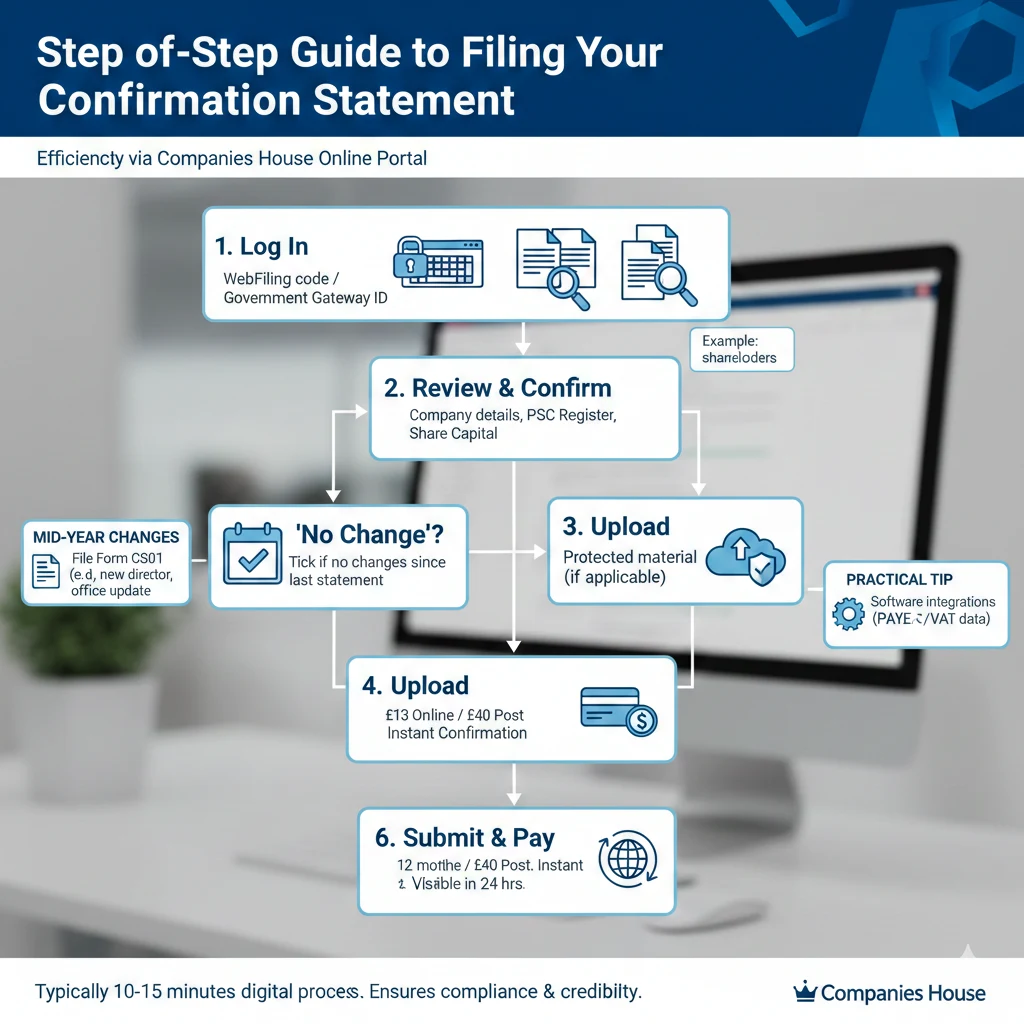
Filing a confirmation statement follows a clear, structured process designed for efficiency via the Companies House online portal. Begin by logging into your company account using a WebFiling authorisation code or Government Gateway ID, accessible 24/7. You’ll review and confirm three core sections: company details (including registered office and directors), PSC register (detailing individuals or entities with more than 25% shares or voting rights), and share capital information (such as issued shares and classes).
For example, if your company has multiple shareholders, extract data from your internal statutory registers to populate the PSC section accurately failure here flags discrepancies. Next, state whether any changes occurred since the last statement; if none, tick ‘no change’. Upload any protected material like residential addresses if applicable. Submit with payment , receiving instant confirmation and a new ‘confirmation date’ set 12 months ahead or on your incorporation anniversary.
If changes are needed mid-year, like appointing a new director or updating the registered office, file an incorporation statement first via form CS01. Practical tip: Use software integrations like with accounting tools for PAYE or VAT data to streamline prep. The entire digital process typically takes 10-15 minutes, with updates public within 24 hours, ensuring your company remains searchable and credible for loans or partnerships.
Benefits and Potential Risks of Timely Filing
Submitting your confirmation statement on time delivers tangible advantages for business operations and growth. Primarily, it upholds compliance, preventing automatic penalties and preserving access to banking services, which often require an up-to-date Companies House record. For growing firms, accurate PSC and director details build trust with investors scrutinising ownership structures during due diligence. It also simplifies audits, as HMRC cross-references this data for corporation tax, VAT returns, and PAYE obligations.
Failure to file a confirmation statement is a criminal offence under the Companies Act 2006. Companies House may commence strike-off proceedings against persistent offenders, while directors can face prosecution for non-compliance. Additional risks now include rejected filings due to incomplete identity verification requirements
Mandatory identity verification became available on 18 November 2025 and is now a core part of Companies House compliance. Directors and Persons with Significant Control (PSCs) must verify their identity through GOV.UK One Login or an Authorised Corporate Service Provider (ACSP). Existing officers have until their first confirmation statement filing date after implementation, with a final deadline of 18 November 2026.
Legal and Compliance Considerations
The confirmation statement is enshrined in the Companies Act 2006 (sections 819-825), obligating every company to confirm register accuracy annually. Directors bear personal responsibility as ‘senior accounting officers’ for truthful declarations, with false statements punishable by fines or up to two years’ imprisonment. Key compliance ties into broader obligations: PSC registers must align with internal records, and changes in directors or control (e.g., share transfers) require prior filings like AP01/TM01.
Integration with HMRC is vital updated addresses ensure tax correspondence reaches the registered office, preventing missed PAYE deadlines or VAT penalties. For complex structures like holding companies, disclose the nature of business via SIC codes. The 2024 Economic Crime Act introduces stricter ‘identity verification’ from spring 2026, requiring directors to submit biometric-proofed IDs, impacting future statements.
Non-compliance risks director disqualification (up to 15 years) and company restoration costs post-strike-off (£100+). Practical implication: A sole-director firm changing its virtual office must notify via AR01 first, then confirm in CS01, maintaining seamless VAT/PAYE flows. Staying abreast of reforms via Companies House alerts fortifies your compliance posture.
New Companies House Requirements for 2026
The Economic Crime and Corporate Transparency Act has introduced several new compliance obligations that companies must address when filing their confirmation statement.
Registered Email Address
All UK companies must provide and maintain a registered email address for official Companies House correspondence. This email address is not displayed on the public register but must remain accessible and monitored.
Statement of Lawful Purpose
Companies are now required to confirm that their future activities will be conducted for lawful purposes. This declaration is mandatory and forms part of every confirmation statement submission.
Identity Verification
Directors and PSCs must complete identity verification through approved channels before the applicable filing deadlines. Companies House may reject filings where verification requirements have not been met.
Enhanced Shareholder Transparency
Companies must maintain accurate shareholder records using full legal names. Initials, abbreviations, or incomplete entries may no longer satisfy transparency requirements introduced under corporate transparency reforms.
Common Mistakes to Avoid When Filing
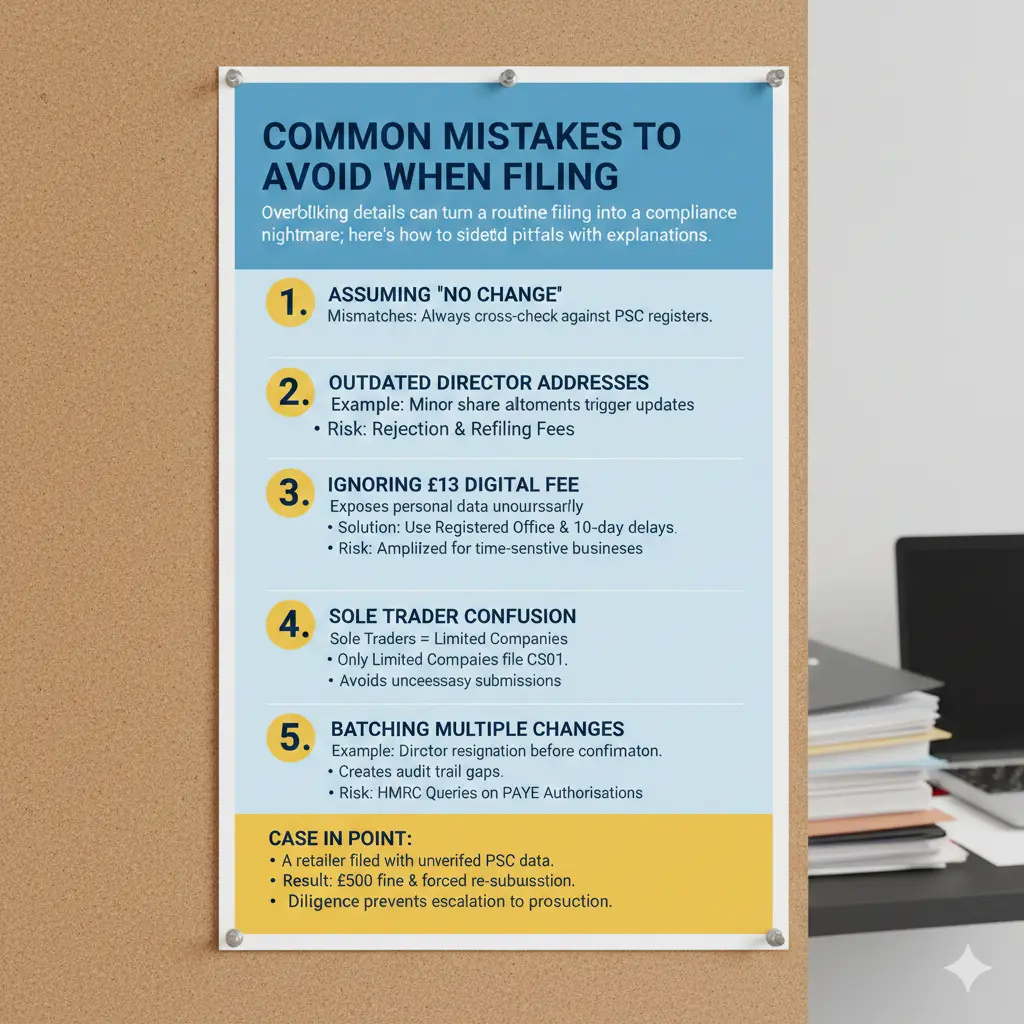
Overlooking details can turn a routine filing into a compliance nightmare; here’s how to sidestep pitfalls with explanations.
First, assuming ‘no change’ without verification leads to mismatches always cross-check against PSC registers, as even minor share allotments trigger updates, risking rejection and refiling fees. Second, entering outdated director service addresses exposes personal data unnecessarily; use a compliant registered office or virtual address service instead.
Third, ignoring the £13 digital fee by posting incurs £40 costs and delays (up to 10 days), amplifying risks for time-sensitive businesses. Fourth, sole traders confusing this with self-assessment miss that only limited companies file CS01, leading to unnecessary submissions. Finally, batching multiple changes without interim filings (e.g., director resignation before confirmation) creates audit trails gaps, inviting HMRC queries on PAYE authorisations.
A case in point: A retailer filed with unverified PSC data, facing a £500 fine and forced re-submission after a shareholder dispute surfaced. Diligence here prevents escalation to prosecution. Many companies assume the confirmation statement can be filed before directors complete identity verification. However, Companies House increasingly links compliance obligations together, and unverified officers may create filing complications. Companies incorporated before the new reforms often overlook the registered email address requirement, causing avoidable compliance issues during filing. Initials or abbreviated shareholder entries may no longer meet Companies House transparency expectations. Companies should review their register of members before filing.
Practical Tips and Best Practices
Elevate your filing process with these actionable strategies rooted in real-world application. Schedule reminders 30 days before your confirmation date using Companies House emails or calendar integrations, allowing buffer for director approvals or shareholder confirmations. Leverage free WebFiling previews to simulate submissions, catching errors like SIC code mismatches early.
For efficiency, integrate with cloud accounting software (e.g., Xero) to auto-pull share capital and director data, syncing with VAT/PAYE modules. Appoint a compliance officer or use virtual office services for address stability, reducing updates. Document everything retain screenshots, PDFs of registers, and board minutes proving PSC accuracy for potential inspections.
Best practice for scaling businesses: Conduct quarterly internal audits aligning registers with Companies House, preempting changes from new share issues or director appointments. Outsource to specialists for complex structures involving LLPs or overseas shareholders, ensuring EEAT compliance. These habits not only save time but future-proof against regulatory shifts like mandatory ID checks.
Mastering UK company confirmation statements ensures unwavering compliance amid evolving regulations. From verifying directors and PSCs to syncing with VAT/PAYE obligations, timely accuracy protects your business structures and reputation.
If you’re ready to streamline company formation or compliance, Form My Company offers fast, fully online services including confirmation statement filing, VAT & PAYE registrations, virtual office solutions, and expert support. Let our specialists handle the details so you focus on growth and get started today.
Frequently Asked Questions
How much does it cost to file a confirmation statement in 2026?
As of 1 February 2026, the filing fee is £50 when submitted online and £110 for paper submissions.
Do directors need identity verification before filing?
Directors and Persons with Significant Control (PSCs) are now required to complete identity verification under Companies House reforms. Existing officers must comply by their first relevant filing deadline and no later than 18 November 2026.
What happens if I miss the filing deadline?
Failure to file can result in prosecution, company strike-off proceedings, and reputational damage. Directors remain legally responsible for ensuring compliance.
Is a registered email address mandatory?
Yes. Every UK company must maintain a registered email address for Companies House communications. The address is not publicly visible.
Do dormant companies still need to file?
Yes. Dormant companies must still submit a confirmation statement annually, even if no company information has changed.
Can I file more than one confirmation statement each year?
Yes. Additional confirmation statements can be filed when necessary to update company information. The filing fee is generally payable only once during each 12-month payment period.