

Foreign business owners can transition to a UK entity by incorporating a private limited company (Ltd) with Companies House, appointing at least one UK-resident director or using a professional service address, and securing a registered office in the UK. This process typically takes 24-48 hours for approval and positions your business to access EU markets, R&D tax credits, and local funding. Partnering with compliance experts ensures seamless VAT, PAYE, and banking setup from abroad.
Expanding into the UK represents a strategic milestone for foreign entrepreneurs seeking access to one of Europe’s largest economies, valued at £2.7 trillion in 2026. Transitioning to a UK entity most commonly a private limited company (Ltd) grants credibility, tax efficiency, and legal protections unavailable through branches or partnerships. Directors and shareholders benefit from limited liability, shielding personal assets, while establishing a registered office fulfils Companies House mandates under the Companies Act 2006.
For overseas owners from the US, India, or EU nations, this move facilitates VAT registration for cross-border trade, PAYE for UK hires, and eligibility for SEIS/EIS investor incentives. However, navigating HMRC rules, AML checks, and post-Brexit customs demands precision. This guide provides a roadmap, drawing on real-world examples like US tech firms incorporating in London to tap talent pools, ensuring your transition supports long-term growth amid UK business structures.
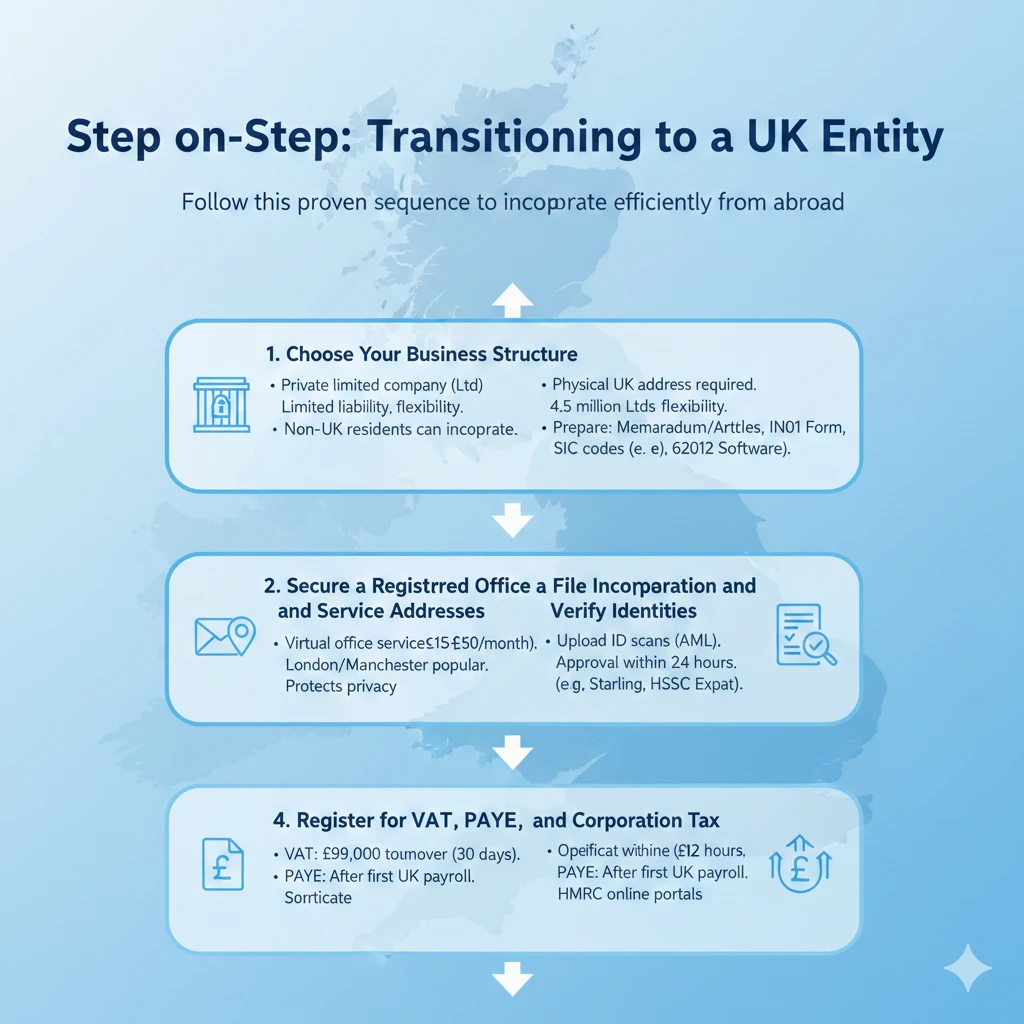
Step-by-Step: Transitioning to a UK Entity
Follow this proven sequence to incorporate efficiently from abroad.
1. Choose Your Business Structure
Select a private limited company (Ltd) for most foreign owners simple setup, limited liability for shareholders, and flexibility for directors. Alternatives like LLPs suit partnerships, but Ltds dominate with 4.5 million registrations. Non-UK residents can incorporate without issue, appointing a UK registered office provider for compliance.
Prepare documents: memorandum/articles of association, IN01 form detailing directors/shareholders, and SIC codes matching your sector (e.g., 62012 for software).
2. Secure a Registered Office and Service Addresses
Every UK entity requires a physical UK address for Companies House mail. Foreign owners use virtual office services (£15-£50/month) in London or Manchester, avoiding home exposure. Directors list a service address publicly, protecting privacy.
3. File Incorporation and Verify Identities
Submit online via Companies House (£12 fee), uploading ID scans for AML compliance. Approval arrives within 24 hours, issuing your certificate. Open a UK business bank account remotely via providers like Starling or HSBC Expat.
4. Register for VAT, PAYE, and Corporation Tax
Hit £90,000 turnover? Mandatory VAT within 30 days. PAYE follows first UK payroll. HMRC online portals integrate seamlessly post-incorporation.
Benefits and Potential Risks
UK entities unlock opportunities, tempered by challenges.
Key Benefits
Market access tops the list: Seamless EU trade via Northern Ireland protocol, plus 28% corporation tax (rising to 25% for profits over £250k). R&D credits refund 33% of spend vital for tech/manufacturing. Banking eases with UK status; investors favour Ltds for SEIS relief (50% tax break).
Example: An Indian SaaS firm incorporated in 2025, claiming £150k R&D relief, scaling UK revenue 300%. Directors gain credibility for contracts; shareholders enjoy dividend tax efficiency.
Potential Risks
Double taxation without treaties (UK has 130+); exchange rate volatility hits remittances. Overstaffing triggers PAYE complexity. Setup delays from AML scrutiny average 5-10 days for high-risk jurisdictions.
Legal and Compliance Considerations
Master UK regulations to avoid penalties.
Companies House and HMRC Obligations
Annual confirmation statement (£13) and accounts filing (micro-entities under £10m turnover file abridged). PSC register discloses beneficial owners over 25%. Directors face fiduciary duties; breaches risk disqualification.
VAT: Register voluntarily below threshold for reclaiming imports. PAYE: Real-time reporting via FPS. Post-Brexit, EORI numbers mandatory for goods.
Director and Shareholder Rules
Non-UK directors suffice, but one EEA-resident preferred for some banks. Shareholders unlimited; PSC filings public. GDPR applies immediately—fines up to 4% global turnover.
Common Mistakes to Avoid
Foreign owners often falter here.
1. Using Non-Compliant Addresses
PO Boxes or overseas addresses fail Companies House scrutiny, delaying incorporation. Always verify physical UK premises.
2. Skipping AML/KYC Preparation
Incomplete ID/passport scans trigger rejections; prepare apostilled documents for non-EEA owners.
3. Ignoring VAT Threshold Timing
Assuming post-move registration track worldwide sales. Late filing incurs 2% monthly penalties.
4. Underestimating Accounting Burden
Forgetting dormant accounts (£10 fee) leads to £1,500 fines. Engage CT600-compliant accountants early.
Practical Tips and Best Practices
Execute flawlessly with these insights.
1. Leverage Formation Agents
Use services like Form My Company for £50 all-in incorporation, bundling registered office/VAT setup.
2. Open Multi-Currency Accounts
Providers like Wise Business handle forex; link to HMRC for PAYE.
3. Plan Tax Residency Strategically
Avoid UK tax residency (183+ days) via non-dom status for first years.
4. Integrate Compliance Software
Xero/FreeAgent automates VAT/PAYE, filing direct to HMRC.

Transitioning to a UK entity equips foreign owners with market access, tax incentives, and credibility, provided you master compliance from the outset. Prioritise Ltd structures, professional addresses, and expert support to sidestep pitfalls and accelerate growth.
If you’re ready to register your company with confidence, Form My Company provides fast, fully online company formation with expert compliance support. From registered offices and virtual solutions to VAT & PAYE registration, our specialists handle every detail. Get started today and let our team manage the paperwork while you focus on growing your business.
Frequently Asked Questions
Can non-UK residents form a company?
Yes, no residency required. Appoint a UK registered office; directors/shareholders can be anywhere.
How long until incorporation?
24-48 hours standard; same-day possible with agents.
What taxes apply immediately?
Corporation tax post-first return; VAT if over £90k; PAYE on UK payroll.
Do I need a UK bank account?
Essential for HMRC payments; remote options via video ID.
How to handle shareholder structures?
File PSC register on incorporation; update annually via Companies House.