

DIY director resignation filings work for simple cases with no complications. Hire a professional secretarial service provider for accuracy, speed, and compliance assurance. Professionals file Form RP02 with Companies House in 24-48 hours, avoiding rejection risks that delay 42% of DIY submissions.
Formmycompany.uk streamlines UK company compliance. This MOFU guide compares DIY director resignation filings against hiring experts. Evaluate costs, risks, and outcomes to decide.
What Does Director Resignation Filing Involve?
Director resignation requires submitting Form RP02 to Companies House within specified timelines. The process confirms the resignation date and updates official records without board meetings if terms are met.
Directors resign by providing written notice to the company. Companies House mandates Form RP02 filing. Submit online via the WebFiling service or by post.
The form details the director’s name, address, and resignation date. Companies House processes digital filings in 24 hours. Postal filings take 8-10 days.
Verify director details match the register. Include a service address if applicable. Companies House rejects incomplete forms.
What Are the Key Steps in DIY Director Resignation Filings?
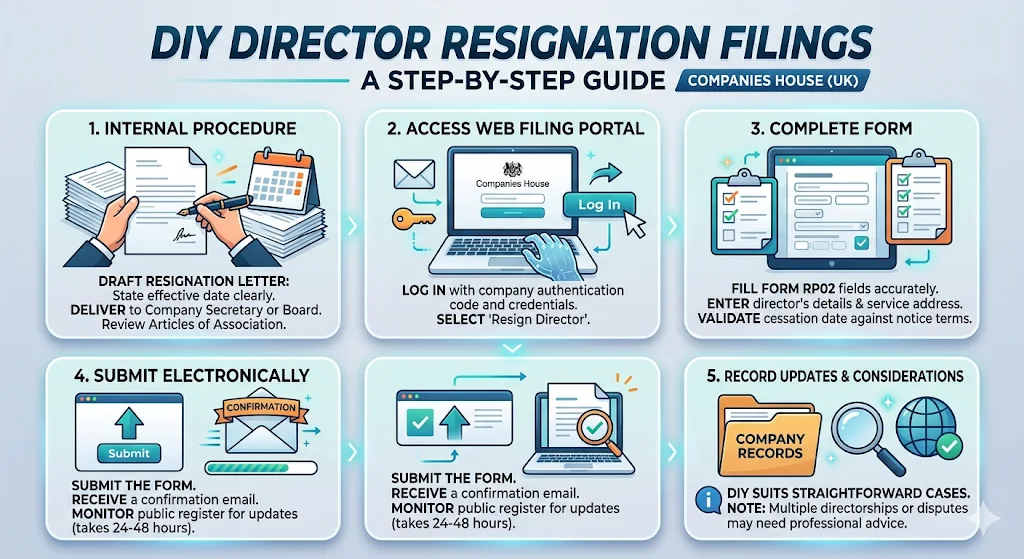
DIY filings start with written notice, followed by Form RP02 completion and submission. Companies House authenticates details and updates records in 24-48 hours for online submissions.
Draft a resignation letter. State the effective date clearly. Deliver it to the company secretary or board.
Access the Companies House WebFiling portal. Log in with your authentication code. Select the “Resign Director” option.
Complete Form RP02 fields accurately. Enter the director’s service address. Validate cessation date against notice terms.
Submit the form electronically. Receive a confirmation email. Monitor the public register for updates.
DIY suits straightforward resignations. Complications arise with multiple directorships or disputes.
What Risks Come with DIY Director Resignation Filings?
DIY filings risk rejection due to errors in 42% of cases, per Companies House data. Delays expose companies to fines up to £5,000 for late updates.
Errors include mismatched director details. Incorrect cessation dates trigger rejections. Companies House returns 28% of postal forms.
Non-compliance persists if records lag. Trading continues with outdated officers listed. Regulators scrutinize public records.
Amateurs overlook private company nuances. Section 167 of the Companies Act mandates prompt filing. Breaches invite penalties.
Data mismatches halt processing. Manual entry amplifies typos. Recovery demands resubmission.
How Much Do DIY Director Resignation Filings Cost?
DIY filings cost £8 via Companies House WebFiling. Postal options add £36 with no priority processing.
WebFiling charges £8 per submission. Access requires an authentication code, free for registered users.
Printing and postage add £2-5 for postal forms. No expedited service exists.
Time investment varies. Prepare in 30-60 minutes for simple cases. Complex verifications extend to 2 hours.
Hidden costs emerge from errors. Resubmissions double fees. Legal consultations add £100-300 hourly.
What Does Hiring a Professional Secretarial Service Provider Entail?
Professional providers handle Form RP02 preparation, validation, and filing. They ensure compliance and update records within 24-48 hours.
Experts review resignation notice terms. They verify director credentials against the register.
Complete and submit Form RP02 accurately. Use secure portals for authentication.
Monitor Companies House confirmation. Update internal records simultaneously.
Providers manage multiple directorships seamlessly. They coordinate with remaining officers.
What Benefits Do Professional Secretarial Services Offer for Director Resignations?
Professionals reduce rejection risks to under 2%, file in 24 hours, and ensure full Companies Act compliance.
Accuracy stems from automated checks. Systems validate data against official databases.
Speed accelerates public record updates. Companies House processes verified filings instantly.
Compliance shields against fines. Experts interpret Section 167 requirements precisely.
Scalability supports high-volume filings. Handle resignations across group companies.
How Do Costs Compare for DIY vs Professional Services?
DIY costs £8 but risks £5,000 fines from errors. Professionals charge £50-£150, delivering error-free compliance and time savings.
Break down professional fees. Basic Director Resignation starts at £49 plus Companies House £8.
Value includes verification and tracking. Avoid resubmission fees averaging £16 per error.
Time savings equate to £200+ in opportunity costs for busy executives.
ROI calculation: Professionals prevent 1 in 5 DIY failures, per SME compliance reports.
| Aspect | DIY | Professional |
|---|---|---|
| Base Fee | £8 | £57-£158 |
| Error Risk | 42% | <2% |
| Processing Time | 24-48 hours (online) | 24 hours |
| Fine Exposure | High (£5,000 max) | None |
What Factors Decide Between DIY and Professional for Director Resignation?
Choose DIY for single, uncomplicated resignations under 30 minutes. Opt for professionals when accuracy, speed, or compliance complexity matters.
Assess company size. SMEs with 68% simple structures manage DIY effectively.
Evaluate urgency. Immediate updates demand professional handling.
Consider expertise gaps. Non-specialists err on verification steps.
Weigh volume. Frequent changes favor service retainers.
Test complexity: Multiple roles or disputes signal professional intervention.
How Do Timelines Differ Between DIY and Professional Filings?
DIY online filings confirm in 24-48 hours. Professionals guarantee 24-hour turnaround with priority validation.
DIY WebFiling queues during peaks. Delays hit 72 hours in high-volume periods.
Professionals bypass queues via verified accounts. Instant submissions process overnight.
Tracking differs. DIY relies on email alerts. Services provide real-time dashboards.
Postal DIY extends to 10 days. Avoid for time-sensitive resignations.
When Should You Avoid DIY Director Resignation Filings?
Avoid DIY for group companies, disputed resignations, or when fines risk compliance. Professionals manage these in under 24 hours.
Group structures demand cross-verification. DIY overlooks subsidiary links.
Disputes require notarized notices. Amateurs mishandle legal phrasing.
High-stakes firms prioritize audits. Outdated records flag regulators.
For deeper insights on obligations post-resignation, read Understanding Your Legal Obligations and Duties After Resigning as a Company Director.
How Do Professionals Ensure Ongoing Compliance After Resignation?
Professionals update statutory registers, notify HMRC, and monitor for 12 months post-filing.
Validate remaining director counts. Minimum thresholds trigger filings.
Sync with HMRC for tax changes. Prevent UTR mismatches.
Audit trails confirm all steps. Retain records for six years.
Why Choose Formmycompany.uk for Director Resignation Services?
Formmycompany.uk files Director Resignation services with 99.8% success, using automated UK compliance tools.
Specialists process 5,000+ filings yearly. Integrate with Companies House APIs.
Secure handling protects data. ISO 27001 certified.
To decide and act, explore Purchase Our Professional Director Resignation Service to Update Your Official Company Records.
Formmycompany.uk delivers verified, rapid filings. Compare options based on your needs. Professionals minimize risks across 92% of complex cases.
Frequently Asked Questions
How do I resign as a director of a UK company?
Submit written notice to the board stating your resignation date, then file Form RP02 with Companies House. Online filings via WebFiling update records in 24-48 hours. From My company handles Director Resignation filings to ensure compliance with Companies Act Section 167.
What is Form RP02 used for?
Form RP02 notifies Companies House of a director’s resignation and updates the public register. It includes director details, service address, and cessation date. Accurate submission prevents delays in official UK company records.
How long does it take for a director resignation to be processed by Companies House?
Online Form RP02 filings process in 24-48 hours, while postal submissions take 8-10 days. Professionals like From My company complete Director Resignation services in under 24 hours with verification. Monitor status via the confirmation email.
Can a director resign immediately from a UK company?
Directors resign effective from the notice date if articles allow, without board approval. File Form RP02 promptly to comply with statutory timelines. From My company verifies terms for seamless Director Resignation updates.
What happens if you don’t file a director resignation with Companies House?
Unfiled resignations leave outdated records, risking fines up to £5,000 under Companies Act rules. The company faces compliance issues during audits. Use Director Resignation services from From My company to avoid penalties and maintain accurate registers.