
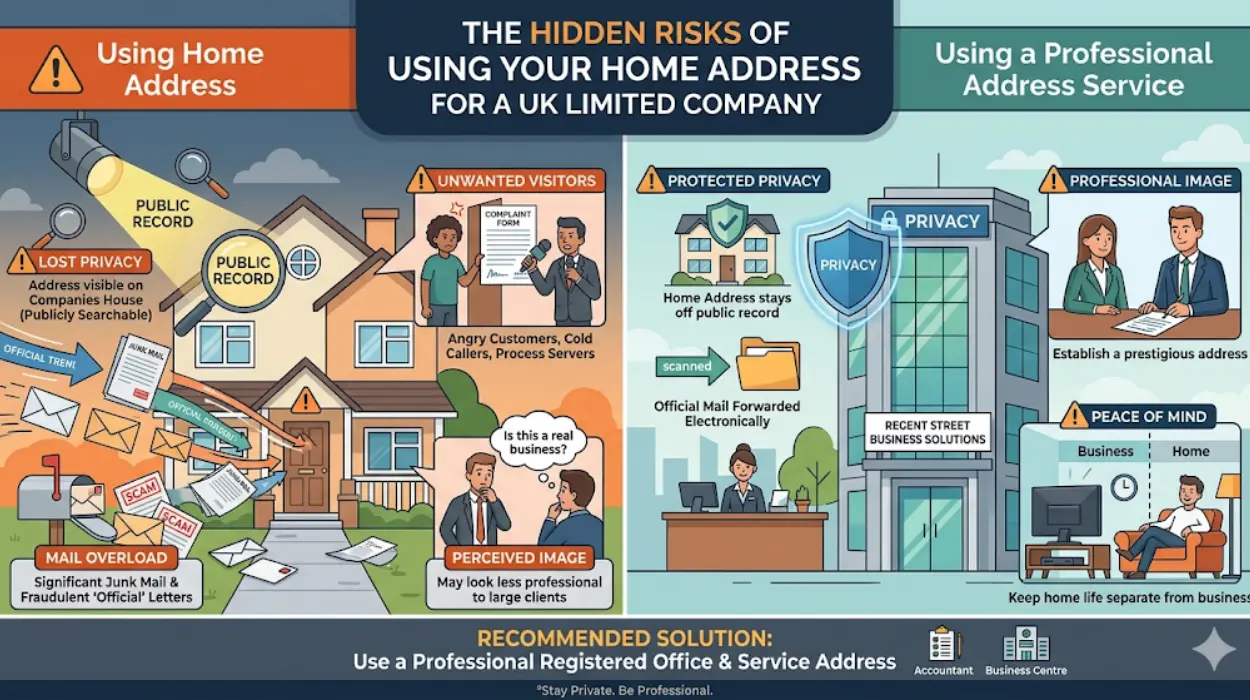
Using your home address as the registered office for a UK limited company may seem convenient, but it exposes you to significant privacy, professional, and compliance risks. Once your residential address is filed with Companies House, it becomes public information, accessible to clients, suppliers, creditors, cold callers, and even enforcement officers, which can disrupt your personal life and weaken your business’s credibility. Understanding these hidden risks and how to protect yourself with a proper registered office address is essential for any UK‑based entrepreneur.
Why entrepreneurs choose a home address
Many small business owners start by registering their UK limited company at their home address because it is readily available, costs nothing, and feels like a simple way to meet the Companies House requirement for a registered office address. A residential address is often the first physical location that comes to mind when setting up company formation, VAT registration, or PAYE, and it can seem harmless when the business is still small and informal. However, this convenience quickly becomes a liability once the address is published on the public register, used on invoices, and shared with customers and suppliers.
From a compliance perspective, the address you provide at incorporation is not just a “formal detail”; it is the legal locus for statutory correspondence from Companies House, HMRC, and courts. If that address is your home, it means all official letters, notices, and enforcement documents will be sent there, and your family may be the first to receive them. This blurs the boundary between personal and professional life in a way that many new directors do not anticipate when they first complete their company registration.
Core benefits of using your home address (and why they are misleading)
At first glance, using your home address appears to offer several advantages: it eliminates the cost of renting office space, simplifies post‑collection, and avoids the need to negotiate with landlords or co‑working spaces. For micro‑businesses or sole‑trader‑style limited companies, it can feel like a perfectly adequate “office” location while you build your client base. In theory, it also streamlines record‑keeping by keeping everything in one place, reducing the need to redirect business mail or manage multiple rent‑rolled locations.
In practice, however, these short‑term benefits are outweighed by long‑term exposure. The cost savings are typically marginal compared with a virtual office or registered office service, yet the risks to privacy, insurance, mortgage terms, and professional image are substantial. Many founders later discover that clients and investors view a residential address as a sign of informality or lack of growth ambition, which can indirectly constrain access to higher‑value contracts and finance.
Key risks of listing your home address at Companies House
When you use your home address as the registered office for a UK limited company, it appears on the public Companies House register, where anyone can search by company name or director name and retrieve your exact residential address. This exposure can lead to targeted marketing, phishing campaigns, and nuisance visits from salespeople, debt collectors, or even aggressive creditors if your business later faces financial difficulties. In extreme cases, creditors or enforcement agents may show up at your door, expecting immediate payment or explanations, which can be distressing and unsafe for your family.
Beyond direct privacy intrusions, listing a residential address can also affect your personal reputation and safety. Neighbours, tenants, or landlords may object to strangers frequently visiting your property, and your home insurance or mortgage terms may be breached if the property is effectively being used for business activity. Residential premises are usually not zoned for commercial use, so declaring a business at your home address can trigger disputes with mortgage lenders or insurers, potentially leading to claims being declined or terms being revised.
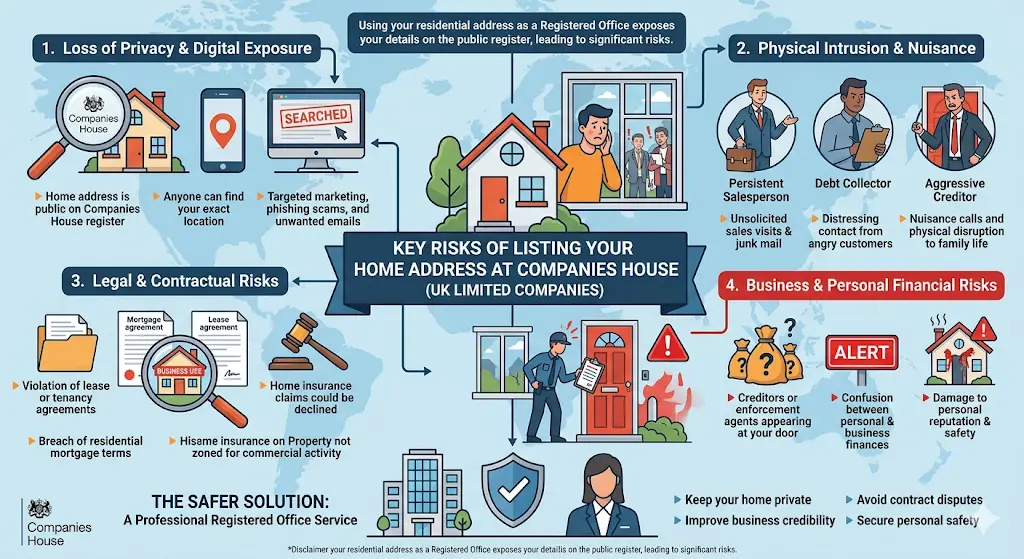
Legal and compliance implications for UK limited companies
Under UK company law, every limited company must have a registered office address within the same legal jurisdiction as the company (England and Wales, Scotland, or Northern Ireland), and it must be a physical address capable of receiving official correspondence. While a home address can legally satisfy this requirement, it does not automatically mean it is the most prudent choice from a compliance or risk‑management standpoint. Statutory notices, annual confirmation statements, and reminders from Companies House will all be sent to this address, and late or missed filings can lead to fines or penalties even if the letters simply get lost in domestic mail.
From a tax and employment perspective, HMRC will also send VAT, PAYE, and Corporation Tax correspondence to the registered office unless you have set up online portals or alternative contact arrangements. If personal mail and business mail are mixed in the same mailbox, important deadlines can be overlooked, increasing the risk of non‑compliance. Directors and shareholders should also be aware that creditors and litigants can use the Companies House register to trace directors’ residential details, which may indirectly affect personal credit and family security.
Common mistakes directors make with address selection
One of the most common mistakes is assuming that “any address will do” as long as it is a physical location. Entrepreneurs often fail to check whether the address they provide is suitable for receiving statutory mail, particularly if they are abroad for part of the year or rely on someone else to manage their post. Another mistake is using a home address for the registered office and then changing the address frequently as the business grows, which can lead to lapsed notices, missed deadlines, and confusion for clients and suppliers.
A further pitfall is not considering the impact on tenancy or mortgage agreements. Many landlords and lenders explicitly prohibit the use of a residential property as a business address without prior consent, and some require that you notify them of any business activity. Breaching these terms can invalidate your insurance or even trigger a default clause, leaving you exposed if a dispute arises. Finally, some founders assume that listing a home address will not affect their professional image, only to discover that key clients or partners prefer to see a commercial postcode or central‑area location.
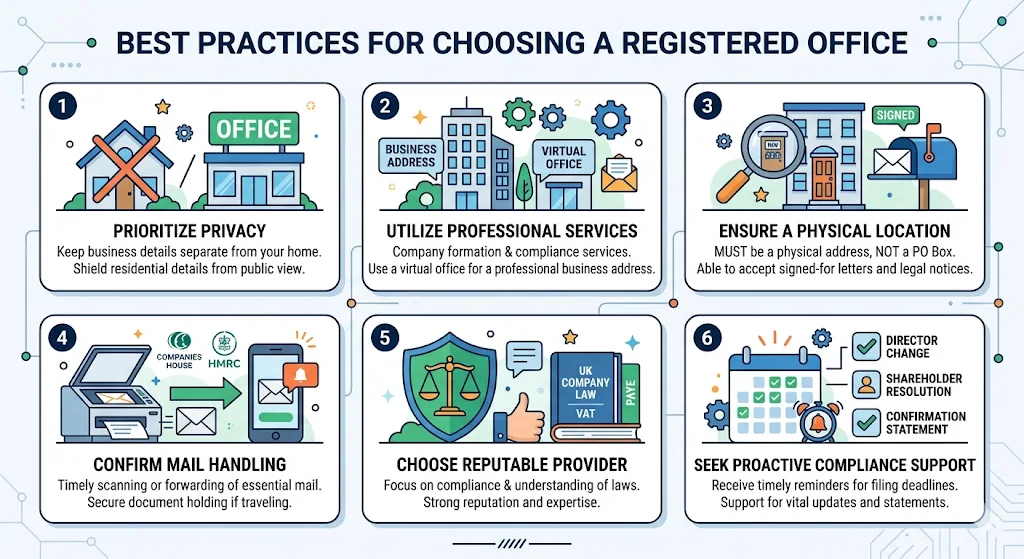
Best practices for choosing a registered office
To protect both your business and your personal life, the safest approach is to designate a separate registered office address that is not your home. Many UK‑based company formation and compliance services offer registered office and virtual office packages that provide a professional business address, mail forwarding, and digital notifications, effectively shielding your residential details from Companies House and third parties. This address can still be within the same jurisdiction as your company, but it is specifically set up to receive statutory correspondence and separate business operations from your home environment.
When selecting a registered office, ensure it is a physical location (not a PO box) that can accept signed‑for letters and legal notices. Confirm that the provider offers timely scanning or forwarding of Companies House and HMRC mail, and that they can hold documents securely if you are overseas or frequently travelling. It is also wise to choose a reputable compliance‑focused provider that understands UK company law, VAT, and PAYE requirements, so you receive proactive reminders and support for updates such as director changes, shareholder resolutions, and confirmation statements.
Practical tips to future‑proof your business address strategy
Once you have chosen a proper registered office, keep your address details consistent across Companies House, HMRC, VAT, PAYE, and your website to avoid confusion and maintain strong compliance hygiene. If you later move premises or switch to a different virtual office, update your address promptly with Companies House and communicate the change to key stakeholders, including your accountant and bank. Avoid using internal flat numbers or temporary addresses that may become obsolete, and always double‑check that your registered office can be clearly identified by delivery services.
For branding and client perception, consider using a professional virtual office address on your website, email signature, and marketing materials, even if your day‑to‑day operations are still home‑based. This simple step can enhance credibility without requiring a full‑scale office lease, and it future‑proofs your image as you scale. Finally, review your insurance and mortgage terms whenever you register a business address or change premises, and obtain written confirmation from lenders or landlords if commercial use is permitted.
Using your home address as the registered office for a UK limited company may appear convenient but introduces serious hidden risks for privacy, compliance, and professional reputation. Once your residential details are published on the Companies House register, they can be accessed by creditors, cold callers, and enforcement agents, which can undermine both your personal safety and your business’s credibility. By adopting a proper registered office address and aligning your VAT, PAYE, and company‑law obligations, you protect your family home while presenting a more professional image to clients and partners.
If you’re ready to register your company with confidence, Form My Company provides fast, fully online company formation with expert compliance support. Get started today and let our specialists handle the paperwork while you focus on growing your business.
Frequently asked questions
Can I use my home address as the registered office for a UK limited company?
Yes, UK company law allows you to register a company at a residential address, provided it is in the same jurisdiction as the company and can receive official correspondence. However, doing so exposes your home address on the public Companies House register, which increases the risk of privacy intrusions, unwanted visitors, and potential disputes with landlords or lenders. For these reasons, many practitioners recommend using a dedicated registered office or virtual office address instead.
Will using my home address affect my mortgage or insurance?
It can. Many mortgage and tenancy agreements restrict the use of a property for business purposes, and using your home as a registered office may be treated as part‑time commercial activity. If this breaches your terms, your insurer or lender could adjust your cover or impose conditions, and in some cases claims may be declined. Before proceeding, review your mortgage and insurance documents and, if necessary, seek consent or switch to a non‑residential business address.
What is the difference between a registered office and a trading address?
The registered office is the legal address filed at Companies House, where official letters from Companies House, HMRC, and courts must be sent. It must be a physical address within the company’s jurisdiction and can be different from where you actually operate your business. Your trading (or operational) address is where you conduct day‑to‑day activities, which may be your home, a rented office, or a virtual workspace. You can use a professional registered office address while continuing to trade from home, giving you both privacy and flexibility.