

An apostille is an official certificate used to authenticate documents for international use between Hague Convention countries. Your business needs one when presenting legal, financial, or company records overseas to ensure their legitimacy is recognized across borders.
An apostille isn’t just an administrative stamp it’s a globally accepted validation tool that confirms a document’s authenticity. For businesses expanding into international markets, it ensures that critical papers such as incorporation certificates, contracts, or powers of attorney are legally recognized abroad. Understanding how and why it matters can save your company delays, rejections, and unnecessary compliance issues.
Understanding What an Apostille Is
An apostille is a form of authentication issued under the Hague Convention of 1961, which simplifies the process of verifying official documents across different countries. Before this system, businesses often had to go through complex embassy or consular legalization steps to prove the validity of their documents abroad. The apostille system replaced those processes with a single standardized certificate.
The document bearing an apostille is verified by a designated authority, such as the Foreign, Commonwealth & Development Office (FCDO) in the UK. Once attached, the apostille certifies that the signature, stamp, or seal on a document is genuine and recognized within participating countries. This makes cross-border business transactions smoother and legally secure.
For example, a UK-registered company presenting a certificate of incorporation in France only needs that document apostilled, not legalized through multiple authorities. This efficiency is the core benefit for international operations.
The Role of the Apostille in International Business
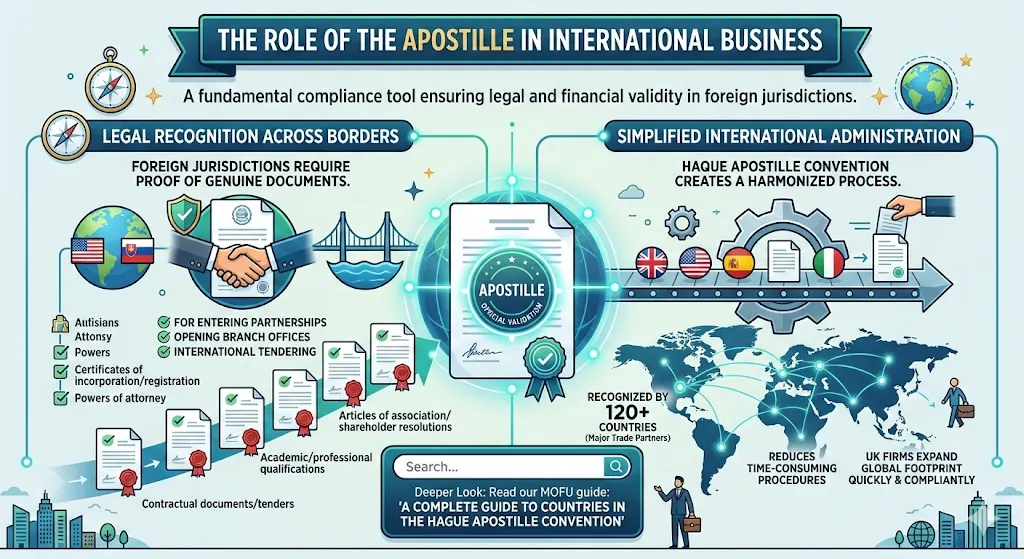
For globally active companies, the apostille is more than a formality it’s a fundamental compliance tool that keeps legal and financial operations valid in foreign jurisdictions.
Legal Recognition Across Borders
When your business sends official documents overseas, foreign organizations or government agencies often require proof that those documents are genuine. The apostille provides that proof instantly. Whether you’re entering a partnership abroad, opening a branch office, or engaging in international tendering, an apostilled document ensures your paperwork meets foreign legal standards.
This cross-border recognition is especially relevant for:
- Certificates of incorporation and registration
- Powers of attorney
- Articles of association and shareholder resolutions
- Academic or professional qualifications used in business submissions
- Contractual documents and tenders
Simplified International Administration
Without an apostille, companies would face time-consuming procedures in every country of operation. The Hague Apostille Convention creates a harmonized process—recognized by more than 120 countries, including major trade partners such as the United States, Spain, Italy, and Australia. This simplification allows UK-based firms to expand their global footprint quickly and compliantly.
For a deeper look at which countries participate in this system, read our MOFU guide, A Complete Guide to Countries in the Hague Apostille Convention an essential reference for businesses managing multinational documentation.
Common Business Scenarios Requiring Apostilled Documents
A variety of corporate processes rely on apostilled paperwork to validate business identity, authority, and legitimacy abroad.
Registering a Foreign Branch or Subsidiary
When forming a branch or subsidiary in another country, local authorities often request proof of the parent company’s legal existence. An apostilled certificate of incorporation and directors’ consent ensures the documents meet official standards.
Engaging in International Contracts
Multinational contracts often require notarized and apostilled signatures to be accepted across jurisdictions. The apostille confirms that your signatory possesses legitimate corporate authority.
Financial and Banking Operations
Banks frequently request apostilled documents when companies open international accounts, apply for loans, or complete compliance checks. The process reassures financial institutions of the document’s authenticity under international law.
Intellectual Property or Licensing Agreements
When licensing IP, software, or trademarks abroad, apostilled powers of attorney or licensing agreements validate your company’s authority to act across territories.
In each case, businesses that maintain properly authenticated records face fewer compliance risks and experience faster, frictionless international processing.
How the Apostille Certification Process Works
In the UK, document apostillation involves a clear procedural sequence designed to verify and certify the source of a public document.
- Document Preparation – Depending on the document type, certain papers require notarization before submission. For example, company resolutions or powers of attorney must first be signed before a solicitor or notary.
- Verification by the FCDO – The Foreign, Commonwealth & Development Office verifies the signature, seal, or stamp and adds an apostille certificate confirming its authenticity.
- Delivery of Apostilled Document – The document, now officially recognized under the Hague Convention framework, is returned to the business ready for international use.
This process yields an apostilled document the UK’s globally trusted format for authentication. Businesses looking for professional help can streamline this procedure through Form My Company’s apostilled document service, which handles paperwork verification, submission, and secure delivery.
Legal and Practical Benefits for Businesses
Apostilled documents provide several key advantages for companies navigating global compliance.
Guaranteed International Acceptance
The apostille certificate ensures documents are legally accepted in over 120 Hague Convention signatory countries. This universal recognition eliminates redundant embassy authentications and dramatically reduces turnaround times.
Increased Trust and Legitimacy
An apostilled document represents verified official status. When dealing with foreign partners, suppliers, or investors, this authentication signals that your business follows proper legal channels—strengthening professional trust.
Reduced Administrative Burden
Without apostillation, businesses must deal individually with consulates or embassies for each country—repeating steps that consume time and resources. The apostille simplifies this into one standardized verification process.
Cost Efficiency and Compliance
Avoiding regulatory bottlenecks and document rejections translates directly into reduced legal costs and operational delays. Apostilled records guarantee compliance without duplication or excessive certification expenses.
Apostilles vs. Legalisation: Understanding the Difference
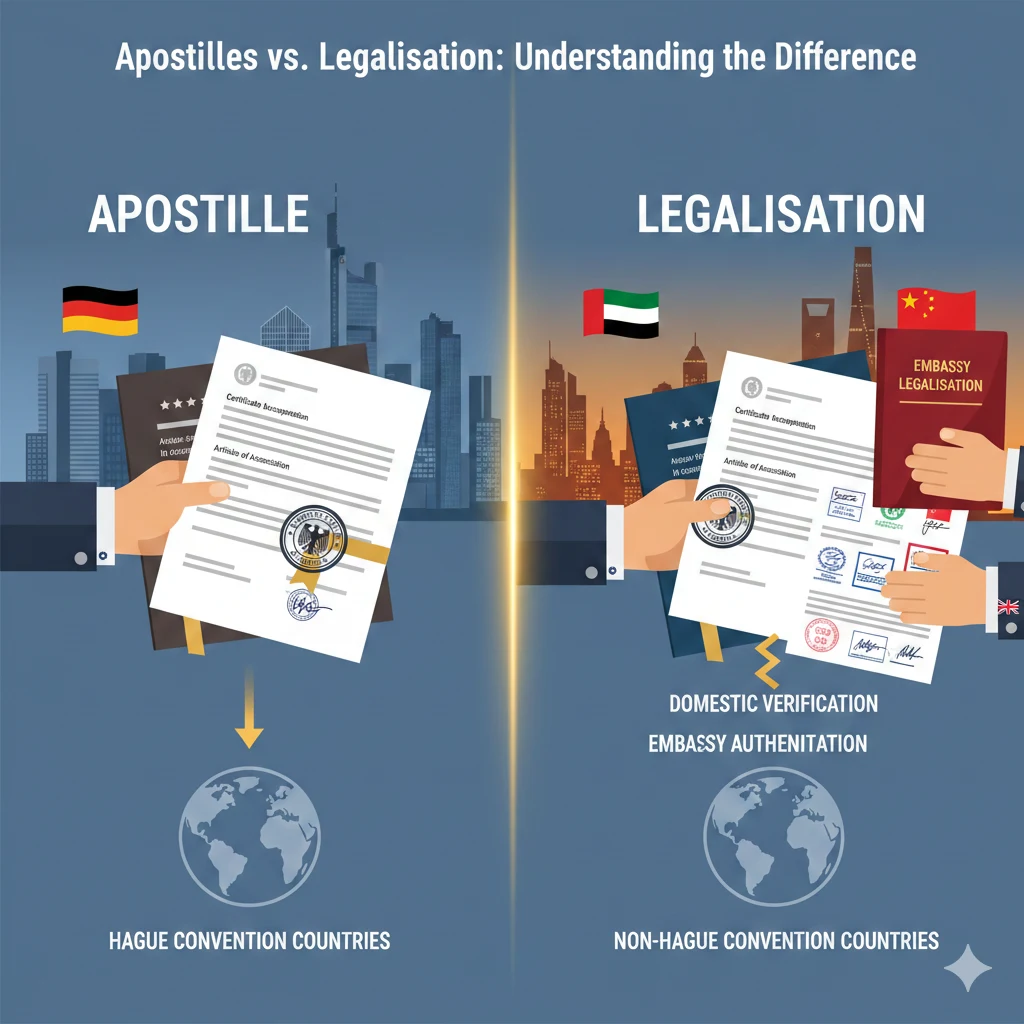
While often confused, apostillation and legalisation serve similar goals but differ in scope and application.
- Apostille: Applicable between Hague Convention countries; a single step that certifies the authenticity of documents through a designated national authority (such as the FCDO in the UK).
- Legalisation: Required when dealing with non-Hague Convention countries; involves additional embassy or consular authentication after domestic verification.
For example, if you are submitting corporate documents to a Hague Convention member like Germany, only an apostille is needed. However, if your destination is a non-member such as the UAE or China, you must proceed with full consular legalisation instead.
How an Apostille Supports Cross-Border Corporate Governance
Corporate governance relies on transparency, accountability, and lawful execution of authority. Apostilled documentation helps enforce these principles internationally. When directors, financiers, or legal representatives act abroad, apostilled records validate their authority in foreign jurisdictions.
Whether you’re acquiring assets overseas, authorising representation, or negotiating international ventures, this layer of proof enables your business to operate transparently and confidently under global standards.
Choosing a Reliable Apostille Service Provider
Selecting a qualified service provider ensures your documents undergo proper verification with accuracy and efficiency. Delays or inaccuracies can create legal challenges especially when dealing with time-sensitive corporate projects.
Form My Company provides end-to-end assistance through its professional apostilled document service. The service covers notarisation coordination, FCDO submission, and secure return of certified documents helping corporations and professional entities remain compliant without administrative stress.
For advanced needs such as urgent certifications or high-volume document management, Form My Company also collaborates with specialists experienced in Professional FCDO Apostille Certification, ensuring reliable and fast processing for businesses.
Key Takeaways: Why Your Business Needs Apostilled Documents
For any enterprise operating internationally, apostilles represent both a legal requirement and a strategic safeguard. They streamline global interactions, standardise compliance, and solidify international reputation.
From company incorporation documents to contract verifications, the apostille ensures your records are internationally valid and professionally recognized. Businesses that integrate apostilled documentation into their operations avoid procedural delays and enhance cross-border legitimacy.
Ultimately, Form My Company supports businesses through every documentation stage allowing entrepreneurs, directors, and legal teams to focus on business growth while maintaining trusted international compliance.
What does an apostilled document mean for businesses?
An apostilled document is an official certificate that verifies the authenticity of a signature, seal, or stamp on a public document for use abroad. Businesses use apostilled documents from Form My Company to ensure their legal and corporate papers are recognized by foreign authorities under the Hague Apostille Convention.
How do I get an apostilled document in the UK?
To obtain an apostilled document in the UK, your document must first be notarised (if required) and then submitted to the Foreign, Commonwealth & Development Office (FCDO) for apostille certification. Form My Company assists businesses with document verification and secure apostille processing through this official channel.
Why are apostilled documents important for international trade?
Apostilled documents prove that UK-issued business records are legally valid in other Hague Convention countries. They help companies avoid rejection when forming overseas branches, entering contracts, or meeting compliance requirements abroad.
How long does it take to get an apostilled document?
The processing time for an apostilled document usually ranges from one to five business days, depending on whether the service requested is standard or expedited. Form My Company manages the end-to-end process to ensure timely certification through the UK FCDO.
Do all countries accept apostilled documents?
Only countries that are members of the Hague Apostille Convention accept apostilled documents directly. For non-member countries, additional consular legalisation is required something Form My Company can coordinate as part of its international document services.