
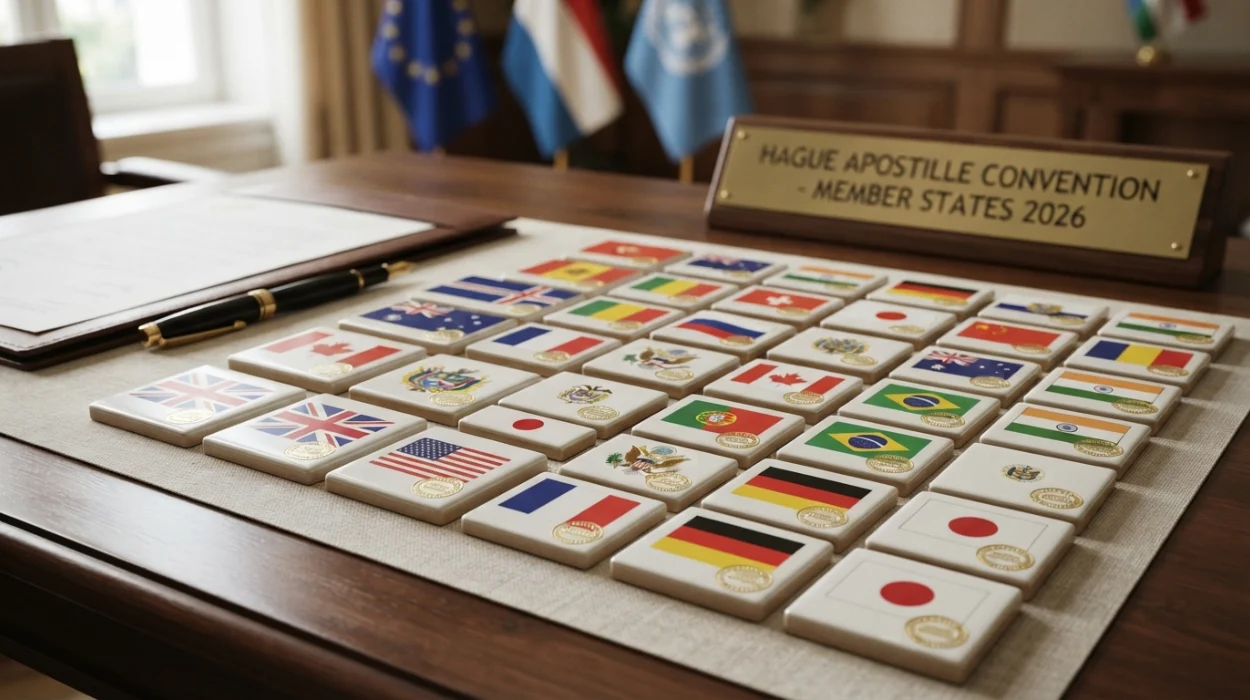
The Hague Apostille Convention countries are the countries and jurisdictions participating in the Hague Convention of 5 October 1961, which simplifies the authentication of public documents for use abroad. Instead of requiring the traditional chain of authentication and embassy legalisation, an eligible document can generally receive an Apostille from the competent authority in the country where it was issued.
The table below provides a practical alphabetical reference to selected participating countries and jurisdictions. Before submitting a document, always check the official Hague Conference on Private International Law list to confirm whether the Convention is in force between the country of origin and the destination, including any applicable objections or special conditions.
Hague Apostille Convention Countries List
The Convention has expanded considerably since its adoption in 1961. Participation is based on contracting states and, where applicable, the territorial extensions of the Convention. The legal effect of an Apostille depends on the countries involved and the status of the Convention between them.
The examples below are a quick reference, not a substitute for the official, current list maintained by the Hague Conference on Private International Law.
| Region | Examples of participating countries and jurisdictions |
|---|---|
| Europe | Albania, Austria, Belgium, Croatia, Czechia, Denmark, Finland, France, Germany, Greece, Ireland, Italy, Netherlands, Norway, Poland, Portugal, Spain, Sweden, Switzerland, United Kingdom |
| Americas | Argentina, Brazil, Chile, Colombia, Costa Rica, Ecuador, Mexico, Panama, Peru, United States |
| Asia-Pacific | Australia, China for Hong Kong SAR and Macao SAR where applicable, India, Japan, New Zealand, Philippines, Singapore, South Korea |
| Middle East | Bahrain, Israel, Oman, Saudi Arabia |
| Africa | Botswana, Morocco, South Africa, Tunisia |
Important: This is a selected list of examples, not a complete or independently verified 2026 membership register. In particular, the Convention’s application to China, Canada and certain territories requires careful checking. Do not assume that every country listed has the Convention in force for every bilateral relationship.
For the definitive Hague Apostille Convention member countries list, consult the official HCCH Apostille Section. Check the contracting parties, dates of entry into force and any objections relevant to the document’s destination before applying.
What Is the Hague Apostille Convention?
The Hague Apostille Convention, formally called the Convention of 5 October 1961 Abolishing the Requirement of Legalisation for Foreign Public Documents, is an international treaty designed to simplify the cross-border use of public documents.
Before the Convention, documents often required several authentication stages involving government departments, diplomatic missions and embassies. The Apostille system replaces that traditional chain with a standard certificate issued by a competent authority in the country where the public document originates.
An Apostille confirms the authenticity of the signature on a public document, the capacity in which the person signing acted and, where applicable, the identity of the seal or stamp on the document. It does not certify that the contents of the document are factually correct, nor does it guarantee that the receiving authority will accept the document for every purpose.
For a more detailed introduction, read our existing guide, What Is an Apostille and Why Does Your Business Need One?.
How the Apostille Convention Countries System Works
The Hague Convention establishes a shared method for authenticating public documents between participating jurisdictions. Each contracting party designates competent authorities responsible for issuing Apostilles.
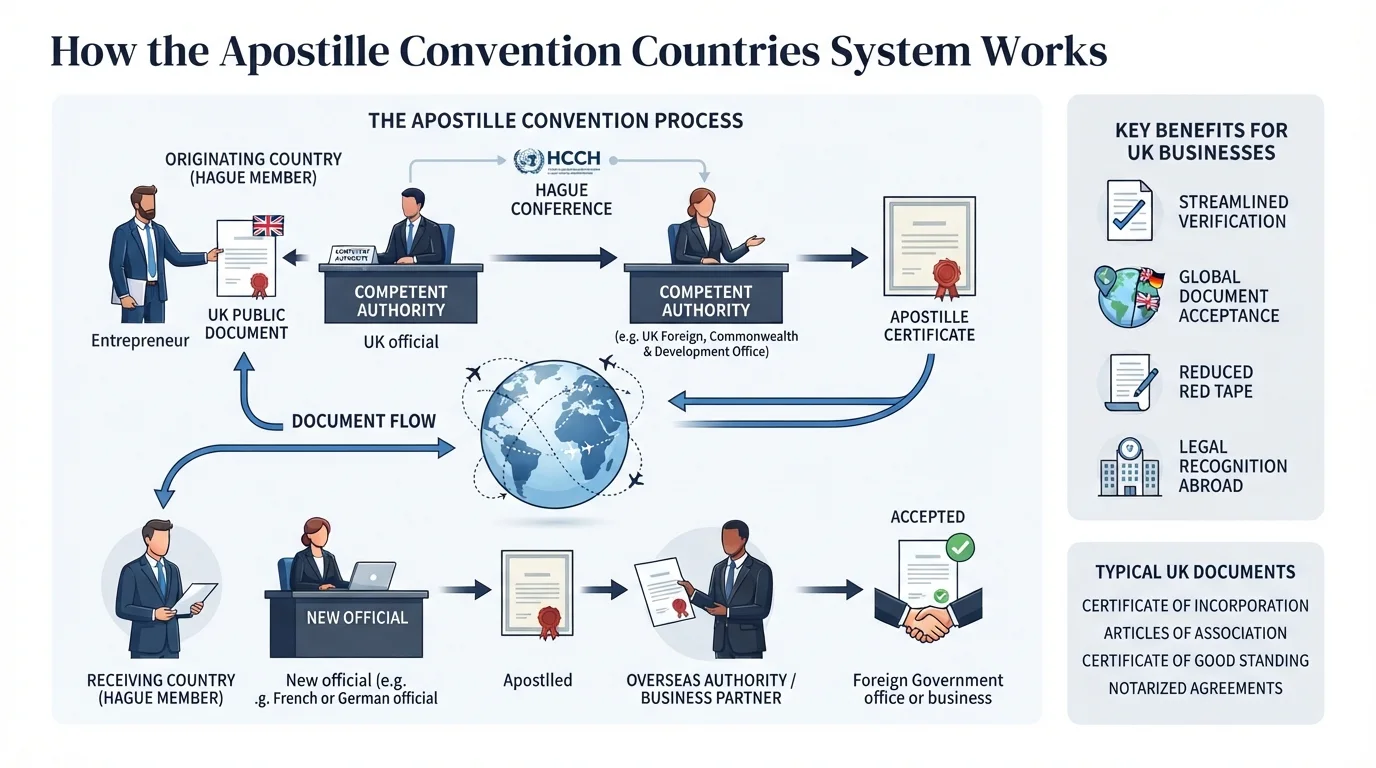
In the UK, the Foreign, Commonwealth & Development Office, or FCDO, issues Apostilles for eligible UK documents. Depending on the document, preliminary certification by a solicitor, notary public or another authorised professional may be required.
The process generally involves:
Confirming that the destination country accepts Apostilles for the relevant document.
Checking whether the document requires notarisation or another form of preliminary certification.
Submitting the document through the appropriate competent authority.
Receiving the Apostille and ensuring that the document meets the recipient’s submission requirements.
The recipient may still require a certified translation, an original document or additional evidence for its particular legal or administrative process.
Which Documents Commonly Need an Apostille?
Apostilles are used for eligible public documents presented abroad. These may include:
Certificates of incorporation and other company registration records.
Certificates of good standing and corporate status documents.
Notarial acts, powers of attorney and affidavits.
Court documents and certain legal records.
Birth, marriage and death certificates.
Academic qualifications and official educational records.
The correct authentication route depends on the document’s origin, its form and the destination country’s requirements. Some documents must be notarised or certified before an Apostille can be issued.
For UK companies preparing documentation for international use, our Apostilled Documents service provides a commercial next step for arranging support with document authentication.
Countries That Are Not Members of the Hague Apostille Convention
If the destination country is not covered by the Convention for the particular document, an Apostille alone may not be available or sufficient. The document may instead need to follow a legalisation process involving the relevant government authority and the destination country’s embassy or consulate.
Even when both countries participate in the Convention, the status of the Convention between them must be checked. Objections, territorial arrangements and other applicable conditions can affect whether an Apostille is accepted.
Do not rely on a country’s name alone. Confirm the current position on the official HCCH website and ask the receiving authority which authentication method it requires.
How to Get a UK Apostille
The process for obtaining a UK Apostille depends on the document and its certification requirements.
Step 1: Check the Document
Identify the document, the issuing authority and the country where it will be used. Confirm whether the receiving organisation needs an original, a certified copy, notarisation or another preliminary step.
Step 2: Arrange Any Required Certification
Some documents can be submitted directly, while others need certification by a solicitor, notary public or another authorised person before the FCDO can authenticate them.
Step 3: Submit the Document
Follow the current FCDO instructions for the appropriate submission method. Check the applicable fee, document format, delivery arrangements and processing estimates before sending anything.
Step 4: Check the Completed Apostille
When the Apostille is issued, confirm that it relates to the correct document and that the receiving organisation’s additional requirements have been addressed.
Form My Company can help businesses prepare eligible documents and navigate the Apostille process. For professional assistance, visit our Professional FCDO Apostille Certification service.
For expected turnaround times, consult our guide to how much it costs to Apostille a UK document and verify current processing estimates and fees with the official provider before submitting your documents.
Why Apostilled Documents Matter for International Business
Businesses expanding internationally often need corporate records to establish their legal status, appoint representatives, open accounts or complete transactions in another jurisdiction.
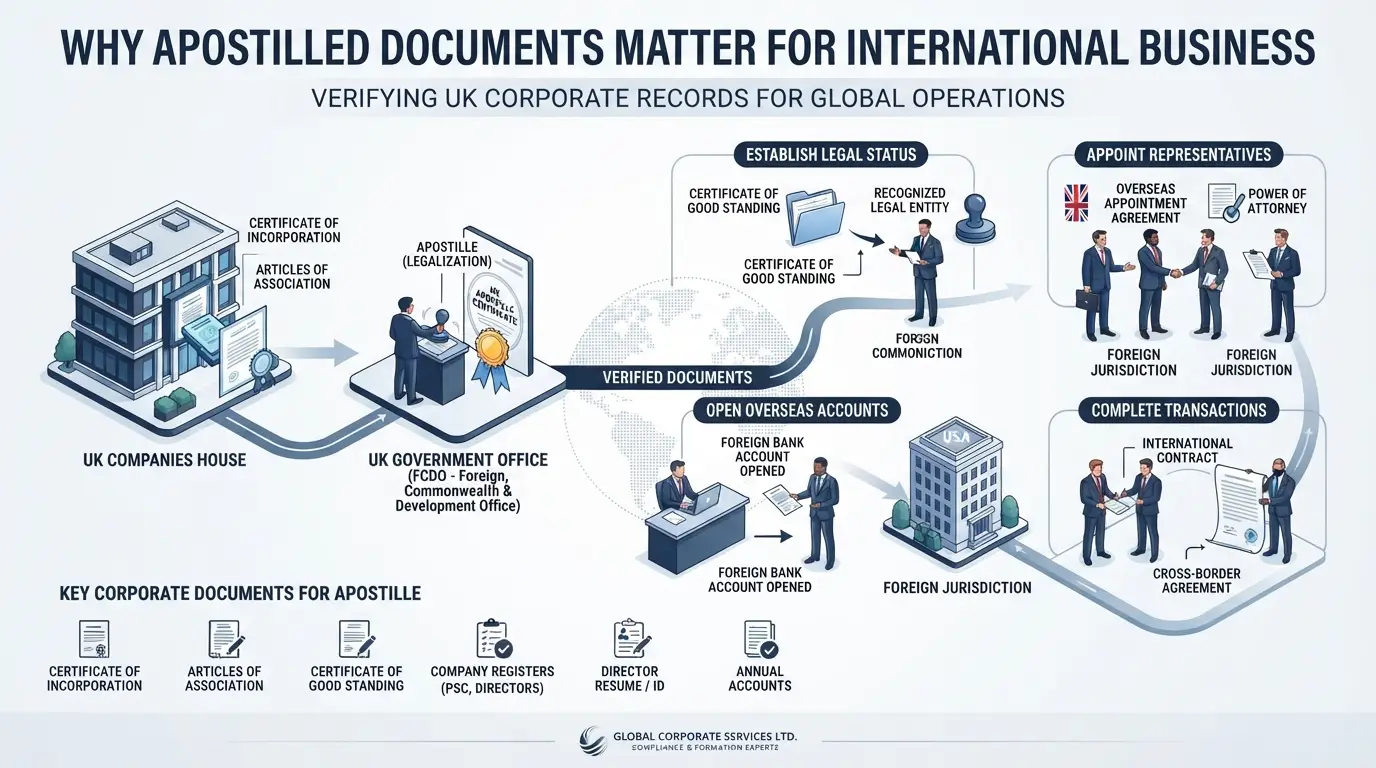
A properly issued Apostille can simplify the authentication stage by replacing a more extensive legalisation chain where the Convention applies. This helps organisations prepare documents for cross-border use while reducing the risk of using an unsuitable authentication route.
However, an Apostille does not replace every requirement imposed by a bank, regulator, court or commercial counterparty. Businesses should check the recipient’s specific requirements before arranging certification.
Certificates of Good Standing for Overseas Transactions
A certificate of good standing can help demonstrate a company’s status when requested by a foreign bank, regulator, supplier or commercial partner. The precise information included depends on the issuing authority and the document available.
If your business needs to demonstrate its UK company’s status for an international transaction, explore our Certificate of Good Standing service. Check whether the recipient requires the certificate itself, an Apostille or additional certification.
For further background, read our existing article on what a Certificate of Good Standing means for UK companies.
Common Mistakes to Avoid When Using an Apostille
Assuming Every Country Accepts Every Apostille
Acceptance depends on the Convention’s application between the relevant jurisdictions and the recipient’s requirements. Check the current official position before submitting documents.
Confusing Authentication With Legal Validity
An Apostille authenticates the origin of a public document. It does not certify the truth of its contents or guarantee that a document satisfies the substantive legal requirements of another country.
Overlooking Preliminary Certification
Some documents require notarisation or other certification before the Apostille can be issued. Check the correct process for the specific document instead of sending it without preparation.
Ignoring Translation Requirements
A receiving authority may require a translation or additional certification. Ask the recipient what it accepts before arranging the Apostille.
Relying on Outdated Country Lists
Membership and the Convention’s application can change. Always consult the HCCH’s official country information rather than relying solely on an old blog post or an unofficial list.
Frequently Asked Questions
What countries are in the Hague Apostille Convention?
The Convention includes participating countries and jurisdictions across Europe, the Americas, Asia-Pacific, Africa and the Middle East. The official HCCH Apostille Section provides the authoritative contracting-party information and details about when the Convention is in force.
How do I find the full Hague Apostille Convention member countries list?
Use the official HCCH Apostille Section. Check the country entries, dates of entry into force and any objections or special conditions relevant to the destination.
What is the difference between an Apostille and legalisation?
An Apostille is a standard authentication certificate used where the Hague Convention applies. Traditional legalisation may involve additional government and embassy or consular authentication stages when the Convention does not apply to the document’s destination.
Does an Apostille guarantee that a document will be accepted abroad?
No. It authenticates the signature, capacity and applicable seal or stamp on a public document. The receiving organisation may impose additional requirements relating to document format, translation, age or substantive validity.
How can I obtain an Apostille in the UK?
First, check the document and destination requirements. Arrange any necessary notarisation or certification, then follow the current FCDO submission procedure. A specialist service can help you understand the steps and prepare the documents.
Do UK companies need Apostilles for overseas transactions?
Sometimes. A foreign bank, regulator, court or commercial partner may request Apostilled corporate documents. Requirements vary by destination and purpose, so confirm exactly which documents and authentication steps are needed.
Arrange Apostille Support with Form My Company
Understanding the Hague Apostille Convention countries list helps businesses choose the correct authentication route before sending documents overseas. Confirming the destination country’s status, checking document requirements and preparing the paperwork correctly can help prevent avoidable delays.
Form My Company supports businesses that need help with UK company documents and Apostille arrangements. Explore our Apostilled Documents service to discuss your requirements and take the next step towards preparing documents for international use.