
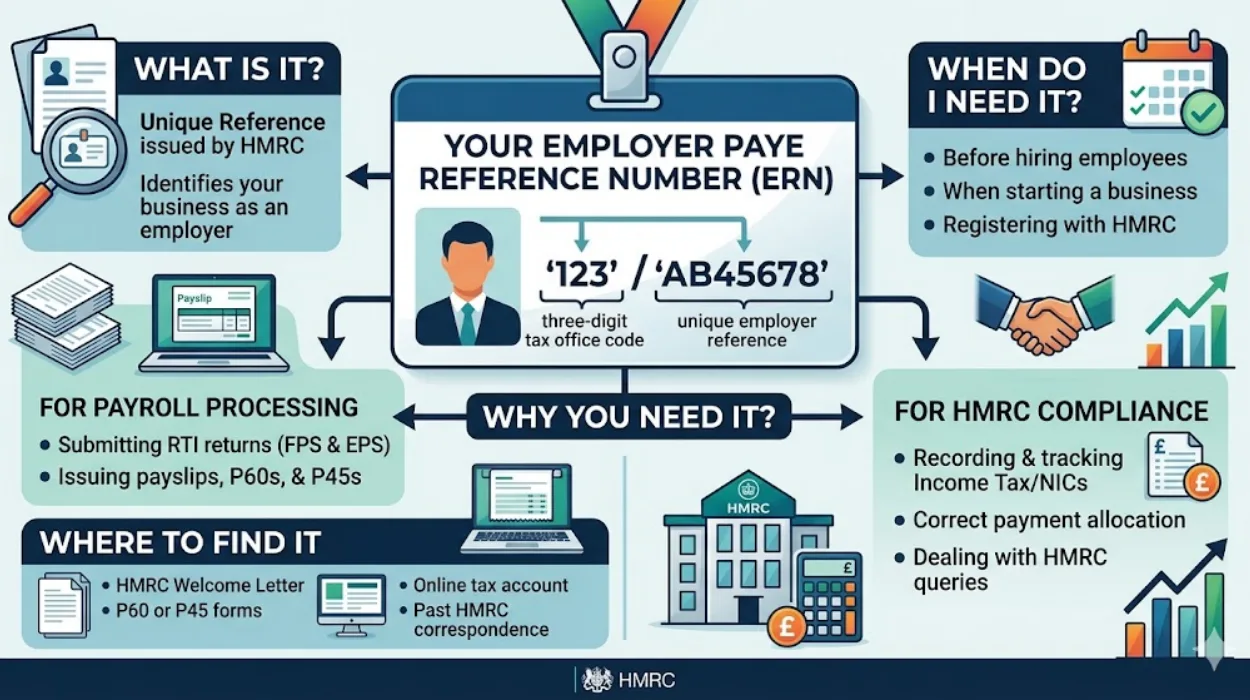
The employer PAYE reference number is a unique 3-digit HMRC code plus 2-digit office number and 6-character employer identifier, like 123/A45678. Employers need it to register for PAYE, process payroll taxes, and comply with UK employment laws.
This 13-character reference identifies your business for Pay As You Earn (PAYE) obligations. HMRC issues it upon registration. Use it for tax submissions, employee payments, and RTI filings.
What Does PAYE Stand For?
PAYE stands for Pay As You Earn. HMRC uses this system to collect income tax and National Insurance from employees’ wages through employers.
PAYE deducts taxes directly from salaries. Employers remit these to HMRC monthly. This process covers 32 million UK employees across 1.5 million employers.
The system automates tax collection. It integrates with payroll software. Employers report via Real Time Information (RTI) submissions.
PAYE applies from the first pay day. It ensures timely tax payments. Non-compliance triggers fines up to £3,000 per employee.
What Is an Employer PAYE Reference Number?
An employer PAYE reference number is HMRC’s unique identifier for your business’s payroll tax account. It formats as XXX/YYZZZZZ, where XXX is the tax office code, YY the district number, and ZZZZZZ your employer code.
HMRC assigns this number after PAYE registration approval. It links directly to your payroll records. Use it on all HMRC correspondence and submissions.
This reference verifies your business identity. Payroll providers require it for setup. It appears on payslips and P60 forms.
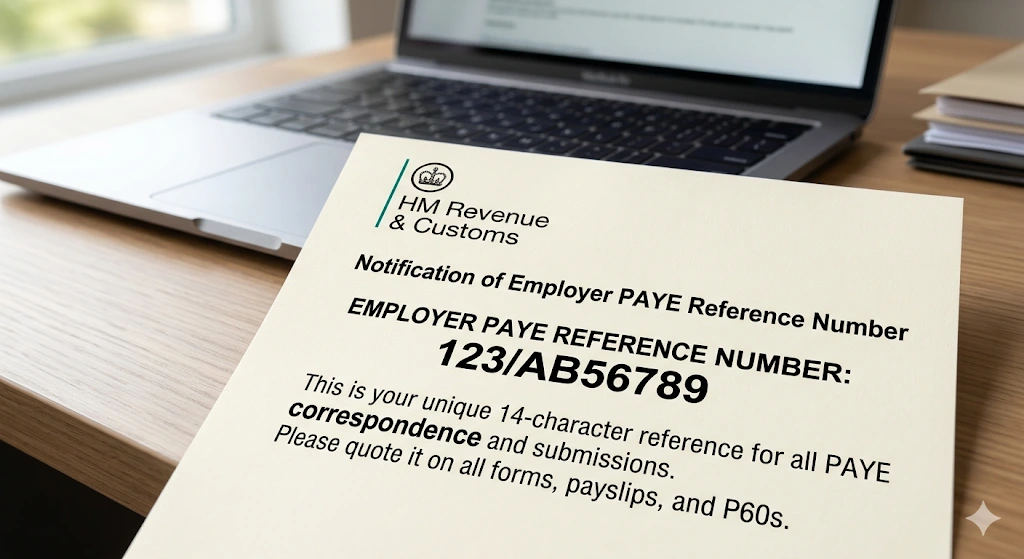
Businesses obtain it through online registration. Approval takes 5-10 working days. HMRC sends it via post and online portal.
How Do You Get a PAYE Reference Number?
Register online via HMRC’s Government Gateway. Submit business details, start date, and employee count. HMRC approves and issues the reference within 10 days.
Access the HMRC website. Create a Government Gateway account. Select PAYE for employers registration.
Provide your Companies House number. Enter expected employee numbers. Specify payroll start date.
HMRC reviews submissions. They verify director identities. Approved registrants receive the reference instantly online or by post.
New companies register post-incorporation. Sole traders apply anytime. Update details if employee numbers change.
Why Does Your Business Need a PAYE Reference Number?
Your business needs a PAYE reference to legally pay employees, deduct taxes, and report to HMRC. Without it, you face fines, penalties, and inability to hire staff.
UK law mandates PAYE registration before paying salaries. The reference enables RTI submissions. It tracks National Insurance contributions.
Employers use it for P45, P46, and P60 forms. It ensures accurate tax calculations. HMRC audits rely on this identifier.
68% of UK SMEs report payroll errors without proper references. Fines average £400 per late submission. Compliance avoids 100% penalties on unpaid taxes.
When Must You Register for PAYE?
Register for PAYE at least two months before your first employee payday if hiring one or more staff. Existing businesses register immediately upon first hire.
HMRC requires proactive registration. Calculate from the hire date. Submit before payroll runs.
Sole traders with employees register online. Companies link to Corporation Tax UTR. Late registration incurs £100 fixed penalty.
Seasonal employers register annually. Contractors with deemed employees comply too. Verify status using HMRC’s CEST tool.
First payroll triggers ongoing obligations. Submit EPS if no payments in a month.
What Happens Without a PAYE Reference?
Without a PAYE reference, HMRC fines your business £100 initially, plus £10 daily. You cannot process legal payroll or claim tax credits.
Operations halt on employee payments. Banks reject payroll without reference. HMRC pursues directors personally.
Audits reveal non-compliance. Back taxes plus interest accrue. 42% of fined businesses pay over £2,500.
Criminal charges apply for repeated evasion. Court orders seize assets. Reputation damage affects client trust.
Resolve by urgent registration. Pay arrears via direct debit.
How Does the PAYE Reference Work in Payroll?
The PAYE reference links payroll software to HMRC systems. Submit FPS on or before each payday via RTI for real-time tax reporting.
Integrate reference into payroll tools like Xero or Sage. Generate payslips with it. Calculate tax and NI deductions.
Transmit Full Payment Submission (FPS). Include earnings, deductions, and reference. HMRC reconciles instantly.
Process Starter Checklists for new hires. Update leavers via P45. Reference ensures accurate records.
Monthly reconciliations use this identifier. Errors trigger HMRC queries.
What Information Goes Into PAYE Registration?
Submit business name, address, Companies House number, UTR, director details, employee count, and payroll start date during PAYE registration.
Verify address matches Companies House. Provide contact telephone. List accounting periods.
Director identities require NI numbers. Estimate first-year employee numbers accurately. Select yes/no for subcontractors.
HMRC cross-checks data. Inconsistencies delay approval. Update via online account post-registration.

Can You Change Your PAYE Reference Number?
HMRC reissues PAYE references only for errors or business transfers. Contact HMRC helpline with proof to request changes.
Office number changes rarely occur. Mergers create new references. Ceasing trading deregisters the old one.
Update address online. No new reference needed. Transfers assign predecessor’s number.
What Are Common PAYE Reference Mistakes?
Common mistakes include incorrect formatting, using VAT numbers instead, and late submissions. Verify format as 3/2/6 characters before use.
Payroll teams enter wrong office codes. This rejects submissions. Double-check HMRC letters.
New businesses confuse it with CT unique taxpayer reference. Use dedicated payroll fields.
72% of errors stem from manual entry. Automate with software validation.
How Does PAYE Link to Other HMRC Systems?
PAYE integrates with RTI, VAT, and Corporation Tax via Government Gateway. One login accesses all using the shared reference.
RTI feeds self-assessment. VAT offsets payroll liabilities. Gateway secures data.
Employers view payment histories. Download P11D forms. Single reference unifies compliance.
Why Register Early for PAYE Assistance?
Early PAYE registration avoids payroll delays and fines. Services streamline setup with compliance checks.
Professionals handle HMRC forms. They verify details pre-submission. Turnaround matches HMRC timelines.
For seamless setup, explore PAYE Registration Assistance. It delivers your reference fast.
Dive deeper into timing with Is PAYE Registration Easier During or After Incorporation?
it clarifies incorporation links. Ready to comply? Check Start Paying Employees Correctly with Our PAYE Setup Support for full implementation.
From My Company provides PAYE Registration Assistance. Experts validate submissions. Businesses gain compliant payroll systems quickly.
What is PAYE registration assistance?
PAYE registration assistance helps UK businesses register with HMRC for Pay As You Earn obligations. It involves submitting business details, verifying director identities, and obtaining your unique PAYE reference number. From My Company streamlines this process to ensure compliance before your first payroll.
How long does PAYE registration take?
PAYE registration typically takes 5-10 working days for HMRC approval after online submission. Provide accurate business details like Companies House number and employee estimates to avoid delays. From My Company assists with error-free applications for faster processing.
Do new companies need PAYE registration?
New UK companies require PAYE registration before paying employees, even part-time staff. Register at least two months prior to the first payday to comply with HMRC rules. PAYE Registration Assistance from From My Company handles setup post-incorporation.
What documents are needed for PAYE registration?
Key documents include your Companies House registration, UTR, director NI numbers, and business address proof. Estimate employee numbers and payroll start date accurately. From My Company verifies these for seamless PAYE reference issuance.
What happens if you don’t register for PAYE?
Failure to register for PAYE results in £100 fines plus £10 daily penalties from HMRC, plus inability to process legal payroll. Back taxes and interest accrue during audits. PAYE Registration Assistance prevents these issues through compliant registration.