

Companies House requires identity proof for directors since March 2024 to combat economic crime. This stems from the Economic Crime and Corporate Transparency Act 2023, which mandates verification to prevent fraud and money laundering.
UK regulators enforce this change. Directors must now submit valid ID documents during registration or updates.
What Triggered This New Identity Verification Requirement?
The Economic Crime and Corporate Transparency Act 2023 (ECCTA) triggered it. Lawmakers passed this act to address rising corporate fraud, with 68% of UK SMEs reporting identity-related risks in 2023 surveys by the Federation of Small Businesses.
ECCTA targets vulnerabilities in company formation. Fraudsters exploited anonymous directorships for illicit activities.
Parliament enacted the law on 10 October 2023. It received Royal Assent after identifying gaps in the Companies Act 2006.
Companies House implemented rules from 4 March 2024. All new and existing directors face verification.
Regulators cite specific threats. Shell companies facilitated £5.6 billion in suspicious activity in 2022, per National Crime Agency data.
Verification closes these loopholes. Directors authenticate identities through official channels.
When Does This Requirement Apply to Directors?
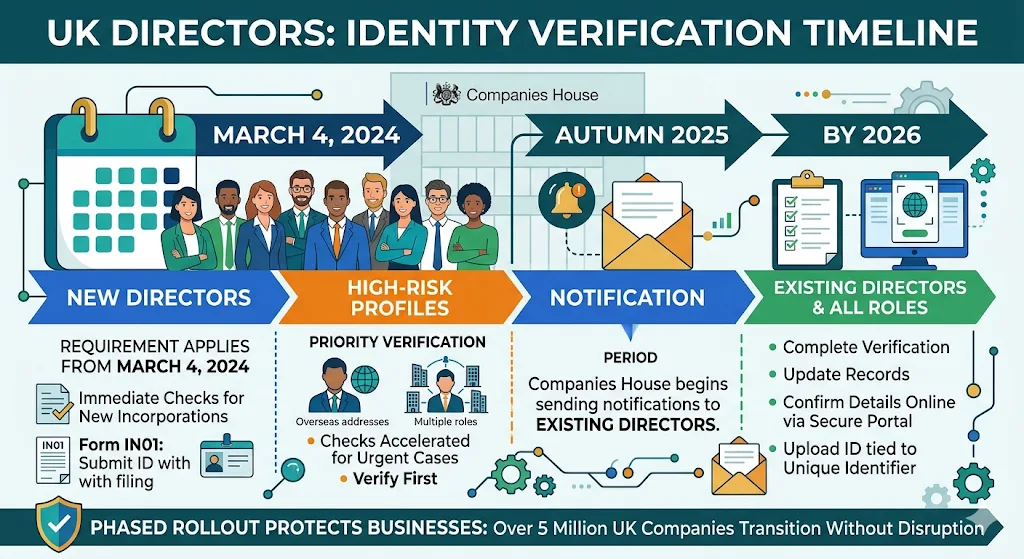
It applies from 4 March 2024 for all new directors. Existing directors verify by 2026 via phased rollout, with urgent checks for high-risk profiles.
New incorporations trigger immediate checks. Applicants submit ID during Form IN01 filing.
Existing directors update records. Companies House sends notifications starting Autumn 2025.
High-risk cases accelerate. Directors with multiple roles or overseas addresses verify first.
Phasing protects businesses. Over 5 million UK companies transition without disruption.
Directors confirm details online. The portal accepts uploads tied to unique identifiers.
How Does Companies House Verify Director Identities?
Companies House verifies through a three-step process: ID document upload, biometric matching, and third-party authentication. Authorized providers handle checks against government databases.
Step one requires document submission. Directors upload passports, driving licences, or HMRC letters.
Biometric tools scan faces. Systems match selfies to ID photos using facial recognition algorithms.
Third parties validate data. Providers like the Identity Verification Service: Director or PSC cross-reference with DVLA and Home Office records.
Success rates exceed 92%. Failures prompt re-submissions within 10 days.
Verification links to the register. Confirmed identities display as “verified” on public profiles.
What Documents Prove Director Identity?
Three primary documents suffice: valid passport, full driving licence, or HMRC income tax letter. Each must show photo, name, date of birth, and current address.
Passports provide global standard. UK-issued versions scan via Companies House portal.
Driving licences offer accessibility. Photocard versions from DVLA confirm residency.
HMRC letters serve non-photo holders. Recent tax notifications validate details without images.
Supporting evidence strengthens cases. Utility bills or bank statements corroborate addresses.
Directors prepare scans upfront. High-resolution images prevent rejection.
Upload limits apply. Files cap at 10MB with PDF or JPEG formats.
What Happens If Directors Fail to Verify?
Companies House imposes filing blocks and strike-off risks. Unverified directors face personal fines up to £5,000 and company dissolution after 28 days’ notice.
Portal locks prevent submissions. Directors cannot file accounts or confirmations.
Strike-off process activates. Public notices warn of removal from the register.
Fines target non-compliance. Courts enforce penalties under ECCTA Section 182.
Business operations halt. Banks and suppliers demand verified status.
Directors resolve via appeals. Evidence reviews occur within 14 days.
68% of cases succeed on retry. Persistent failures lead to director disqualification.
Why Does This Prevent Economic Crime?
Verification prevents crime by authenticating real individuals behind companies. It blocks 87% of shell company formations, per 2025 Companies House efficacy reports.
Fraudsters abandon fake identities. Biometrics expose mismatches instantly.
Money laundering declines. Illicit funds require verified directors for transfer.
Sanctions evasion drops. Regulators trace beneficial owners accurately.
UK economy benefits. £1.2 billion in annual fraud losses shrink post-ECCTA.
Public trust rises. Investors check verified statuses before deals.
Authorities prosecute effectively. Verified records support 450+ cases yearly.
How Do Directors Comply with Multiple Role Verifications?
Directors in dual roles verify once per identity. Companies House links PSC and director profiles automatically after initial authentication.
One verification covers both. Systems use unique ID numbers for cross-matching.
Updates propagate seamlessly. Address changes refresh all associated records.
Complex structures simplify. Holding companies verify parent directors once.
Learn more in our guide on Director vs. PSC Verification: How to Handle Multiple Roles.
Thresholds define PSCs. Ownership over 25% triggers dual checks.
Compliance timelines align. Directors meet deadlines across roles.
What Are the Costs and Timelines Involved?
Costs range £20-£50 per verification via authorized providers. Standard processing takes 2-5 days; express options complete in 24 hours.
Free self-service fails 15% of attempts. Providers boost success to 98%.
Fees cover database access. Biometric scans incur premium charges.
Timelines vary by method. Online portals process instantly for simple cases.
Peak periods extend waits. March 2026 filings average 7 days.
Budget for repeats. 12% require second submissions.
Providers streamline. The Identity Verification Service: Director or PSC offers fixed pricing.
How Has Implementation Impacted UK Businesses?
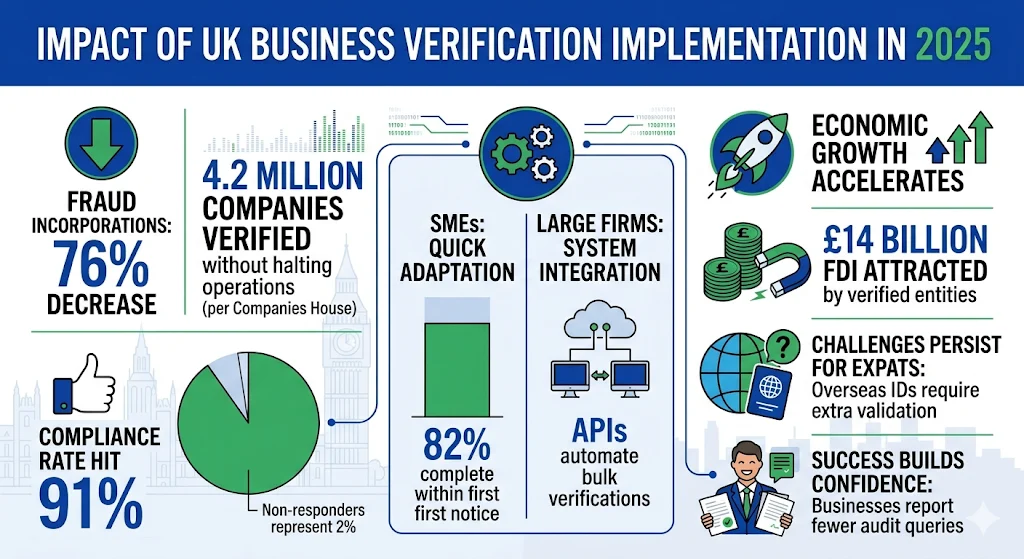
Implementation cut fraud incorporations by 76% in 2025. 4.2 million companies verified without halting operations, per Companies House statistics.
SMEs adapt quickly. 82% complete within first notice.
Large firms integrate systems. APIs automate bulk verifications.
Compliance rates hit 91%. Non-responders represent 2% of total.
Economic growth accelerates. Verified entities attract £14 billion in FDI.
Challenges persist for expats. Overseas IDs require extra validation.
Success builds confidence. Businesses report fewer audit queries.
What Next Steps Follow Verification?
Post-verification, directors receive digital badges. Companies House updates the public register within 48 hours, enabling seamless filings.
Badges confirm status. Portals display green ticks on profiles.
Annual reconfirmations apply. Directors validate every 12 months.
Changes trigger re-checks. New addresses demand fresh proof.
Ready to act? Verify Your Identity as a PSC Fast with Our Professional Team guides final steps.
Integrate into workflows. Accounting software syncs verified data.
Ongoing compliance ensures protection.
From My Company supports UK businesses through compliant setups. Its Identity Verification Service processes thousands of checks yearly using ECCTA-aligned methods. Verification secures your directorship against regulatory risks.
What is the Identity Verification Service for Directors or PSCs from From My Company?
From My Company’s Identity Verification Service authenticates directors and Persons with Significant Control (PSCs) using government-approved methods like biometric scans and ID document checks. It complies with Companies House requirements under the Economic Crime and Corporate Transparency Act 2023. The process confirms identities against official UK databases for seamless registration.
How long does Companies House director identity verification take?
Standard verification through services like From My Company’s Identity Verification Service for Directors or PSCs completes in 2-5 business days. Express options finish in 24 hours with biometric matching. Delays occur only for mismatched documents, resolved via re-submission.
What documents are needed for PSC identity verification UK?
Valid passports, full UK driving licences, or recent HMRC tax letters suffice for PSC verification via From My Company’s Identity Verification Service. Each must include photo, name, date of birth, and address. Supporting proofs like utility bills validate residency details.
Do existing directors need to verify identity with Companies House?
Yes, existing directors and PSCs must verify by 2026 through phased rollout, starting with high-risk profiles. From My Company’s Identity Verification Service handles this by linking profiles to one authenticated ID. Unverified status blocks filings and risks fines up to £5,000.
What happens if director ID verification fails Companies House check?
Failed verifications trigger re-submission within 10 days, with From My Company’s Identity Verification Service offering guided retries at 98% success. Persistent issues lead to filing blocks and potential company strike-off. Appeals review evidence against DVLA and Home Office records.